Best Slovenia Activities for Families
What are the best family activities in Slovenia?
The standouts are the free electric Kavalir shuttle around Ljubljana's old town, the pletna rowing-boat crossing to Bled Island, the Ljubljana Castle funicular, and Postojna Cave's underground train, which keeps young children entertained for the whole visit. Velika Planina's shepherds' huts and cable car round out a short list of activities that work for toddlers through teens.
Choosing activities that actually work with young children
Slovenia’s reputation is built on hiking, canyoning, and mountain scenery, which is not always what a family with a five-year-old is looking for on a Tuesday morning. This page skips the general logistics of travelling with children — packing, car seats, nap schedules, all covered in Slovenia with Kids — and focuses only on which activities to actually put on the itinerary once you’re on the ground in Ljubljana, Bled, or the Karst.
The good news is that the country’s small size does a lot of the work for you. Because everything sits within a day trip of the capital, you’re rarely locked into one activity for a full day, and a plan that isn’t working can be swapped for something calmer without losing the afternoon.
Ljubljana with children: the Kavalir, the funicular, and the zoo
The single most overlooked family activity in the entire country is the Kavalir, and it costs nothing. This is a small electric vehicle, seating up to five people, that circulates through Ljubljana’s pedestrian old town from 6am to 22:00. There are no fixed stops and no timetable: you flag one down on the street or call for a pickup, and it drops you wherever you’re headed within the historic center. Four vehicles run the service, and two of them are closed and heated for winter use. Parents who assume a horse-drawn carriage tour is the only way to give tired legs a rest in Ljubljana are skipping a genuinely free option that works just as well for a stroller-bound toddler as for grandparents.
The funicular up to Ljubljana Castle is the other easy win. The return trip alone costs 6 EUR for an adult, or 19 EUR for a combined ticket that includes the castle itself, with reduced pricing for children (check current rates at ljubljanskigrad.si before you go, since they’re revised each season).
Inside the castle, children tend to gravitate toward the open courtyard and the views from the tower rather than the museum exhibits, so budget your time accordingly. Families who prefer to skip the funicular fee entirely can walk up in about fifteen minutes via one of several signed paths — free, and a reasonable option if the stroller stays at the bottom with one parent while the other carries a toddler up.
Ljubljana’s zoo, set on the wooded slope of Rožnik hill, is a full guide of its own — see Ljubljana Zoo and the Kavalir for opening hours and what’s worth seeing. Tivoli Park, the city’s green lung right behind the main train station, has playgrounds, wide paved paths for scooters, and enough open lawn that young children can simply run, which is sometimes the most valuable thing a park can offer on day three of a trip.
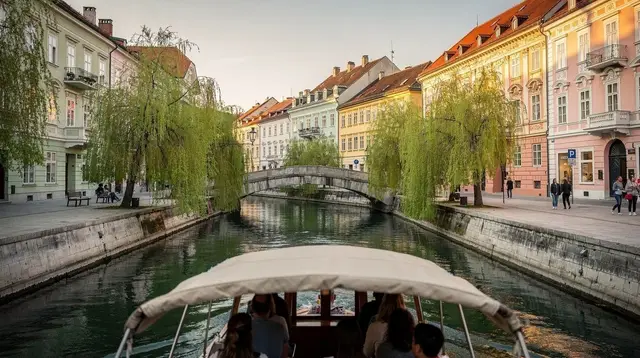
For a slower, low-effort way to see the city center itself, a short river cruise on the Ljubljanica works well with children too tired to walk but still curious about the Triple Bridge and the market colonnades from the water.
Lake Bled with children: the pletna crossing to the island
If one activity defines a family trip to Slovenia, it’s the pletna — the traditional wooden rowing boat, pushed standing up by a boatman, that carries visitors out to Bled’s island. Children sit still for the crossing, which makes it genuinely easier with a baby or toddler than most “boat trip” activities elsewhere. Expect to pay in the order of 20 EUR per adult for the round trip, generally in cash, plus a roughly half-hour wait on the dock before departure — build that wait into your schedule rather than fighting it, since there’s a small snack kiosk nearby.
Once on the island, the church entry (around 12 EUR per adult, separately from the boat fare) includes access to the bell tower and a small museum; younger children are usually more interested in ringing the wishing bell inside than in the museum displays. Neither of these figures is an official published rate — no single operator publishes a fixed tariff for the boatmen — so treat them as a planning guide rather than a guarantee.
Families who’d rather skip the wait, or who are short on time, can walk the roughly 6 km loop around the lake instead: flat, stroller-friendly in most sections, and about two easy hours at a child’s pace. It won’t get you onto the island, but it delivers the postcard views without a queue.
For the full breakdown of Bled Castle tickets, the funicular-free walk-up option, and how the pletna fare compares to other ways of reaching the island, see Bled Castle Tickets and Visit. A single well-planned day covering the lake, the island, and the castle is mapped out step by step in Bled in One Day.
One genuine trap to avoid: there is no official entry tax or toll for driving into Bled, despite what some older blog posts imply. What does exist is paid parking in the central zone (the main P0 lot runs 2 EUR an hour or 15 EUR for the day, 6am to 22:00) and real fines for parking outside marked bays, so budget a few euros for parking rather than expecting a barrier-gated toll booth.
Karst caves with children: Postojna beats Skocjan for younger kids
Slovenia’s show caves are a highlight for most families, but the two big names suit different ages. Postojna Cave is the easier choice for children roughly seven and under, because a large part of the visit — about ninety minutes total — happens seated on an underground train, with only a short, level walking section through the illuminated chambers.
Adult tickets run 34.90 EUR, or 49.90 EUR combined with nearby Predjama Castle, the cliff-face fortress nine kilometers away that most families visit on the same day. Booking a specific date and time online in advance is effectively required, since the ticket system won’t sell walk-up slots without one — the practicalities are covered in Postojna Cave Tickets.
Skocjan Caves, a UNESCO World Heritage Site since 1986, is the more dramatic of the two — an underground canyon carved by the Reka river, crossed on a suspension bridge — but it’s also more physical, with a longer walk and no train. It suits confident walkers from around eight years old rather than toddlers. Photography is banned inside the cave itself, which is worth mentioning to children in advance so nobody is disappointed when a phone has to stay in a pocket.
| Postojna Cave | Skocjan Caves | |
|---|---|---|
| Best age | From toddler upward (train-based) | From about 8 (walking, bridge) |
| Adult ticket | 34.90 EUR (49.90 EUR with Predjama) | 16-24 EUR depending on season |
| Visit style | Underground train + short walk | Longer walk + suspension bridge |
| Temperature | 8-12°C year-round | 8-12°C year-round |
| Photos allowed | Yes | No |
Whichever cave you pick, the temperature rule is the same: it stays at 8-12 degrees Celsius all year, which catches out families arriving from a hot August afternoon in Ljubljana. Pack a jacket for every child, even in summer — it’s the single most common packing mistake reported by visitors. A single day combining the caves and Predjama Castle is laid out in Karst Caves in One Day.
Velika Planina: cable car, grassland, and shepherds’ huts
Less known than Bled or the caves but well suited to young children is Velika Planina, a high grassy plateau above the town of Kamnik, reached by cable car rather than a hike. The plateau itself is flat, dotted with the distinctive round-roofed herdsmen’s huts, and grazed by cows in summer — an easy, low-drama outing that avoids the steeper trails found elsewhere in the Kamnik Alps. It’s one of the attractions covered by the Ljubljana Card’s included entries, which is worth factoring in if you’re weighing up a multi-day pass against paying for each activity separately.
Slower days: farms, ice cream, and gentle water activities
Not every family day needs a landmark. A morning built around a working farm — feeding animals, making cheese, or in one popular family tour actually scooping and creating your own ice cream — gives younger children something hands-on rather than another set of ruins or a museum corridor. a farm visit where kids make their own ice cream from scratch fits neatly into a slower half-day, especially paired with a relaxed lake or park visit rather than another cave or castle.
For families who want a single guided day covering several highlights without renting a car or planning logistics themselves, an organized full-day tour takes the pressure off:
a guided full-day tour hitting Slovenia’s main highlights in a single dayAnd for families based across the border and adding Slovenia as a day trip, a full-day highlights tour departing from Zagreb covers Ljubljana, Bled, and Postojna in one organized outing rather than three separate bookings.
Adventure activities for older kids and teens
Families traveling with older children or teens can add genuine adventure without abandoning the “family activity” label. Most operators around Bled and the Soca valley set minimum ages — typically eight to ten — for gentler canyoning and rafting routes, with wetsuits, helmets, and guides included; always confirm the specific age and height limits with the operator before booking, since they vary by river level and route. A softer introduction to canyoning near the lake itself, suited to families rather than hardened adventurers, is worth considering for a first try:
a family-friendly canyoning introduction near Lake BledStand-up paddleboarding on Lake Bled’s calm water is another option that works from around age ten with a life vest and a few minutes of instruction, and it avoids the cave temperature and cliff-edge concerns that come with some of the more adventurous Karst and Alpine activities.
A sample two-day family plan
| Day | Morning | Afternoon | Notes |
|---|---|---|---|
| 1 – Ljubljana | Old town walk + free Kavalir ride | Castle funicular + courtyard, Tivoli Park playground | Skip museum interiors with under-6s |
| 2 – Bled | Pletna crossing to the island, church bell | Walk part of the lakeshore loop | Book pletna time loosely; wait is normal |
| 3 – Karst | Postojna Cave underground train | Predjama Castle (combined ticket) | Pack jackets even in summer |
This isn’t the only order that works, but it groups the low-effort, high-payoff activities — the free Kavalir, the pletna, the cave train — on days when energy is already lower, and saves anything more physical, like Velika Planina or a canyoning taster, for a day when everyone’s rested.
Frequently asked questions about family activities in Slovenia
Is the Kavalir really free in Ljubljana?
Yes. The Kavalir is a small electric vehicle that carries up to five passengers around Ljubljana’s pedestrian old town at no charge, running from 6am to 22:00. There are four vehicles, including two closed and heated ones for winter, and no fixed stops: you simply hail one or call for a pickup.
What age is the Bled pletna boat suitable for?
The pletna suits any age, including babies on a lap, since passengers sit still while the boatman rows standing up. The crossing plus the wait on the island runs to roughly an hour in total, which is the main thing to plan around with a toddler’s patience.
Which cave is better for young children, Postojna or Skocjan?
Postojna is the easier choice for children under about seven, because most of the visit happens seated on an underground train and the walking section is level and short. Skocjan involves a longer walk and a suspension bridge over a deep canyon, which suits confident walkers from roughly eight upward.
Do children need tickets for the Ljubljana funicular and castle?
Children pay a reduced rate for both the funicular and the combined castle ticket; exact child pricing is set by ljubljanskigrad.si and is worth checking before you go, since it changes by season. Walking up the hill on foot, in around fifteen minutes, is free for everyone and often easier with a stroller left at the bottom.
Is Velika Planina good for toddlers?
Velika Planina works well for toddlers because most of the plateau is flat grassland dotted with the shepherds’ herdsmen’s huts, reached by cable car rather than a hike. The cable car and the huts are an easy half-day that avoids the steeper trails in the wider Kamnik Alps.
What should we pack for cave visits with kids in summer?
A jacket or fleece for every family member, even in August: Postojna Cave and the Skocjan caves sit at a constant 8-12 degrees Celsius year-round, which surprises visitors who arrive from a 30-degree Ljubljana afternoon. Closed shoes are worth adding too, since cave floors stay damp.
Are canyoning and rafting suitable for children?
Most operators on the Soca and around Bled set a minimum age of around eight to ten for canyoning and a similar or slightly lower minimum for gentler rafting sections, with full safety gear provided. Always confirm the age and height limits directly with the tour before booking, since they vary by route and by water level.
Family-friendly things to do on GetYourGuide
Verified deep-linked GetYourGuide tours. Book through these links and we earn a small commission at no cost to you.
GetYourGuide does not provide a product photo for this activity — the image shows the meeting point, photographed by us.