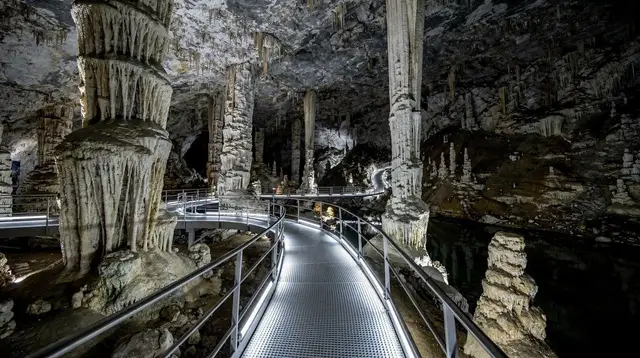
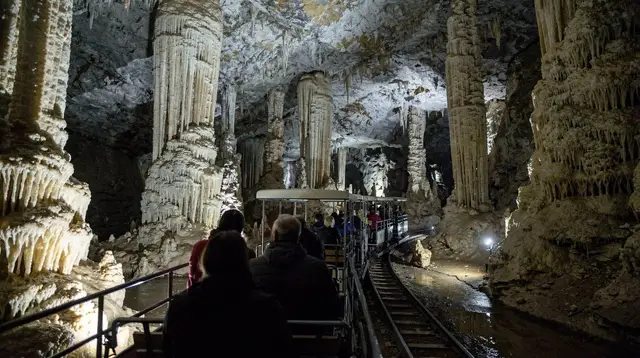
Most visitors to the Slovenian Karst hear “cave” and picture Postojna’s underground train gliding past illuminated stalactites. Škocjan Caves are something else entirely: a collapsed underground canyon big enough to swallow a cathedral, carved over millennia by the Reka river, crossed on a bridge suspended more than forty metres above rushing water. There is no train here, no seat to settle into, and no camera allowed out of your pocket. If you are trying to decide between the two great caves of the Postojna, Predjama, Škocjan and the Karst region, this page is about the one that asks you to walk, not ride.
What Škocjan Caves Actually Are
Škocjan Caves became the first natural site in Slovenia inscribed on the UNESCO World Heritage list, in 1986, years before Ljubljana’s own Plečnik heritage joined the register. The listing recognised something genuinely singular: an enormous karst system where the Reka river vanishes underground near the village of Škocjan and re-emerges, after roughly 34 kilometres of subterranean travel, on the Italian side of the border near Trieste.
What visitors actually walk through is the Reka’s underground canyon — in places over 100 metres deep and up to 60 metres wide, one of the largest known underground canyons in the world. A guided path descends past dripstone chambers into this void, crosses the Cerkvenik Bridge suspended high above the roaring river, and climbs back out on the far side. It is a hike disguised as a cave tour, and it should be approached as one: sturdy shoes, a working level of fitness, and a willingness to climb stairs both down and back up.
If you are weighing this against the show-cave circuit more broadly, the overview at show caves of Slovenia puts Škocjan in context alongside Postojna and the smaller karst attractions of the region.
The Canyon, the River Reka and the Bridge
The Reka river gives Škocjan its drama. Above ground, it is an unremarkable stream flowing off the Snežnik plateau. At the village of Škocjan it plunges underground through the Velika Dolina (“Big Valley”) sinkhole and disappears into the karst, carving the very canyon that visitors now walk through.
The tour follows the river’s underground course through a sequence of named halls — Silent Cave, then the vast Murmuring Cave where the Reka becomes audible again and then visible, a torrent moving through darkness. The path narrows, opens, narrows again, until it reaches the Cerkvenik Bridge: a slim suspended crossing built specifically to let visitors traverse the canyon at height rather than detour around it. Standing on it, with the river invisible below in the dark and the cave ceiling far overhead, is the single moment most visitors describe afterward. It is also, for anyone uneasy with heights or exposed walkways, worth knowing about in advance — the bridge has railings but no enclosure, and there is no alternate route that skips it.
The guided walk continues to the Cerkvenica Bridge and eventually to a viewpoint over the collapsed dolines where the river reappears briefly before diving underground again toward Italy. Tours run at fixed times with a live guide; unlike Postojna, there is no self-paced or train-assisted segment anywhere in the visit.
Škocjan vs Postojna: Which One Fits Your Trip
Both caves sit within a short drive of each other in the Karst, and both are frequently marketed together, but the visits could hardly be more different. If you can only fit one into your itinerary, this comparison should settle it:
| Škocjan Caves | Postojna Cave | |
|---|---|---|
| How you move through it | On foot, entire visit, including stairs | Mostly by underground train |
| Physical demand | Moderate to high — a real hike | Low — mostly seated |
| Signature feature | Suspended bridge over an underground canyon | Electric train through illuminated chambers |
| Photography | Strictly forbidden inside | Generally allowed without flash |
| UNESCO status | Listed since 1986 | Not a UNESCO site |
| Typical visit length | About 2 hours | Around 1.5 hours |
| Combines easily with | Lipica, Štanjel, Divača | Predjama Castle |
| Crowd level | Lower, capped guided groups | Higher, larger tour groups |
For a longer breakdown of exactly how the two differ in practice, see Postojna vs Škocjan Caves. If your itinerary already points toward the train-and-castle combination instead, Postojna Cave and Predjama Castle each have their own dedicated pages, along with a joint plan at Postojna and Predjama Castle day trip.
Tickets and Seasonal Pricing for 2026
Škocjan does not use a single flat entry fee. Prices move with the season, rising through the summer months when demand is highest:
| Season | Months | Adult ticket |
|---|---|---|
| Low season | January, February, March, November, December | Around EUR 16 |
| Mid season | April, May, June, September, October | Between the two extremes |
| High season | July, August | Around EUR 24 |
Because the guided groups are capped in size, booking ahead matters far more here in July and August than it does in the shoulder months. A dedicated walkthrough of the ticket process, including what to expect on arrival, is at Škocjan Caves guide; if you want a single-day plan built around it, see Škocjan Caves day trip.
The No-Photography Rule Nobody Warns You About
This is the pitfall that catches visitors coming straight from Postojna, where cameras and phones stay out for most of the walk without objection. Škocjan enforces the opposite policy: photography is explicitly forbidden inside the cave system, for the entire guided walk, cameras and phones included. Guides do check, and being asked to put a phone away mid-tour is an avoidable embarrassment.
The reasoning is partly practical — flash photography on a moving group crossing a suspended bridge in the dark is a real safety concern — and partly about protecting a fragile UNESCO-listed environment from the wear of constant photography. Either way, the rule is not a suggestion. Plan to experience the canyon and the bridge crossing with your eyes rather than through a screen, and save the photography for the surface: the collapsed dolines and the entrance area above ground are not covered by the same restriction.
Getting There from Ljubljana
Škocjan Caves sit near the village of Matavun, a few kilometres from the town of Divača, roughly 65 kilometres and about an hour’s drive southwest of Ljubljana on the way toward the coast. Divača is also a stop on the main rail line, so the caves are one of the more realistic Karst sites to reach by train without a rental car — a short walk or local connection covers the last stretch from the station.
For travelers without a car, Slovenia without a car and getting around Ljubljana cover the practical side of public transport planning, while renting a car in Slovenia and the Slovenia vignette guide are the references to check before driving any Slovenian motorway — the e-vignette is mandatory and there is no paper alternative anymore.
A more active way to link Škocjan with the surrounding Karst plateau is by e-bike out of Divača, which covers ground between the cave, the karst villages and vineyards without the effort of pedalling unassisted:
a Škocjan Caves e-bike rental from Divača puts you on an assisted bike right at the trailhead, useful for reaching the entrance and exploring the plateau around it in the same outing. For a longer version that turns the whole day into a Karst circuit, a full-day e-bike experience across Karst Slovenia extends the same idea across a wider stretch of the plateau, including villages that a rental car would only pass through.
What to Wear and Bring
Underground temperatures at Škocjan sit in the same 8 to 12 degree Celsius range as every other Karst show cave, holding steady regardless of what the surface is doing outside — the detail covered in full at karst cave temperature: what to wear. A light jacket is not optional even in August, and the stone paths can be damp, so shoes with real grip matter more here than at Postojna, given the amount of stair climbing involved on both the descent and the return.
Because the visit is a guided walk with a fixed pace and no seating breaks beyond the scheduled stops, anyone with limited mobility should weigh this carefully against the considerably gentler Postojna visit; the general planning notes at accessibility in Slovenia are worth reading before booking either cave.
Combining Škocjan with the Rest of the Karst
Škocjan rarely needs to stand alone in a day plan, since several other Karst landmarks sit within easy reach. The Lipica stud farm, home of the Lipizzaner horse breed since 1580, lies close to the Italian border a short drive south, and makes a natural half-day pairing — see Lipica Stud Farm and Lipizzaner horses at Lipica: tradition. The village of Štanjel, with its medieval hilltop core overlooking the Karst plateau, is another realistic add-on covered at Štanjel and the Karst plateau.
Travelers curious about the region’s food traditions rather than another cave can build the same day around the Karst’s famous cured ham instead:
a guided visit to a traditional Karst prosciutto ham house pairs naturally with a morning at Škocjan, and for a day that folds in the wine country further north as well, a Karst and Goriška Brda tour with lunch and tastings covers both the plateau and the vineyards in one organised outing from Ljubljana.
For travelers coming from the opposite direction — arriving already having seen Postojna and wondering if Škocjan is worth the extra stop — the honest answer is usually yes, precisely because the two visits are so different in character rather than being a rerun of the same experience. Anyone still undecided between the two should still book Postojna properly if they choose it instead:
a Postojna Cave day trip from Ljubljana is the standard way most visitors cover the train-based cave and Predjama Castle together in a single organised outing, and remains the right choice for travelers who want the easier of the two visits rather than Škocjan’s hike.
For the intermittent lake nearby that catches many visitors off guard by season, Lake Cerknica is worth reading before planning a summer visit — it disappears entirely for months at a time, and a day trip built around seeing water there in August will be disappointed. The dedicated page on timing is at Lake Cerknica day trip.
A Half-Day Plan for Škocjan
A workable structure for most travelers based in Ljubljana: leave in the morning, arrive at Divača or Matavun for the first or second guided slot of the day, allow around two hours for the walk itself including the return climb, then use the rest of the day for one nearby stop — Lipica, Štanjel, or simply lunch in Divača — before heading back.
Combining Škocjan with Postojna on the same day is possible but makes for a long, cave-heavy day; splitting them across two visits, or two different day trips from Ljubljana, tends to leave more room to actually enjoy each one. The broader Karst caves in one day itinerary lays out a fuller version of this plan for travelers who want to see as much of the region as reasonably fits into a single outing.
Frequently Asked Questions about Visiting Škocjan Caves
Is Škocjan harder to visit than Postojna Cave?
Yes, physically. Škocjan is a guided walk of roughly two hours along paths, stairs and a suspended bridge, with no train at any point. Postojna covers most of its distance on an underground train and suits visitors who prefer to sit rather than walk.
Can I take photos inside Škocjan Caves?
No. Photography is explicitly forbidden inside Škocjan Caves, unlike Postojna, where photos without flash are generally tolerated. Cameras and phones must stay put away during the guided walk, and guides do enforce this rule.
How much does it cost to visit Škocjan Caves in 2026?
Adult tickets range from around EUR 16 in low season (January, February, March, November, December) to around EUR 24 in July and August, since Škocjan prices by season rather than a single flat rate.
Do I need to book Škocjan Caves in advance?
Booking is strongly recommended in the warmer months, since guided groups are limited in size and popular time slots sell out on peak summer days. Outside July and August, arriving without a reservation is usually fine.
Can I visit Škocjan Caves without a car?
Yes. The caves sit a short walk from Divača train station, which has direct rail connections to Ljubljana, making Škocjan one of the easier Karst sites to reach without your own vehicle.
Should I visit Škocjan or Postojna if I only have time for one?
Choose Škocjan for a dramatic natural canyon and a genuine hike, and choose Postojna for an easier, faster visit that pairs neatly with Predjama Castle. Neither is a lesser choice; they show different sides of the same karst landscape.
How cold is it inside Škocjan Caves?
Like all Karst show caves, Škocjan holds a steady temperature of roughly 8 to 12 degrees Celsius year-round, regardless of the season outside. A jacket is necessary even in the middle of a Slovenian summer.
Can Škocjan Caves and Postojna be visited on the same day?
It is possible but tiring, since both sites involve their own guided tour lengths and Postojna also includes Predjama Castle for most visitors. Splitting them across two half-days from Ljubljana is generally more comfortable.