The Largest Cave Castle on Earth
No photograph quite prepares you for the first look at Predjama. A pale Renaissance facade is wedged into the mouth of a cave, halfway up a sheer 123-metre limestone cliff, as if the rock had simply opened and someone had built a house inside. It is, by most measures used to rank such things, the largest cave castle in the world, and it earns the title honestly: parts of the structure are built rooms with roofs and windows, and parts are simply the cave itself, left open and used as storage, stables, or escape routes for seven centuries.
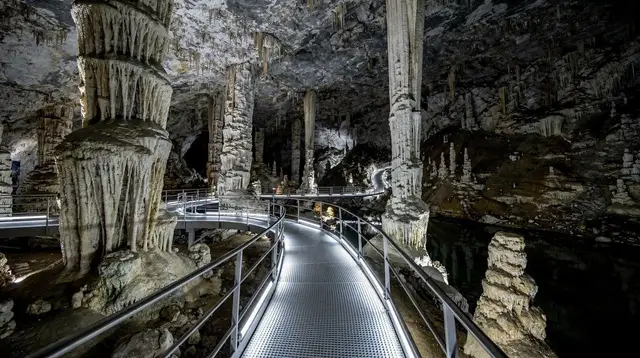
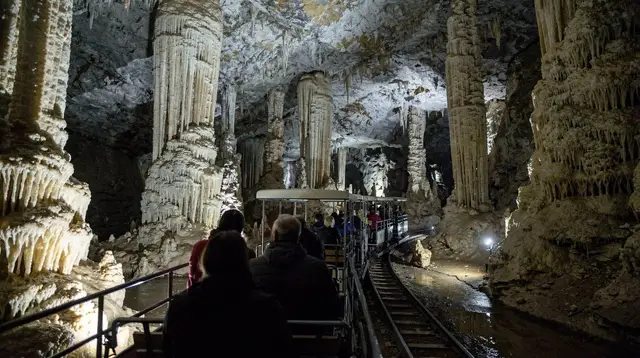
Predjama sits about 9 km from Postojna Cave, the show cave that draws the crowds to this stretch of the Karst. That proximity is the whole point of this page. Almost nobody visits Predjama Castle as an isolated errand from Ljubljana; almost everybody visits it as the second half of a Postojna morning or afternoon. If you have already booked your timed entry to the cave, this guide picks up from there and walks you through slotting the castle into the same outing, without repeating the ticket and pricing details that belong on the cave’s own page.
Why Predjama and Postojna Are Really One Visit
The Postojna Cave Park sells a combined ticket covering both the cave and the castle, at a lower price than buying each separately, and that single fact shapes how almost every visitor and every tour operator plans the day. Coach excursions from Ljubljana, Bled, or the coast that stop at Postojna Cave almost always continue on to Predjama afterward; independent drivers with a rental car do the same thing because the detour costs barely fifteen minutes.
Treating Predjama as a stand-alone half-day trip from Ljubljana, on its own, is technically possible but a poor use of a travel day: you would drive past the cave, one of the most visited sights in Slovenia, without going in. For the ticket details, the choice between the cave-only ticket and the combined option, and how to reserve your cave time slot, see our dedicated Postojna Cave tickets and tips guide — that is where the numbers live, and they are worth checking before you fix a departure time, since the cave entry is what anchors the rest of the schedule.
If you want the fuller walkthrough of the castle itself, room by room, our Predjama Castle guide goes deeper than this destination overview.
Getting There From Ljubljana
By car, Predjama Castle is roughly 53 km southwest of Ljubljana, about 50 to 55 minutes on the A1 motorway toward Postojna, followed by a short stretch of secondary road. Since the drive passes directly through Postojna, the natural order for a self-drive day is cave first, castle second: park at the cave, do the underground tour, then drive the 9 km to Predjama with the morning’s schedule already behind you.
If you are renting a car for this trip, remember Slovenia’s motorway system runs on an electronic vignette rather than a toll booth — our vignette guide explains which category to buy before you set off, and our car rental guide covers the practicalities of hiring in Slovenia more broadly.
Without a car, the honest answer is that there is no direct scheduled bus service between Postojna Cave and Predjama Castle, which is exactly why the combined organized tour exists as an option. A tour or transfer that includes both stops removes the logistics problem entirely, and it tends to be the simplest choice for visitors basing themselves in Ljubljana without their own vehicle. Our guide on reaching Postojna without a car lays out the bus, train, and organized-tour options for that leg of the day.
What You’ll See Inside
The castle as it stands today is largely a 16th-century Renaissance rebuild over a much older core; the first written record of a fortress on this exact cliff dates back to the 13th century. Walking through it, the building alternates between conventional furnished rooms — a chapel, a small armory, period furniture arranged across several floors — and stretches where the tour simply continues into bare cave passage, damp stone underfoot, before opening again into another built room. That contrast is what makes Predjama memorable rather than just another hilltop castle: you are inside a building and inside a cave in the same ten minutes, often without a clear line between the two.
A narrow passage, cut and enlarged through the rock behind the castle, connects to the cliff above and is the origin point of the site’s best-known story.
The Legend of Erasmus of Predjama
Predjama’s history would be a footnote without the story of Erazem Predjamski — Erasmus of Predjama — a 15th-century knight cast in local legend as a robber baron who defied the Habsburg authorities from inside these walls. Besieged for months, Erasmus reportedly used the hidden passage through the cliff to slip out at night, bring back fresh fruit and game, and throw them down to the frustrated soldiers camped below as proof he was in no danger of starving. The siege is said to have ended not through the strength of the attackers but through betrayal from within — a signal given to time a cannon shot for the one moment Erasmus was exposed in an outbuilding.
How much of this is documented fact and how much is centuries of retelling is genuinely debated by historians, and the castle’s own displays present it as legend rather than settled record. That does not make it any less worth hearing before you go in; the passage, the outbuilding, and the general shape of the siege are pointed out during the visit, and knowing the story in advance turns a walk through empty rooms into something closer to a scene you can picture.
Timing Your Visit
Predjama Castle is open every day of the year, though hours shrink somewhat in the winter months compared with peak summer. A visit itself takes roughly 1 to 1.5 hours at an unhurried pace, which is short enough that it slots comfortably either before or after the cave tour without stretching the day past a half day in total.
Midsummer mornings and early afternoons bring the heaviest crowds, largely tour groups arriving straight from Postojna Cave in the hour after their underground tour finishes. If your own cave time slot is a late-morning one, visiting the castle in the early afternoon usually means walking into a quieter site than the group that toured the cave at the same time as you. Outside July and August, and especially from October through April, Predjama sees a fraction of the summer footfall, and the pale facade against a cloudy Karst sky is arguably more atmospheric than the same view under a flat midday sun.
One practical note carried over from the cave: temperatures inside Postojna’s tunnels sit at 8-12°C year-round regardless of the season outside, so if your day includes both stops, dress for that swing rather than for the Karst surface weather alone — our guide on what to wear for karst cave temperatures covers this in more detail, since a light jacket that feels unnecessary at Predjama in August becomes essential twenty minutes earlier, underground at Postojna.
Booking the Castle, and Booking a Tour That Covers Both
Because the combined Postojna Cave and Predjama Castle ticket requires choosing a fixed date and time for the cave portion, that reservation is effectively what fixes your whole day. Once it is booked, Predjama itself needs comparatively little advance planning — its own ticket queue moves faster and its opening hours are more forgiving than the timed cave entries.
For visitors who would rather not manage the driving, the two-site logistics, and the cave’s timed booking themselves, a guided option that bundles transport, both entries, and a guide removes that entirely. The Postojna Cave and Predjama Castle half-day tour is built around exactly this pairing and runs from Postojna, while the day tour to both sites departing from Izola works well for anyone based on the coast rather than in Ljubljana.
Travelers who prefer to book cave and castle entry as a standalone ticket rather than a guided tour can also look at the Postojna Cave and Predjama Castle combined ticket, which secures both entries without a guide attached.
If you are extending the day into the wider Karst rather than heading straight back to Ljubljana, the region rewards it. A short further drive reaches Lipica’s historic stud farm, home to the Lipizzaner horse since 1580, or the Karst plateau town of Stanjel with its stone terraces. Anyone curious about the region’s food traditions rather than only its rock formations can build in the guided Karst prosciutto house tasting experience, a look at the air-cured ham the limestone region is known for beyond its caves.
Beyond Predjama: The Rest of the Karst
Predjama and Postojna Cave together are the anchor of the Karst region, but they are not the whole of it. Skocjan Caves, a UNESCO World Heritage site since 1986, offers a genuinely different experience underground — a vast natural canyon crossed by a suspended footbridge rather than a train ride — and pairs naturally with a separate day if your schedule allows it; our piece on how Skocjan and Postojna actually differ is worth reading before deciding whether to fit both into one trip.
Further south, Lipica and its centuries-old stud farm make for a slower, more pastoral contrast to the cave-and-castle circuit, while the plateau town of Stanjel rewards anyone interested in traditional Karst stone architecture. To the north, Lake Cerknica is the region’s strangest feature: an intermittent lake that floods in wet seasons and disappears into pasture by summer.
For a ready-made structure rather than piecing the day together yourself, our Postojna and Predjama day trip itinerary lays out a full schedule from Ljubljana, hour by hour, built around exactly the pairing this page describes. And if the castle photographs are what drew you here in the first place, our things to do at Predjama Castle page rounds up the activities, viewpoints, and nearby stops worth adding once the main visit is done.
Predjama Castle FAQ
Can I visit Predjama Castle without visiting Postojna Cave?
Yes, Predjama sells a standalone entry ticket and you can drive straight there. In practice almost no one does it that way: the castle is 9 km from Postojna Cave, a combined ticket covers both, and most tours and self-drive itineraries treat them as one half-day outing.
Do I need to book Predjama Castle tickets in advance?
It helps in July and August and around public holidays, when tour buses stack up in the small car park, but Predjama is far less time-slot strict than Postojna Cave. If you are also visiting the cave, book that timed entry first and let it set your schedule for the day.
How long does a visit to Predjama Castle take?
Budget 1 to 1.5 hours for the self-guided walk through the rooms, courtyard, and secret passage. Add travel time to and from Postojna Cave, and a half day covers both sites comfortably.
What is the combined Postojna Cave and Predjama Castle ticket?
It is a single ticket sold by the Postojna Cave Park that covers entry to both the cave and the castle at a lower combined price than buying each separately. Current prices, seasonal variations, and how to book the required cave time slot are covered in our Postojna Cave tickets guide, since that is where the official pricing lives.
How do I get from Postojna Cave to Predjama Castle without a car?
There is no scheduled public bus running directly between the two, which is the main reason most car-free visitors join an organized tour that includes transport between the cave and the castle. Our guide to reaching Postojna without a car covers the taxi and tour alternatives in detail.
Is Predjama Castle suitable for wheelchairs or strollers?
Only partially. The castle is built across multiple levels of natural rock with staircases, uneven stone floors, and narrow passages, including the secret tunnel, none of which are step-free. The courtyard, ticket area, and views from outside are accessible; the interior rooms are not.
What is the legend of Erasmus of Predjama?
Erasmus was a 15th-century robber knight who held out inside the castle during a months-long siege, reportedly using a hidden passage through the cliff to smuggle in fresh food and taunt the besiegers. The story ends with a betrayal from inside the castle rather than a battlefield defeat, and it is retold throughout the visit.
Is Predjama Castle worth visiting in winter?
Yes. The castle stays open year-round, crowds thin out sharply, and the cliff face photographs just as well against a grey winter sky. The main change is that Vintgar Gorge and some seasonal Karst sites close for winter, so Predjama and Postojna Cave become an even more natural pairing on a shoulder-season or winter trip.