Most European capitals ask you to budget a full week and a metro map. Ljubljana asks for neither. Slovenia’s capital holds around 285,000 people, and its entire historic center — the part a visitor actually spends time in — can be crossed on foot in about twenty minutes. That scale is not an accident of small size; it is the reason this page exists. Ljubljana works best not as a destination to exhaust in itself, but as the base you return to each evening while the rest of Slovenia — the Julian Alps, the Karst, the Adriatic coast — sits within a single day’s reach.
This page covers the city as a place to stay: how it is laid out, how you move through it without a car, where to sleep, and how to time two or three nights here around the excursions that make Slovenia’s small size so useful. It does not go deep on the castle that watches over the rooftops — that has its own page at Ljubljana Castle — and it does not detail the day trips themselves, which have their own destinations at Bled and Postojna. Think of this as the hub page for the wheel.
A city shaped by one river and one architect
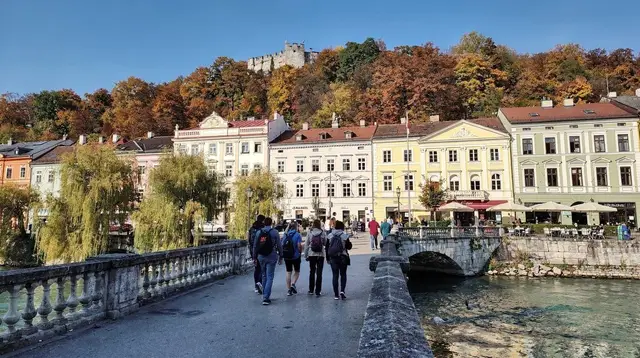
Ljubljana sits where the Ljubljanica river bends beneath a wooded hill, and almost everything a visitor cares about is arranged along that bend. On one bank: Preseren Square, pink Franciscan church, and the start of the old town’s arcaded streets. Crossing to the other bank: the Triple Bridge, three parallel spans fanning out from a single point, which is as good an introduction as any to the man whose work shapes the whole center.
That man was Joze Plecnik, a Ljubljana-born architect who spent decades rebuilding his home city’s public spaces — bridges, embankments, a market hall, a library, a cemetery — around the idea that ordinary urban life deserved monumental care. In July 2021, UNESCO inscribed his body of work here as a World Heritage Site, one of very few listings anywhere built around a single architect’s civic output rather than a single building or ensemble.
Walking the riverside colonnades of the Central Market or standing inside the reading room of the National and University Library, it is worth knowing that this is not generic old-town charm — it is one coherent design, laid down over roughly forty years, that still organizes how the city functions today.
Above it all, on the hill the river curves around, sits Ljubljana Castle. It is the skyline’s obvious landmark and the destination most visitors climb toward on their first afternoon, whether on foot or by funicular — full detail, including current ticket prices, lives on its own page rather than here.
Getting around: a center built for feet, not cars
The single most useful fact about Ljubljana for a short stay is this: its historic core is a pedestrian zone, closed to private cars. That decision, phased in over the past two decades, is why the riverside cafés spill onto the cobbles without a line of parked cars behind them, and why walking here feels unusually calm for a national capital.
For anyone who still wants a lift — heavier bags, tired feet, or simply crossing from one end of the pedestrian zone to the other — there is the Kavalir, a small electric vehicle that carries up to five passengers, runs with no fixed stops or timetable, and costs nothing. You hail one on the street or call for one, and it operates from 6:00 to 22:00; a couple of the fleet are enclosed and heated for winter. It is a genuinely useful detail for anyone with mobility limits, small children, or luggage between a hotel and the old town, and it is worth reading up on before arrival — see getting around Ljubljana for the full picture.
Beyond the old town, city buses run by LPP cover the rest of Ljubljana, and they have not accepted cash since May 2010: you need an Urbana card (a couple of euros to buy, then topped up) or a contactless bank card. A single ride runs to roughly EUR 1.30, though it is worth checking lpp.si for the current fare rather than treating that as fixed. Most visitors staying in or near the center will barely need the bus network at all — it matters more for reaching the airport or outlying neighborhoods than for anything inside the pedestrian zone.
For a stay built around sightseeing rather than transit, the Ljubljana Card bundles unlimited city buses with the castle funicular and entry, a guided walking tour, a river cruise, a bike rental, entry to more than twenty museums and galleries, the zoo, and the Velika Planina cable car — priced at EUR 41 for 24 hours, EUR 49 for 48 hours, or EUR 54 for 72 hours (adult rates; reduced pricing applies for ages 6 to 14). The math is straightforward: stack the castle, one river cruise and two museums against the card price and it usually comes out ahead, especially over 48 or 72 hours. The full comparison, including when it is not worth it, is in is the Ljubljana Card worth it.
Book the Ljubljana Card here to cover the castle, a river cruise and city transit in one passGetting here: airport, and the neighboring cities
Ljubljana Airport (Brnik, code LJU) sits about 25 km northwest of the center. The public option is bus line 28, which runs to the main bus station in roughly 45 to 55 minutes, departing every 30 to 60 minutes between around 5:00 and 21:30. Fares differ between weekdays and weekends, so it is worth checking ap-ljubljana.si directly rather than trusting a fixed number — the Ljubljana Airport guide walks through the alternatives, including taxis and shared shuttles, in more depth.
A meaningful share of visitors arrive overland instead. Ljubljana sits within striking distance of three other cities that feed it tourists: Zagreb, Trieste and Venice all run regular bus or train connections, and each has its own approach guide if that is how you are arriving — from Zagreb, from Trieste, from Venice.
One detail worth flagging if you are coming from Croatia: Slovenia reinstated temporary border checks with Croatia and Hungary in October 2023, and as of this writing they remain in force — currently extended to December 21, 2026. It rarely causes a real delay, but it is not accurate to say the border is entirely check-free.
If you are arriving by rental car, the one thing to sort out before you drive anywhere is the e-vinjeta, Slovenia’s fully electronic highway toll sticker — there is no physical vignette anymore. A standard car needs the 2A category: EUR 16 for a week or EUR 32 for a month. Buy it online or at a service station before you join the motorway network; driving without one is enforced.
What fills two or three nights in the center
Inside that twenty-minute-wide old town, the standard first afternoon runs: Preseren Square, the Triple Bridge, a wander through the Plecnik-designed riverside arcades of the Central Market, then up to the castle either on foot (about fifteen minutes by several signed paths, free) or by funicular. From the ramparts, the view lays out the whole logic of the city — river, old roofs, Tivoli Park’s green wedge on the far side, and the hills beyond where the rest of Slovenia begins.
Beyond that obvious circuit, a few things are easy to miss. Metelkova, a former military barracks turned alternative art and nightlife district, is a short walk from the center and a useful counterpoint to the tidy old town — worth an hour by day and considerably more after dark. Tivoli Park, the city’s green lung, connects to the center on foot and is where locals actually spend their weekends rather than tourists. And a walking tour with a local guide remains one of the more efficient ways to absorb the Plecnik story and the old town’s layout in a single go, especially for a stay this short.
Join a small-group walking tour of Ljubljana’s old town with a local guideFor food, Ljubljana’s dining scene has moved well past tourist-trap territory in the past decade, from riverside terraces to a genuinely good open-air market on weekday and Saturday mornings — the what to eat in Ljubljana guide covers what to actually order.
Museum-wise, the city holds more than twenty worthwhile collections, most bundled into the Ljubljana Card above; see the Ljubljana museums guide for which ones earn a half-day and which don’t. If you’d rather see the center from the water, a short Ljubljanica river cruise covers the same bridges and embankments from a different angle, and pairs naturally with an evening after the museums close.
Where to stay
Because the center is small and pedestrianized, “location” in Ljubljana means something narrower than it does in a larger capital: inside the old town or just across the river puts everything in this guide within a ten-minute walk. Staying slightly further out, near the train and bus station, trades a few minutes of walking for typically lower prices and easier luggage access on arrival.
The full breakdown of neighborhoods, price bands and which streets are worth avoiding at night sits in where to stay in Ljubljana; if this is your first visit to the city at all, pair it with first time in Ljubljana, which walks through arrival, orientation and first-day logistics in more detail than fits here.
A simple plan for two or three nights
| Night | Focus |
|---|---|
| Arrival evening | Airport or station to hotel, dinner near the river, first look at the illuminated Triple Bridge and castle |
| Day 1 | Old town on foot, Central Market, castle hill (walk up or funicular), Tivoli Park or Metelkova in the afternoon |
| Day 2 | One full-day excursion — Bled, or Postojna and Predjama together — using Ljubljana as your overnight base |
| Day 3 (optional) | Museums, a river cruise, or a second excursion before departure |
For a more detailed hour-by-hour version, see Ljubljana in two days or Ljubljana in three days, both built around exactly this rhythm: city mornings, one excursion, city evenings.
Using Ljubljana as your base for the rest of Slovenia
This is really the point of building your trip around Ljubljana rather than moving hotels every night. Slovenia covers just 20,271 km², smaller than the Netherlands, so almost nothing in the country sits more than a couple of hours from the capital. Bled is about 55 km away; Postojna’s cave and Predjama Castle around 53 km; even Piran on the coast and Maribor in the wine country are comfortable day trips at roughly two hours each way.
The full menu of single-day excursions from the capital lives at the day trips hub, and it is worth building your Ljubljana nights around whichever of those pulls you most — the Julian Alps, the Karst caves, or the green hills just outside the city itself, like Velika Planina’s shepherd huts, reachable on a guided hike straight from town.
Take a guided hiking day trip from Ljubljana to Velika Planina and the Logar ValleyWine country to the east is another realistic day out from the capital, and one many first-time visitors overlook entirely in favor of Bled and the caves — a countryside tasting trip covers ground you would otherwise need a rental car and a full itinerary of your own to reach.
Book a countryside wine and food tasting day trip from LjubljanaMoney, plugs and the practical basics
Slovenia uses the euro, adopted in January 2007 — it was the first of the ten countries that joined the EU in 2004 to enter the eurozone, so there is no currency conversion to think about here, unlike in neighboring Croatia before 2023 or Hungary today. Sockets are the standard European two-pin type (types C and F, 230V/50Hz). The emergency number is 112. Ljubljana’s tap water is genuinely good and safe everywhere; restaurants serve it without being asked. None of this requires much planning, which is part of why the city works so well as a low-friction base rather than a logistics project.
Best time to visit Ljubljana
Ljubljana’s weather is fairly typical Central European: warm, sometimes hot, summers (often above 30°C in July and August) and a genuinely cold winter. The sweet spots are late spring (late April through June) and early autumn (September into October), when the old town’s outdoor cafés are at their best and day-trip destinations like Bled haven’t hit peak crowding.
December brings a well-regarded Christmas market along the river and lends the old town a different, cozier character, though several of the day trips covered elsewhere on this site — notably the Vintgar Gorge near Bled — close for the season. For a month-by-month breakdown across the whole country, not just the capital, see Slovenia weather by month.
Ljubljana city break: FAQ
Is Ljubljana a walkable city?
Yes, unusually so. The historic center is a pedestrian zone closed to private cars, and it can be crossed end to end on foot in about twenty minutes. Most visitors staying centrally will not need public transport at all beyond arriving from and departing to the airport or station.
How many days do I need in Ljubljana itself?
Two to three nights covers the old town, castle hill, a museum or two, and one day trip. Add a third or fourth night only if you plan to fit in a second excursion, such as pairing Bled with the caves at Postojna on separate days.
Is the Ljubljana Card worth it for a short stay?
Often, yes, especially over 48 or 72 hours. It bundles the castle and funicular, unlimited city buses, a guided walking tour, a river cruise, a bike rental, more than twenty museums, and the Velika Planina cable car for a flat rate — the math typically works out ahead of buying those separately. See is the Ljubljana Card worth it for the detailed comparison.
What is the Kavalir and how do I use it?
The Kavalir is a small, free electric shuttle that operates inside Ljubljana’s pedestrian zone from 6:00 to 22:00, carrying up to five passengers with no fixed stops — you hail one on the street or call for a pickup. It is especially useful for luggage, tired legs, or reduced mobility within the car-free old town.
Do I need a car to see Ljubljana and its surrounding day trips?
Not for the city itself — the center is pedestrian and easy on foot. For day trips like Bled or Postojna, a car adds flexibility but is not required: organized day tours and public transport both reach the main destinations, and driving requires an electronic highway vignette (e-vinjeta) purchased in advance.
Is it “Lubiana” or “Laibach”?
Neither, in English. “Lubiana” is the Italian name and “Laibach” the historic German one; in English-language writing today the city is simply Ljubljana, pronounced roughly “lyou-BLYA-na.”
How do I get from Ljubljana Airport to the city center?
Public bus line 28 runs from the airport to the main bus station in about 45 to 55 minutes, departing roughly every 30 to 60 minutes between 5:00 and 21:30. Taxis and shared shuttles are faster and more expensive; full options are covered in the Ljubljana Airport guide.
What is the best time of year to visit Ljubljana?
Late April through June and September into October give the most comfortable weather and the lightest crowds, both in the city and at nearby day-trip destinations. Summer is warm to hot and busier; winter is cold but brings a notable Christmas market to the riverside.