Stand-Up Paddleboarding on Lake Bled
Can you go stand-up paddleboarding on Lake Bled?
Yes. Rental huts around the lakeshore hire out stand-up paddleboards and kayaks, and the flat, sheltered water suits beginners. You can paddle to Bled Island under your own power, but landing there does not include entry to the Assumption of Mary church, which is ticketed separately from the island itself.
Why paddle instead of ride
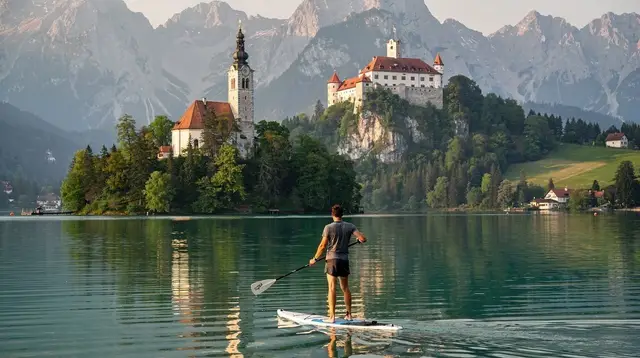
Almost every photo of Lake Bled is taken from the shore or from inside a pletna, the traditional rowed boat that carries visitors out to the island and back. Both give you the postcard view, but neither puts you in charge of your own route or your own pace. A stand-up paddleboard does. You decide how close you get to the island’s cliffs, whether to loop around the far side away from the crowds, or to simply sit down on the board in the middle of the lake and let the reflection of the castle and the Julian Alps settle around you.
This guide covers paddleboarding specifically: where to rent a board, how the lake behaves through the day and the seasons, what a beginner should expect, and the one thing almost every first-time paddler assumes wrongly about the island. It does not cover the pletna crossing itself or the roughly six-kilometre walk around the lake shore — both of those are detailed in Bled day trip from Ljubljana, which remains the better starting point if you are still deciding how to spend your day at the lake before narrowing in on paddling.
Where to launch a paddleboard on Lake Bled
Rental huts and small operators line the lakeshore at several points, most concentrated near the public swimming area below the castle hill and around the village of Mlino on the southern shore, with further options near the larger hotels and the camping ground at the lake’s eastern end. None of these spots require advance scouting: walk the shore path for ten minutes in July or August and you will pass several racks of boards and kayaks stacked and ready to go. Staff typically fit you with a paddle, a leash, and a short rundown of the lake’s informal rules before sending you off, and most rent by the hour with half-day and full-day rates for anyone planning a longer session.
If you would rather not manage logistics yourself, or if you want the company and local knowledge of a guide, a booked session removes the guesswork entirely. a guided experience on Lake Bled typically bundles time on the water with the kind of local commentary a self-guided rental cannot offer, which is worth considering on a first visit or when the shoreline huts are busy. For travellers who would rather have the whole outing organised as a small group, a small-group tour of the lake is a straightforward way to combine the water time with the rest of a Bled visit without arranging each piece separately.
Reading the lake: when to go
Lake Bled behaves very differently at 7am and at 2pm, and the difference matters more for paddling than for almost any other activity on the lake. Early morning, before the pletna boats start their runs and before the rowing clubs finish training, the water is close to glass. This is also when the light is best for photographs looking back toward the castle, and when the shoreline paths and rental huts are quietest. For a longer discussion of crowd patterns at the lake more broadly, see avoiding the crowds at Bled and the best photo spots around Lake Bled, both of which apply just as much to paddlers as to people on foot.
By late morning the lake fills with pletna traffic ferrying visitors to and from the island, plus rowing boats, hotel-based canoes, and other paddlers. None of this makes the lake unsafe, but it does mean sharing space, giving way to the pletna boatmen, who have a fixed route and limited manoeuvring room, and expecting a choppier surface as more wakes cross each other. Afternoon can also bring a light breeze funnelled down from the surrounding hills, which is rarely strong enough to be dangerous but is enough to notice, especially standing up rather than kneeling.
Season shapes the experience as much as time of day. Water levels and temperature swing with the seasons the way they do everywhere in this part of the Alps — see Slovenia’s weather by month for the wider pattern. Roughly:
| Season | Water and conditions | What to expect |
|---|---|---|
| June-August | Warmest water, busiest lake | Best for beginners’ comfort, but book ahead at midday and weekends |
| September-October | Cooler air, calmer lake | Fewer boats, crisp morning light, a light top layer is worth packing |
| April-May | Cold, sometimes rain-fed high water | Fine for confident paddlers, less pleasant for first-timers who expect to fall in |
| November-March | Cold, most rental huts closed or reduced | Paddling largely stops; this is not the season to plan around |
Who this suits, and the basics of staying upright
Lake Bled has no current worth mentioning, very limited motorised traffic, and a shoreline you are never more than a few hundred metres from, which makes it one of the easier lakes in the region to learn on. If you have never stood on a paddleboard before, expect to spend your first ten minutes finding balance on your knees before standing, and expect to fall in at least once. That is normal, not a sign you are doing it wrong.
A few practical points rental staff will usually cover, worth knowing before you go:
- Wear the ankle or calf leash provided; it keeps the board within reach if you fall.
- Stay further from the pletna lanes than feels necessary — the boatmen have a fixed line and cannot easily steer around a paddler who drifts into it.
- The water is noticeably colder than the air, even at the height of summer, so a rash guard or light wetsuit top makes a real difference on longer sessions.
- Sun exposure on open water is stronger than it feels, with no shade and glare bouncing off the surface; sunscreen and a hat matter more here than on land.
None of this requires a permit, a license, or prior paddling experience. It does require basic swimming ability and comfort with the idea of getting wet, since falling in is part of learning.
The island: what paddling there actually gets you
This is the point where most first-time paddlers on Lake Bled get something wrong, so it is worth stating plainly. Paddling to Bled Island is entirely possible and, on calm water, well within reach of a beginner — the crossing from the nearer shore points is short, flat, and free of any barrier stopping a private board from approaching. What paddling there does not include is entry to anything on the island itself.
The church of the Assumption of Mary, its bell tower, and the small museum attached to it are ticketed separately, the same ticket a pletna passenger or a swimmer who reaches the island would also need to buy. Arriving under your own power does not create a free way in; it simply gets you to the shoreline of the island, where the same entrance fee applies as for everyone else.
It is worth planning for this rather than discovering it on the spot: bring a way to pay once you land, and treat the paddle itself as the activity, with the church visit as an optional add-on rather than something bundled into getting there. Anyone who wants the fuller picture of the island, the church, and the traditional pletna crossing, including how the pletna boatmen are typically paid, should read Bled day trip from Ljubljana, which covers that side of the lake in full.
Landing itself is informal — there is no dedicated paddleboard dock, so most paddlers beach their board on the shingle near the main steps or find a quiet stretch of shoreline away from the pletna unloading point, taking care not to block the boatmen’s landing area.
Combining paddling with the rest of a Bled visit
A paddling session pairs naturally with the rest of a day at the lake without needing to be the whole plan. Many visitors paddle in the early morning, then spend the middle of the day walking up to Bled Castle for the view down over the water they were just on, or working through the wider list of things to do around Bled.
If you are building a full day or two around the lake rather than just the water time, the one-day Bled itinerary sequences paddling, the castle, and the shoreline walk into a single realistic plan, and parking in Bled and getting to Bled without a car cover the logistics of actually arriving, which matter more here than at almost any other stop in Slovenia given how narrow the lakeside roads get in peak season.
Beyond Bled: other places to paddle
Lake Bled is the best-known place in Slovenia to pick up a paddleboard, but it is not the only one, and travellers who want a quieter alternative or a different kind of water have a few realistic options worth knowing about. Lake Bohinj, the larger and much less crowded lake inside the Triglav National Park, sees far less boat traffic and none of the pletna routes, which makes for a calmer, more solitary paddle if Bled’s midday activity is not what you are after — see Bled versus Bohinj for how the two compare more broadly, and hiking around Lake Bohinj if you want to combine the water with a walk.
Bohinj itself is more commonly paired with a guided kayak trip than a solo SUP rental; a half-day kayak trip to Lake Bohinj with a picnic swim stop is a practical way to see that lake from the water without arranging your own rental.
For a smaller, quieter alpine lake further from the usual circuit, some operators also run a half-day stand-up paddleboarding trip on Lake Predil, a good option if the goal is alpine scenery with a fraction of Bled’s visitor numbers. None of this is necessary if Bled is the only lake on your itinerary — it simply broadens the options for anyone building a longer trip around Slovenia’s lakes rather than a single day at Bled.
Travellers who enjoy the water more generally and are not limited to lakes have further choices once they leave Bled behind: the category page for kayaking and paddling activities across the site lists river and sea options as well as lake ones, and paddlers heading toward the mountains often add river time on the Soča alongside a lake session at Bled. Anyone spending time in the capital before or after Bled can also get a calmer, guided introduction to being on the water via a Ljubljanica river cruise, which is a very different, city-based experience from open-water paddling but a pleasant complement to it.
Practical summary
For a quick comparison of the three main ways to experience Lake Bled from the water or its shore:
| Method | Effort | Reaches the island | Typical time needed |
|---|---|---|---|
| Stand-up paddleboard | Active, some balance required | Yes, under your own power | 1-2 hours |
| Pletna boat | Passive, no effort | Yes, with the boatman | 1-1.5 hours including waiting |
| Walk around the lake shore | Moderate, flat walking | No | About 2 hours |
None of these is strictly better than the others; they simply suit different kinds of visits. Paddling is the option for anyone who wants to be active on the water rather than transported across it, who does not mind falling in once or twice while learning, and who understands going in that reaching the island is not the same as being let inside its church for free. With that expectation set correctly, a couple of hours on a board is one of the more memorable ways to spend a morning at Slovenia’s most photographed lake.
tours.kayaking-paddling
Verified deep-linked GetYourGuide tours. Book through these links and we earn a small commission at no cost to you.
GetYourGuide does not provide a product photo for this activity — the image shows the meeting point, photographed by us.