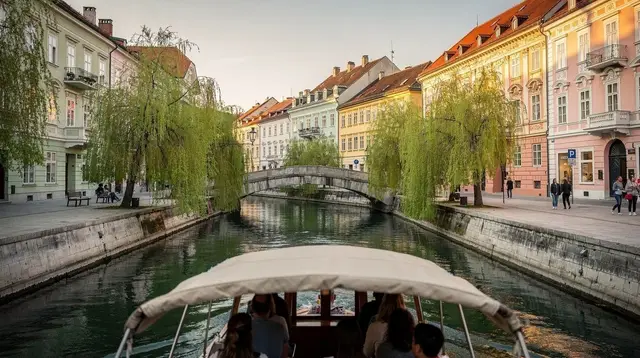
Ljubljana by Boat: The Ljubljanica River Cruise
Is the Ljubljanica river cruise worth it, and is it already included in the Ljubljana Card?
Yes for most visitors: a short sightseeing cruise on the Ljubljanica is one of the more relaxing ways to see Plecnik's bridges and the castle hill from below. It is already included in the Ljubljana Card (24h, 48h or 72h), so check that pass before booking a separate boat ticket — buying both means paying for the same cruise twice.
A different angle on a familiar skyline
Everyone who spends an afternoon in Ljubljana ends up crossing the Triple Bridge two or three times without meaning to, because the old town is small enough that the same landmarks keep reappearing. The old town walking guide covers that on-foot version in detail. This page covers the other way to see the same stretch of the city: from a boat, sitting still, while the Ljubljanica does the moving.
The Ljubljanica is the river that gives the capital its shape. It flows through the historic center between the castle hill and the market colonnade, continues north to join the Sava, which itself eventually reaches the Danube — a small, unglamorous fact that nonetheless connects a city of 285,000 people to the Black Sea. None of that is visible from the boat, of course. What is visible is a few hundred meters of quayside architecture that one architect, Joze Plecnik, spent decades quietly rebuilding, and which is now part of what UNESCO inscribed as world heritage in July 2021.
What you actually see from the water
A Ljubljanica sightseeing cruise covers the short central loop, not the whole river. In that loop, the standard sights are:
- The Triple Bridge (Tromostovje), Plecnik’s best-known structure — technically three bridges fused into one crossing, widened in the 1930s without demolishing the older single bridge at its center.
- The Cobblers’ Bridge (Sustarski most), a plainer stone crossing just downstream, once lined with shoemakers’ stalls.
- The covered market and colonnade, Plecnik’s riverside arcade that turned a working market into part of the promenade — best seen from the water in the morning, when stalls are open on the bank above.
- The castle hill, rising behind the rooftops on the eastern side; the cruise doesn’t take you up to the castle itself, but it gives the best low-angle view of the hill without craning your neck from the quay.
- The riverside cafés and willow trees along both banks, which is really what a lot of people are there for: watching the city go by at deck level instead of pavement level.
It is a compact, unhurried view of the same core that the walking route covers — worth doing as a change of pace rather than as your only look at the center. Anyone deciding between the two, or wondering whether to do both, might find the comparison useful before locking in a plan for three days or fewer.
How long it takes, and where to board
Most standard sightseeing cruises run somewhere in the range of 30 to 45 minutes, covering the loop between the Triple Bridge area and a turning point downstream near Trnovo or the Dragon Bridge, depending on the operator. That’s short enough to fit into a single afternoon alongside a museum visit or a walk up to the castle, and it doesn’t require blocking out half a day.
Boats depart from landing points clustered along the central quays — within two or three minutes on foot of Preseren Square, the obvious meeting point in the middle of town. The exact jetty differs slightly between operators and between a standalone cruise ticket and one redeemed through a pass, so the departure point on your booking confirmation is the one to trust, not a general sense of “somewhere near the Triple Bridge.” If you’re staying somewhere further out, the where-to-stay guide and the general getting-around guide both cover how quickly the center is reachable on foot or by the Kavalir electric shuttle.
The trap: paying for the cruise twice
This is the one thing worth getting right before booking anything. The Ljubljana Card — the city’s tourist pass, sold in 24-, 48- and 72-hour versions — already includes one Ljubljanica sightseeing cruise among its benefits, alongside unlimited city buses, the funicular and castle entry, a guided walking tour of the old town, a bike rental, entry to more than twenty museums and galleries, and the Velika Planina cable car. If you’re holding the card, or thinking about buying it, the cruise is one of the things it pays for — not an extra.
The trap is straightforward: booking a separate river cruise ticket on top of a Ljubljana Card that already covers one. It happens because the card’s benefit list is long and the cruise is easy to overlook among the museums and the transport, or because a cruise gets booked online in advance before the card itself is purchased, out of order. Either way, the result is the same cruise paid for twice.
The fix is just as straightforward: decide on the card first. If a few museums plus the castle plus the cruise plus a bus ride or two look likely across your stay, the math tends to favor the card outright — that calculation is worked through in full in the Ljubljana Card guide, including the exact 2026 price tiers.
If the card doesn’t make sense for your itinerary — a very short stopover, say, with no museum plans — booking the cruise on its own is a perfectly normal way to do it; just don’t do both. For a side-by-side of what each individual sight costs versus the bundled price, the card versus individual tickets comparison lays out the arithmetic sight by sight.
The different ways to do the cruise
There isn’t one single “the Ljubljana river cruise” — a few different formats cover the same stretch of water, and which one suits you depends on whether you want company, commentary, or just twenty minutes of quiet.
A standalone sightseeing cruise, redeemed through the Ljubljana Card or bought on its own, is the simplest version: board, sit, loop the center, disembark. No guide, no itinerary, just the view.
A combined walking tour and river cruise pairs a guided stroll through the old town — Preseren Square, the market, the riverside arcades — with a boat ride on the same outing, run back to back by the same guide. It suits a first visit to Ljubljana well, since the guide fills in the history (Plecnik’s decades of work, the UNESCO listing, why the market looks the way it does) that a self-guided boat ride leaves you to look up afterward. For anyone weighing whether to book this or handle the walking part independently: a guided city walk combined with a Ljubljanica river cruise covers both in a single, organized outing.
An electric boat tour runs on battery power rather than a conventional engine — quieter on a narrow waterway lined with outdoor tables, and with no exhaust drifting over the cafés. These tend to run on a fixed schedule with a capped group size, which in practice means picking a departure time in advance rather than turning up and boarding the next available boat: a quieter electric boat tour along the Ljubljanica is the option to book ahead if a fixed departure time and a quieter ride matter more than flexibility.
A cruise bundled into a longer day trip from elsewhere on the coast is a different case worth flagging separately: visitors based in Koper for a cruise-ship call, or staying along the coast for a few days, sometimes book a combined excursion that includes both Bled and a Ljubljanica cruise on the same day. That’s a very different format from a standalone city cruise — a full day out rather than a half-hour loop — a full-day trip pairing Lake Bled with a Ljubljanica cruise is the one to look at if the plan is to see both in a single outing from Koper or the coast, rather than treating the river cruise as a stand-alone activity in the capital.
None of the whitewater options further afield — rafting or kayaking on the Sava near Bled, or the Soca Valley trips out west — cover the same stretch of river as a Ljubljana sightseeing cruise; they’re a different kind of activity in a different part of the country, and worth their own separate decision if adventure sports rather than sightseeing are the goal.
Cruise or walk: which one first
If time allows for only one, the honest answer is that the walking route shows you more — you can stop, go inside the market hall, climb toward the castle, detour into a side street. The cruise shows you less ground but a calmer version of the same core, and it’s the better choice after a few hours on foot, or with kids or anyone who’d rather sit than walk another loop of the center.
Most visitors end up doing both on the same day, in either order, since the two together take under two hours combined. The full walking route, landmark by landmark, is covered separately in the old town walking guide; the architectural throughline connecting the bridges, the market and the library is unpacked further in the Plecnik guide.
Practical notes before you book
A few things worth checking before locking in a cruise, separate from the card question above:
| Consideration | What to check |
|---|---|
| Departure point | Confirm the exact jetty on your booking confirmation — it can differ from the general “near the Triple Bridge” area |
| Weather | Boats generally still run in light rain; check with the operator on cancellation terms for heavy weather |
| Seating | Some boats are open-air, others partly covered — worth knowing if the forecast calls for sun or rain |
| Time of day | Late afternoon gives the warmest light on the Plecnik quays; midday in July–August offers little shade on deck |
| Card redemption | If using the Ljubljana Card, confirm where and how the cruise voucher is exchanged for a boarding slot |
None of this is complicated, but it’s the kind of detail that’s easy to skip when a cruise looks like the simplest thing on the itinerary — which, in fairness, it usually is.
Beyond the boat
A river cruise is a small, self-contained hour in a stay that’s usually built around bigger things: the castle above the old town, a day trip out to Bled or the Postojna and Predjama castle combination, or simply a few unhurried days figuring out how many days in Slovenia actually makes sense.
Families weighing what else fits around a short cruise might find the family activities guide useful, and anyone building out a longer stay can compare the shape of a one-day versus a two-day plan for the capital before deciding how much time the water, rather than the pavement, is worth.
Ljubljanica river cruise: frequently asked questions
What does the Ljubljanica river cruise actually show you?
A loop or there-and-back run along the short central stretch of the Ljubljanica, past the Triple Bridge, the Cobblers’ Bridge, the covered fish market, the riverside arcades Joze Plecnik built into the quays, and the castle hill rising above the rooftops. It is a view of the same landmarks you’d see walking, just from the water and at a slower pace.
How long does a Ljubljana river cruise last?
Most sightseeing cruises on the Ljubljanica run for roughly 30 to 45 minutes, covering the central loop between the Triple Bridge area and Trnovo or the Dragon Bridge, depending on the operator. Combined walking-tour-and-cruise packages run longer because the walking portion is added on top.
Is the river cruise included in the Ljubljana Card?
Yes. The Ljubljana Card includes one Ljubljanica sightseeing cruise among its benefits, alongside unlimited city buses, the castle funicular and entry, a guided city walk, a bike rental and more than twenty museums. If you already hold the card, redeem the cruise through it rather than buying a separate ticket.
Where do the boats depart from in Ljubljana?
Landing points cluster along the central quays near the Triple Bridge, the Cobblers’ Bridge and the market colonnade — all within a two or three minute walk of Preseren Square. Exact departure points vary slightly by operator, so check your confirmation for the specific jetty.
Is there a difference between a regular boat and an electric boat tour?
Yes. Standard sightseeing boats run on conventional engines and are the more frequent, walk-up option. Electric boats are quieter, produce no exhaust on a narrow waterway lined with outdoor cafés, and tend to run on a fixed schedule with a smaller group size, which usually means booking a specific departure time in advance.
Can I combine the cruise with a walking tour?
Yes, and it’s a practical way to do both without organizing them separately. Combined walking-and-cruise tours pair a guided stroll through the old town with a boat ride on the same outing, useful if you’d rather have context from a guide than read plaques on your own.
Is the cruise suitable for children or people with reduced mobility?
Generally yes. The boats are stable, the ride is short and flat, and there’s no walking involved once aboard. Boarding does typically involve a step down from the quay to the deck, which is worth asking about in advance if a wheelchair or a stroller is involved.
What’s the best time of day for the cruise?
Late afternoon into early evening gives the warmest light on the Plecnik quays and the castle, and the riverside terraces are at their liveliest. Midday in July and August can be hot with little shade on deck; a morning or evening slot is more comfortable in high summer.
tours.boat-cruises
Verified deep-linked GetYourGuide tours. Book through these links and we earn a small commission at no cost to you.
GetYourGuide does not provide a product photo for this activity — the image shows the meeting point, photographed by us.