The Oldest City in Slovenia Nobody Mentions
Why Everyone Skips Ptuj
I’ll admit the bias upfront: I’ve spent more time defending Ptuj to skeptical readers than writing about almost any other town in this country. Say “Slovenia” to most people and they picture the island on Lake Bled, or the Triple Bridge in Ljubljana. Nobody pictures a hilltop castle above the Drava river in a town most travelers can’t pronounce and have never heard of. That town is Ptuj, and it happens to be the oldest documented town in the entire country.
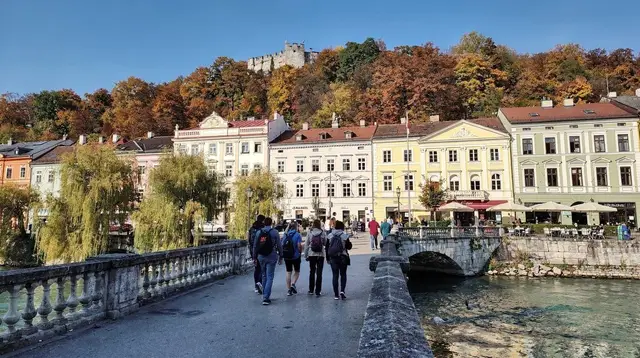
I don’t say that to score a trivia point. Ljubljana’s own Roman settlement, Emona, is old too. But Ptuj — Roman Poetovio — has a continuous urban record that predates it, sitting on a river crossing that Rome fortified for the same reason anyone would: whoever holds this bend of the Drava controls the road east. Walk the old town today and that logic is still legible in the street plan, in the castle silhouette on the hill, in the medieval core that never got flattened by war or rebuilt into something generic. Ptuj looks like what it is: a place that has mattered, quietly, for two thousand years.
What Actually Sits on That Hill
The castle above the town is worth the climb on its own — not for scale, it’s not Bled’s fairy-tale silhouette, but for the museum inside, which holds one of the better collections of historical instruments and folk masks in the country. Below the castle, the old town is compact enough to see properly in an afternoon: a main square, a scatter of churches, and the Drava sliding past at the bottom of the hill, wide and unhurried in a way the Ljubljanica never quite manages.
I mention this because Ptuj rewards exactly the kind of unstructured wandering that Ljubljana’s old town, however lovely, doesn’t really allow anymore in high season. There’s no equivalent of dodging tour groups on the Triple Bridge. You get the streets mostly to yourself, which either sounds appealing or sounds like a warning that there isn’t much here — and I want to be honest that it’s a bit of both. Ptuj isn’t a day of nonstop sights. It’s a town you let sit with you for a few hours, the same way you’d let a smaller Slovenian wine village like Šmartno reveal itself slowly rather than rushing it.
The Carnival That Should Have Made This Town Famous
Here’s the part that actually should have put Ptuj on every Slovenia shortlist: Kurentovanje, the town’s carnival, is inscribed on UNESCO’s Representative List of the Intangible Cultural Heritage of Humanity. I want to be direct about this because I’ve read too many travel write-ups that mention the Kurent in passing, as a quaint local costume parade, and move on. That framing undersells it, and it’s worth correcting rather than repeating.
The Kurenti are the costumed figures at the center of the tradition — sheepskin suits, cow-bell belts, wooden-horned masks, a physical presence built to be heard as much as seen. They go door to door and through the streets in the days before Ash Wednesday, and the ritual behind it is pre-Christian: driving out winter, clearing the way for spring, noise as a form of protection. UNESCO doesn’t hand out intangible heritage status to charming local customs. It’s the same list that protects flamenco, the Mediterranean diet, and reggae music — practices judged significant enough that losing them would be a loss for everyone, not just the community that keeps them. Ptuj’s carnival sits in that company.
If your dates line up with the run-up to Ash Wednesday, this is reason enough on its own to route east. If they don’t, you’ll still see the Kurenti’s presence everywhere in the town — in the castle’s mask collection, in shopfronts, in a local’s willingness to explain the ritual to you over coffee, which is how I first heard the full version of it myself, well after I thought I already understood the carnival from a paragraph in an old guidebook.
Where Ptuj Fits, and Where It Doesn’t
I want to be precise about what I’m arguing here, because it’s easy to overcorrect. I’m not telling you to swap Bled or Postojna for Ptuj on a first trip — the crowds at those places exist for good reasons, and if you’re asking how many days in Slovenia you actually need, three or four is still not enough time to add a two-hour detour east. Ptuj is a second-trip town, or a slower, week-long itinerary town.
Where it does fit naturally is alongside the country’s eastern wine regions. Ptuj sits closer to Maribor than to the capital, in the same stretch of Slovenia as Celje and the mining town of Idrija, and it’s routinely folded into the itinerary most people already build for that side of the country. I’ve deliberately kept the turn-by-turn planning for that pairing out of this piece — if you want the practical route through the vineyards, including where Ptuj slots in, that’s covered properly on the Slovenian wine trail itinerary rather than here.
What I wanted to do here instead was make the case for the town on its own terms: as the oldest place in a country whose independence itself is barely three and a half decades old, and as the home of a carnival that carries the same UNESCO recognition as traditions most travelers would never think to call “just folklore.” A countryside wine and food tasting through this part of Slovenia is one of the easier ways to see Ptuj without building a whole separate trip around it, and if you’d rather explore a smaller village on foot first, a guided walk through Šmartno gives you the same slower, uncrowded pace before you ever reach Ptuj itself.
It won’t replace Bled or Ljubljana on your must-see list, and it isn’t trying to. It’s the town you go back for once you’ve stopped needing Slovenia to prove itself to you — a bit like adding a day out to Lipica and the coast once the headline stops being new. For what it’s worth, my own notes on Plečnik’s UNESCO-listed Ljubljana started from the same instinct: the places that shaped this country aren’t always the ones getting photographed.
The Oldest Town in Slovenia, Answered
Why is Ptuj important if it’s not on most Slovenia itineraries?
Ptuj is Slovenia’s oldest documented town, founded by the Romans as Poetovio on the Drava river. Its Kurent carnival, Kurentovanje, is inscribed on UNESCO’s Representative List of the Intangible Cultural Heritage of Humanity, yet it barely registers next to Ljubljana and Bled in most guides.
Is the Kurent carnival just a local folklore show?
No. Kurentovanje is recognized by UNESCO as intangible cultural heritage of humanity, the same category that protects traditions like flamenco or reggae. It is a living pre-Christian ritual, not a staged tourist reenactment.
When does the Kurent carnival happen in Ptuj?
Kurentovanje runs in the run-up to Ash Wednesday, so the dates shift with the church calendar every year — usually somewhere in February. Outside that window, Ptuj is quiet, which is exactly why I’d still send you there.
How far is Ptuj from Ljubljana?
Ptuj sits in eastern Slovenia, roughly two hours from Ljubljana, closer to Maribor than to the capital. It’s usually folded into a day heading further east rather than visited on its own.
What makes Ptuj older than Ljubljana?
Ptuj was documented as the Roman town of Poetovio, making it the oldest town in Slovenia with continuous urban life on record — older than Ljubljana’s own Roman settlement, Emona.
Can I combine Ptuj with the Slovenian wine regions?
Yes, and that’s the itinerary most visitors actually use. I’ve kept the practical route planning for that pairing separate — see the dedicated wine trail itinerary linked here.
Is Ptuj worth visiting if I only have a few days in Slovenia?
If you have three days or fewer, I’d still send you to Ljubljana, Bled and Postojna first. Ptuj earns its place on a second or third visit, or on a slower, week-long trip through the east.
tours.Local voices
Verified deep-linked GetYourGuide tours. Book through these links and we earn a small commission at no cost to you.
GetYourGuide does not provide a product photo for this activity — the image shows the meeting point, photographed by us.