Slovenia’s Second City Is Built Around a Vine
Most itineraries treat Slovenia as Ljubljana plus a ring of day trips: Bled, the Karst, maybe the coast. Maribor sits outside that ring, far enough east that it rarely gets squeezed into a Ljubljana-based week, which is exactly why it rewards travelers who go looking for it. It is Slovenia’s second-largest city, spread along the Drava river at the foot of the Pohorje hills, and its identity is not built around a castle or a lake but around a single, specific, still-living plant: a vine over 400 years old, rooted against the wall of a house on the Lent embankment, that still produces grapes and still gets pressed into wine every year.
That last point is worth stating plainly, because it is the detail most visitors get wrong before they arrive. This is not a preserved specimen kept alive for photographs, and it is not a symbolic gesture the way a ceremonial tree might be. It is a working grapevine that a wine city continues to harvest, in public, on a fixed date each autumn, and has done so for centuries. Everything else in Maribor, from its wine cellars to its hillside villages, sits in the shadow of that one fact.
This page treats Maribor as a base for the eastern half of a Slovenia trip, not as a stop to squeeze into a Ljubljana day. It does not go deep on Ptuj, the country’s oldest town, or on Celje, the other major stop on the same route east — both get their own pages, and both are worth a dedicated look. What follows is Maribor on its own terms: the vine, the old town, the wine hills around it, and how to fit the city into a longer route through Slovenia’s wine country.
| At a glance | Maribor |
|---|---|
| Position | Second-largest city in Slovenia, on the Drava river |
| Known for | The world’s oldest vine still producing wine (400+ years) |
| Distance from Ljubljana | ~130 km, about 1h20 by car |
| Pairs well with | Ptuj (30-40 min), Celje (on the way from Ljubljana), Graz, Austria |
| Time needed | 1-2 days for the city and its immediate wine hills |
The Old Vine House and a Vine That Refuses to Retire
The Old Vine House (Hiša Stare trte) sits on Lent, Maribor’s riverside quarter, and the vine trained along its outer wall is the reason people put Maribor on a map at all. It has been growing in the same spot for more than 400 years, through the collapse and reconstruction of empires, and it still gets harvested every year in a public ceremony rather than a private one.
The grape variety, an old, dark local cultivar, produces only a small amount of wine each vintage, and a share of every bottle traditionally goes to visiting dignitaries as a gift rather than to a shop shelf. It is a working part of the city’s wine identity, not a museum piece behind glass, and the small exhibition inside the house explains that continuity in more detail than a walk-by ever could.
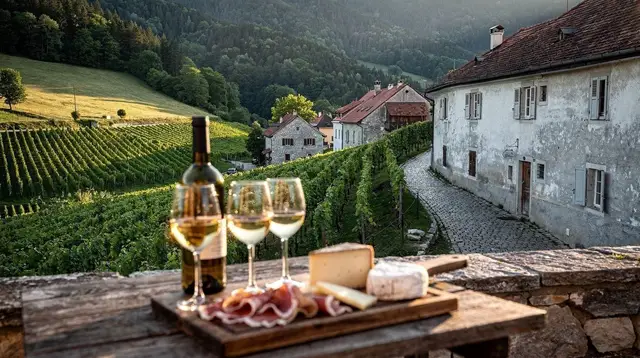
That same idea, an old vine that still earns its keep, extends into the wine hills that ring the city. Maribor’s own hills, generally referred to locally as the Maribor wine district or the Slovenske Gorice, produce whites that rarely travel far outside Slovenia and Austria, which is part of the appeal for travelers who already know the more exported wines of Vipava or the coast. A tasting built around the historic vine and its neighboring cellars is the single most efficient way to understand why this city calls itself a wine capital rather than merely a city that happens to have vineyards nearby.
an aroma-led wine tasting experience just outside Maribor is built around exactly that context, walking through the character of the local varieties rather than treating the tasting as a generic pour-and-move-on stop.
Lent and the Old Town, on Foot
Lent, the embankment where the old vine grows, is also where Maribor’s old town meets the Drava. It is a compact, walkable stretch of riverside cafés, the Water Tower, the Judgment Tower, and views across to Pohorje, and in summer it hosts one of the city’s biggest cultural events, the Lent arts festival, with music and performance spilling along the quay. Away from the river, the historic core climbs gently toward Glavni trg, the main square, past the cathedral and Maribor Castle, whose museum covers the city’s history from the medieval period through the Habsburg era.
None of this takes long to walk through on your own, but Maribor’s history is layered in a way that rewards a guide rather than a guidebook: the city sat on shifting borders between Austrian, Hungarian, and Slovenian influence for centuries, and that back-and-forth shaped the mix of Baroque, medieval, and 19th-century architecture that survives in the old town today.
a guided walk through Maribor’s old town, from its medieval core to its modern layers is the most efficient way to get that context without piecing it together from plaques.
Getting to Maribor from Ljubljana
Maribor is roughly 130 km northeast of Ljubljana, and the A1 motorway covers it in about an hour and twenty minutes when traffic behaves. A valid e-vignette on the windshield is required for any Slovenian motorway, and it is worth sorting out before you leave rather than at a service station on the way; the Slovenia vignette guide covers which category applies to a standard rental car. If you are renting specifically for this leg of the trip, the car rental guide covers what to check before you sign.
If you would rather not drive, the train is a reasonable option: Ljubljana to Maribor runs in roughly 1h45 to 2 hours depending on the service, arriving close to the old town, which makes a car unnecessary once you are there. The Slovenia train guide has the practical details, and intercity buses cover the same route on a different schedule, laid out in the intercity bus guide. Either way, budget for a full travel morning if you are coming from Ljubljana and want a proper afternoon in Maribor rather than a rushed one.
Maribor’s Wine Hills, and How They Differ from the West
Slovenia’s wine country is not a single region, and Maribor sits at the opposite end of it from the country’s better-known western vineyards. Out west, Vipava Valley and Goriška Brda sit close to the Italian border, share a Mediterranean-leaning climate, and produce wines that overlap in style with nearby Collio and Friuli.
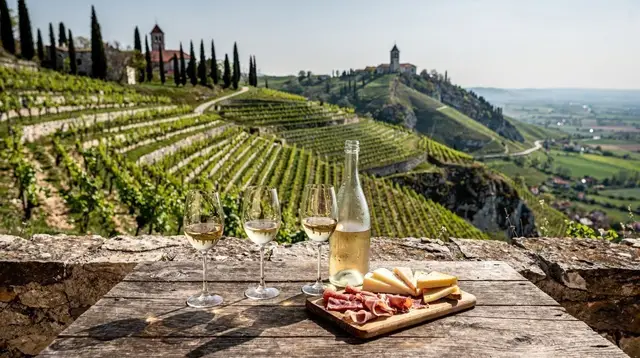
Maribor’s hills sit in the opposite corner of the country, closer to Austria than to Italy, cooler, and shaped by a continental climate that suits crisp, aromatic whites rather than the richer reds more common in the west. The Slovenia wine regions overview lays out how the country’s wine map divides, which is worth reading before you decide whether Maribor or the western valleys fit your route better, or whether you have time for both.
A wine-focused day around Maribor typically means a short drive into the surrounding hills, a stop at a family cellar or two, and a meal built around the same local ingredients as the wine. a countryside tour through the Styria wine roads with tastings along the way covers that ground without requiring you to plan the route yourself, and it doubles as a useful introduction to a region, historic Styria, that stretches across the modern Slovenian-Austrian border.
If your interest runs more toward a specific style, an orange wine tasting session with a sommelier is a good way to understand a wine tradition that is more visible in Slovenia than in most of Western Europe, or a paint-and-wine evening is a lighter option for an evening that does not need to be an education. Either fits into an overnight stay more comfortably than into a rushed day trip.
One Day, or Two?
A single focused day in Maribor covers the old town, Lent and the Old Vine House, and one wine tasting, and it is realistic if you are driving in and back out to Ljubljana or continuing east the same evening. Two days opens up the wine hills properly, gives you room for the Pohorje foothills above the city, which shift from summer hiking and mountain biking to a small ski area in winter, and leaves space to add Ptuj as a half-day trip without feeling rushed.
The how many days in Slovenia guide is useful for slotting Maribor into a longer national itinerary rather than treating it as an isolated stop, and the Slovenian wine trail itinerary sketches a multi-day route that links Maribor with the country’s other wine regions rather than treating it in isolation.
Autumn changes the calculation. If your trip lines up with late September, the Old Vine Festival turns the harvest of that 400-year-old vine into a public event, with a formal ceremony, folk costume, and the first pressing offered to honored guests, and it is worth building a day around rather than stumbling into by accident. The Slovenia in autumn guide covers what else shifts into gear at the same time of year, including harvest activity across the country’s other wine regions.
Pairing Maribor with Ptuj, Celje, and Graz
Maribor rarely works best as a solitary stop, and most travelers who make the trip east from Ljubljana build it into a short chain of stops rather than a single destination. Ptuj, Slovenia’s oldest town, is only about 30 to 40 minutes away and pairs naturally with Maribor as a half-day add-on, particularly if your visit overlaps with its UNESCO-listed Kurent carnival tradition, covered in the Ptuj Kurent carnival heritage guide. Celje, with its medieval counts and hilltop castle ruins, sits roughly on the route between Ljubljana and Maribor and works well as a stop on the way in either direction rather than a separate trip.
Maribor also sits close enough to the Austrian border that a cross-border day is genuinely practical rather than a stretch: Graz, Austria’s second city, is under an hour away, and the two cities share the historic Styria wine tradition even though a national border now runs between them.
a day trip that links Maribor and Graz across the border is a straightforward way to see both without renting a car specifically for the crossing, and it makes a useful bridge if your trip is continuing north into Austria rather than looping back to Ljubljana. For activity options around the city beyond what is covered here, the things to do in Maribor page lists the fuller range, from cellar visits to river-based options along the Drava.
Maribor Wine Country: Questions Before You Go
Is the old vine in Maribor really still producing wine?
Yes. The vine on the facade of the Old Vine House, on Maribor’s Lent embankment, is more than 400 years old and is still harvested every year. It is not a preserved relic or a decorative planting; it produces a small batch of wine annually, some of which is bottled and given as a ceremonial gift to visiting dignitaries.
How far is Maribor from Ljubljana, and how do you get there?
Maribor is roughly 130 km northeast of Ljubljana. By car on the A1 motorway it takes about 1h20, and you will need a valid e-vignette on the windshield. By train it takes around 1h45 to 2 hours, and intercity buses cover the route as well.
Can Maribor be a day trip from Ljubljana, or does it need an overnight stay?
Both work. A focused day covers the old town, the Old Vine House, and one wine tasting. An overnight stay gives you time for the wine hills outside the city, the Pohorje foothills, or a side trip to Ptuj, which is much harder to fit into a single day alongside Maribor.
What’s the difference between Maribor, Ptuj, and Celje?
Maribor is Slovenia’s second-largest city and its wine capital, built around the Drava river. Ptuj, a short drive away, is the country’s oldest town, with a hilltop castle and the UNESCO-listed Kurent carnival. Celje sits between the two, known for its medieval counts and hilltop castle ruins. Each makes a distinct half-day or full-day stop.
When is the best time to visit Maribor for wine?
Late September, around the Old Vine Festival, when the historic vine is harvested in a public ceremony and the surrounding hills are mid-harvest. For a quieter visit with the same access to wine cellars and tastings, aim for May, June, or early October.
Is Maribor worth combining with a trip to Graz, Austria?
Many visitors do combine them, since Maribor sits close to the Austrian border and shares the historical Styria wine region with Graz. It works well as a two-country day built around wine, rather than as a rushed add-on to a Ljubljana-based itinerary.
Do I need a car to visit Maribor and its wine hills?
Not to reach Maribor itself, since train and bus connections from Ljubljana are reliable. The wine hills and villages around the city are easier with a car or an organized tour, though several tastings and the old town are entirely walkable without one.