The Plečnik UNESCO Listing: What It Actually Covers
What did UNESCO actually list in Ljubljana?
On 31 July 2021, UNESCO inscribed 'The Works of Jože Plečnik in Ljubljana – Human Centred Urban Design' as a World Heritage Site. It covers a connected set of squares, parks, the Ljubljanica riverside and its bridges, the Central Market, the National and University Library, several churches, and the Žale funerary complex — not just the Triple Bridge.
A Listing That Isn’t About One Bridge
Most visitors who cross the Triple Bridge in Ljubljana know, vaguely, that it has something to do with UNESCO. Fewer realize how much they’re missing by stopping there. The bridge is a single, photogenic fragment of a much larger inscription — one that covers squares, riverside quays, a covered market, a library, several churches, city parks, and a cemetery complex on the far side of town. Walk only the postcard route along the river and you will have seen perhaps a third of what UNESCO actually recognized in 2021.
This page is about that recognition itself: what got listed, why it was listed as a single connected work rather than a historic district, and what it means when you’re standing in front of a market hall or a library trying to understand why it matters. If you want a walking route through central Ljubljana built around this legacy, the dedicated Plečnik walking guide covers that ground. If you want the library on its own, there’s a separate guide to the National and University Library. Here, the question is narrower and, in a way, more useful: what exactly did the World Heritage Committee agree to protect, and where is all of it?
“Human-Centred Urban Design”: The Official Listing
On 31 July 2021, during the 44th session of the UNESCO World Heritage Committee, Ljubljana’s centre gained a new designation: “The Works of Jože Plečnik in Ljubljana – Human Centred Urban Design.” The title matters more than it might seem. UNESCO wasn’t recognizing a historic town centre the way it might for a medieval walled city — Ljubljana’s old town, on its own, is handsome but not exceptional by European standards. What it was recognizing was a design philosophy applied consistently across an entire capital by one architect, over more than three decades, at every scale from a lamppost to a library.
That distinction shapes everything about the listing. Rather than drawing a boundary around the old town and calling everything inside it protected, UNESCO named a specific set of sites and structures — a list, not a zone. Some of those sites sit right next to each other along the river. Others, like Žale, are several kilometres away, in what feels like a completely different part of the city. What connects them isn’t geography. It’s the same hand, and the same underlying idea: that a city’s public spaces should be designed around how people actually move through and use them, not around monumental effect for its own sake.
Plečnik himself worked without a single master plan handed down in advance. He renovated Ljubljana piece by piece, project by project, often responding to specific requests from the city — a market needed rebuilding, a riverside needed embankments, a cemetery needed reorganizing — and used each commission to extend the same visual and structural language a little further across the city. UNESCO’s listing is, in effect, a recognition of that accumulated, decentralized process as a coherent body of work.
What the Inscription Actually Covers
Here is the core of what’s misunderstood most often: the listed elements span several distinct categories, not just “the riverside.” A simplified overview:
| Category | What it includes | Where |
|---|---|---|
| Bridges and riverside | Triple Bridge, Cobblers’ Bridge, the river embankments and quays | Along the Ljubljanica through the centre |
| Public squares | Squares reshaped around the Triple Bridge and along the processional route toward the market | Central Ljubljana |
| Central Market | Covered market halls, colonnade, and riverside market structures | Along the river, behind the cathedral |
| National and University Library | The building and its reading room, widely seen as Plečnik’s masterpiece | Near the old town |
| Churches | Several churches redesigned or completed with Plečnik’s interiors and furnishings | Scattered across the city |
| Parks | Public green spaces reshaped as part of the wider urban design | Central Ljubljana |
| Žale funerary complex | Cemetery entrance, chapel pavilions, and grounds | Northern edge of the city |
None of these figures should be read as a complete, official catalogue — UNESCO’s own documentation lists specific structures and boundaries in more technical detail than fits a travel guide. What matters for a visitor is the shape of it: this is a listing that follows one designer’s hand across an entire city, not a fence around a single neighbourhood.
The Squares and the Route Toward the Market
Plečnik’s most visible urban intervention is the sequence of spaces that lead from the Triple Bridge toward Prešeren Square and onward to the Central Market. He didn’t just build the bridge; he reshaped the approach to it, extended sightlines, and controlled how the space opens up as you walk through it. This is the part of the listing most visitors experience without realizing they’re inside it — the paving, the balustrades, the pyramid-topped columns near the bridge, the way the space narrows and widens as you move.
It’s worth slowing down here rather than treating it as a photo stop on the way to somewhere else. A short stay based centrally makes this easy to do more than once, at different times of day — the guide to where to stay in Ljubljana covers neighbourhoods within easy walking distance of this stretch.
The Riverside, the Quays, and the Bridges
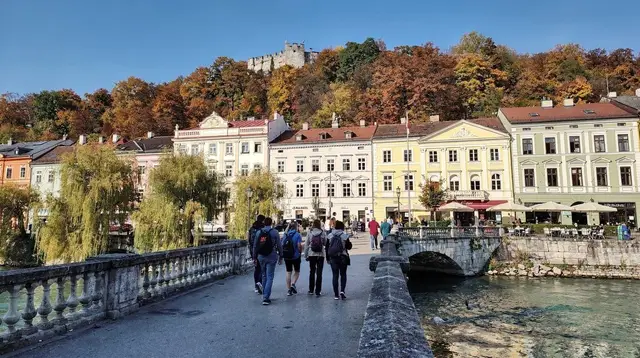
The embankments along the Ljubljanica are as much a part of the listing as the bridges themselves. Before Plečnik’s work, the river had a more utilitarian relationship with the city; his redesign turned the quays into a place to walk, sit, and look, lined with willow trees and lower terraces closer to the water. The Triple Bridge — three linked spans replacing a single older bridge — is the most photographed result, but the Cobblers’ Bridge downstream, with its rows of columns, is arguably a purer expression of the same idea: a bridge treated as a place to linger, not just a way to cross.
A river cruise along the Ljubljanica gives a different angle on this same stretch — worth doing once you’ve walked it, since the water-level view makes clear how much of the embankment design was built to be seen and used from the river, not only from above.
The Central Market: A Building That Doesn’t Look Like a Market
The Central Market complex is one of the inscription’s more surprising inclusions for first-time visitors, mostly because it doesn’t look like what people expect a “market” to be. Plečnik designed a long covered colonnade running along the riverside, connected to market halls, with a butchers’ bridge crossing the water nearby. The result reads more like a piece of civic architecture than a functional shed for selling produce — which was exactly the point. Plečnik treated an everyday commercial building with the same seriousness he gave a library or a church, and that’s a meaningful part of what “human-centred” means in the listing’s title: dignity applied to ordinary daily use, not reserved for monuments.
The market is still a working market today, which makes it one of the few UNESCO-listed structures in the city you can walk through on an entirely mundane errand.
The National and University Library — Briefly
The National and University Library (NUK) is widely considered the single most important building in the listing, and it deserves more space than a section here can give it — the dedicated guide to the library covers its reading room, its symbolism, and how to visit. For the purposes of understanding the UNESCO inscription as a whole, what matters is this: NUK, completed in 1941, is treated as the culmination of Plečnik’s approach — the building where his ideas about light, material, and procession through space reach their fullest expression. Its inclusion is not incidental to the listing; in many summaries of the inscription, it’s treated as the anchor point.
Žale: The Part Almost Everyone Skips
Ask a visitor walking the Triple Bridge whether they plan to see Žale, and most will have no idea what you’re talking about. Žale is Ljubljana’s main cemetery complex, on the northern edge of the city, and Plečnik redesigned it from the late 1930s onward — a monumental entrance gate, a series of individual chapel pavilions for different denominations and communities, and grounds laid out with the same attention to procession and pacing found in his central-city work.
Its inclusion in the UNESCO listing is, in a way, the clearest evidence that this inscription isn’t about tourist-facing monuments. A cemetery isn’t designed to impress visitors; it’s designed for grief, ritual, and remembrance, repeated over generations. That Plečnik applied his full design vocabulary here — not scaled down, not simplified — is exactly what “human-centred” is meant to convey: design that serves the person using the space, whether that person is a tourist crossing a bridge or a family visiting a grave.
Žale sits outside the usual old-town walking loop, which is precisely why it’s the piece most travel itineraries leave out. It rewards a deliberate detour rather than a passing glance.
Parks and the Quieter Green Spaces
Beyond the built structures, the listing also recognizes several of Plečnik’s park and green-space designs within the city. These tend to be the least dramatic parts of the inscription and the easiest to underrate — a reshaped path, a line of trees, a change in level that guides how people move through a space rather than announcing itself. They’re worth folding into a longer stay rather than treating as a separate errand; if you’re building out multiple days in the city, the itinerary for two days in Ljubljana or the three-day version both leave room to wander through them without turning the day into a checklist.
Why Plečnik, and Why Ljubljana
Jože Plečnik was born in Ljubljana in 1872 and trained as an architect in Vienna under Otto Wagner, absorbing a design sensibility rooted in Central European classicism reworked for modern use. His career took him to Prague, where he worked for years on renovations to Prague Castle at the invitation of the new Czechoslovak presidency — work that alone would have secured his reputation. He returned to Ljubljana in 1921, in the newly formed Kingdom of Serbs, Croats and Slovenes, and spent the rest of his working life, until his death in 1957, reshaping his home city.
That timing matters for understanding the scale of what he achieved. Ljubljana in the 1920s was a modest provincial capital, not a wealthy imperial city with an unlimited public budget. Plečnik worked project by project, often with limited resources, and used ideas repeated and refined across many small commissions rather than one grand unified scheme.
The 2021 UNESCO listing recognizes the cumulative result of that patient, decades-long process — and it sits alongside the broader story of a small nation building its own capital’s identity, a theme that also runs through the history of Slovenian independence, gained decades after Plečnik’s death but shaped by the same instinct to build something distinctly Slovenian rather than borrowed wholesale from elsewhere.
Seeing It for Yourself
Understanding the listing on paper is one thing; recognizing it while you’re walking through the city is another. A guided walk built specifically around the UNESCO-listed sites is the most efficient way to connect the pieces — a good guide will point out details that are genuinely easy to miss on your own, like the difference between a classical column and Plečnik’s reworking of one, or why a particular market roofline echoes a shape used elsewhere in the city.
a guided walk through Ljubljana’s UNESCO-listed sites, connecting the bridges, market and library into one route is the most direct way to do this, and it pairs naturally with independent time spent re-walking the same ground afterward at your own pace.
If you’re also planning trips outside the capital, Slovenia holds other UNESCO recognition worth knowing about — the Škočjan Caves, inscribed since 1986, are covered on a different kind of day trip entirely, and a day trip combining the Škočjan Caves with the old town of Piran makes a good contrast: one UNESCO listing built underground by water over millennia, the other built above ground by one architect over three decades.
For a first visit, the practical sequence that works best is simple: start with the old town walking guide to get oriented, spend unhurried time along the river and around the market, make the deliberate trip out to Žale rather than skipping it, and set aside a separate visit for the library rather than rushing it between other stops. If it’s your very first time in the city more broadly, the first-time-in-Ljubljana guide and the Ljubljana museums guide both fill in the context around what a single UNESCO-focused day leaves out.
None of this requires a full day set aside purely for “UNESCO sites” — the listed elements are woven through the same streets and river frontage most visitors already walk on their first day in the city. What changes, once you know what you’re looking at, is how much of it you actually notice.
tours.museums-art
Verified deep-linked GetYourGuide tours. Book through these links and we earn a small commission at no cost to you.
GetYourGuide does not provide a product photo for this activity — the image shows the meeting point, photographed by us.