Slovenia's Wine Trail: Vipava Valley to Goriška Brda and Maribor
Most visitors build a Slovenia trip around Lake Bled and the mountains, and never notice that the country’s wine regions sit just as close to Ljubljana. This itinerary flips that priority: three days spent among vines rather than lakes, tracing a line from the wind-swept Vipava Valley through the terraced hills of Goriška Brda to Maribor, home to the oldest producing grapevine on earth, with a short detour into Ptuj at the end.
It is a road trip by design. The wineries here are family cellars on rural hillsides, not tasting rooms clustered around a train station, and the payoff is exactly that: pouring rooms where the person behind the counter also pruned the vines outside. Get the timing right and this becomes one of the most rewarding three days in the country; get it wrong — say, a July visit expecting harvest color — and you’ll find handsome, green, thoroughly unripe vineyards instead. For background on the country’s wine map as a whole, the Slovenia wine regions overview is worth a skim before you leave Ljubljana.
Before You Set Off: Car, Timing and Season
This itinerary assumes a rental car picked up in Ljubljana. If you haven’t rented one yet, the renting a car in Slovenia guide covers what to expect, and the Slovenia vignette guide explains the electronic toll sticker you’ll need before joining the motorway — it’s sold online or at filling stations, never as a windshield sticker anymore, and driving without one is a real, enforced fine.
Season matters more here than almost anywhere else in the country. September into October is the harvest window for both the Vipava Valley and Goriška Brda: vines turn color, small producers are busiest and most interesting to visit, and the local food calendar fills with harvest lunches. The Slovenia in autumn guide lays out the broader seasonal picture. A summer visit still has plenty to offer — cooler cellars, quieter roads, easier restaurant bookings — but don’t expect grapes on the vine or a harvest atmosphere in July or August.
| Day | Region | Focus |
|---|---|---|
| Day 1 | Vipava Valley | Wind-shaped valley, whites, the burja |
| Day 2 | Goriška Brda | Terraced hills on the Italian border |
| Day 3 | Maribor + Ptuj | The world’s oldest vine, then a short old-town stop |
Day 1: The Vipava Valley
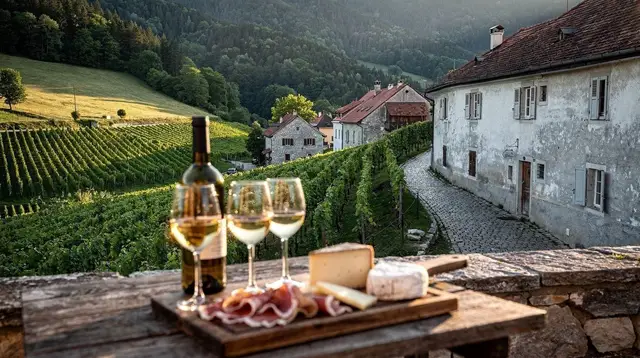
Leave Ljubljana in the morning; the drive to the Vipava Valley takes a bit over an hour on the A1 motorway before you drop down into the valley floor. The Vipava is a different landscape from anything else on this trip — a wide, open corridor running toward the Italian border, regularly swept by the burja, a cold, powerful wind that funnels down from the Nanos plateau. Locals will tell you the wind is why the wines taste the way they do: it keeps the air dry and the vines healthy without much need for spraying.
Spend the late morning and early afternoon moving between small producers. This is the kind of valley where the best plan is loose — pick two or three cellars rather than racing between five — and where a guided introduction pays off if you don’t already have addresses in hand. A guided wine tasting in the Vipava Valley is a straightforward way to taste across several styles in one sitting without needing to schedule each stop yourself. The Vipava Valley wine guide has more detail on the valley’s grape varieties and its handful of standout villages.
Overnight in or near the valley, or push on toward the Italian border in the late afternoon if you’d rather sleep closer to tomorrow’s route through Goriška Brda — the two regions are close enough that either works.
Day 2: Goriška Brda
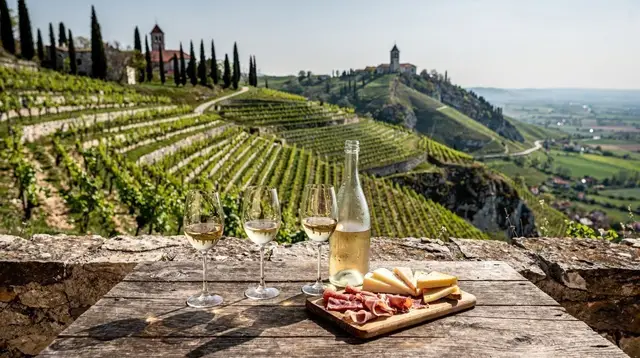
Goriška Brda sits just south of the Vipava Valley, and the change in landscape is immediate: instead of a flat valley floor, you’re driving switchbacks through steep, terraced hills, vineyards on every slope, with the Italian border running so close through the middle of the region that some producers farm plots on both sides of it without much ceremony about which country they’re technically in. It is often compared to Tuscany, and the comparison holds up better than most tourist-brochure comparisons do — the hills, the cypress-lined lanes and the light are genuinely similar.
Spend the day working through the region at a relaxed pace: a cellar visit in the morning, a hilltop village for lunch, another producer or two in the afternoon. Brda’s whites and its reds made from Merlot and Cabernet Sauvignon on limestone-clay soil are the reason serious wine drinkers make the detour at all. The Goriška Brda wine guide is the fuller reference for planning which villages and producers to prioritize if you have strong preferences going in.
There isn’t a fixed script for this day — unlike the more structured tastings elsewhere on this trip, Brda rewards simply driving the ridge roads and stopping where a sign or a view catches your eye. Overnight in the region if you can; waking up to vineyard fog rolling off the hills is one of the better mornings this itinerary offers.
Day 3: Maribor’s Oldest Vine, with a Detour to Ptuj
The drive from Goriška Brda to Maribor cuts across the width of Slovenia — from the Italian border to the edge of the Pannonian plain — so give yourself a good chunk of the morning for it. Maribor is Slovenia’s second city, and its single most famous attraction is almost absurdly modest in scale: a single grapevine trained along the facade of a house on the quay Lent, on the banks of the Drava. That vine is more than 400 years old and still produces grapes every year, making it the oldest documented, still-producing grapevine on earth. There’s a small dedicated house and exhibit next to it explaining how it has survived four centuries of wars, floods and neglect.
Beyond the vine itself, Maribor’s old town along the river is worth an unhurried walk, and the region around the city produces its own respected wines from the Štajerska hills nearby.
A wine aroma tasting experience near Maribor is a good way to taste locally without needing your own list of producers, and if you’d rather add something playful to the day, gold panning on the river near Maribor is a genuinely unusual half-day activity tied to the region’s mining history. The Maribor old-vine wine tasting guide has the practical details for visiting the vine house itself.
From Maribor, Ptuj is a short 25-to-30-minute drive and makes a natural final stop before heading back toward Ljubljana. This itinerary treats Ptuj briefly rather than as a full destination in its own right — it’s Slovenia’s oldest town, with a compact old town below a hilltop castle, and it’s worth an afternoon walk even outside of its famous Kurent carnival season. A guided walking tour of Ptuj’s historic center or a wine-hopping walk through Slovenia’s oldest town both fit into two or three hours before the drive home.
If Ptuj’s own layered history and its UNESCO-recognized Kurent carnival interest you beyond this quick stop, the Ptuj Kurent carnival heritage guide and the blog piece on Slovenia’s oldest town both cover it as a destination on its own terms — worth bookmarking for a separate trip.
From Ptuj, it’s roughly a two-hour drive back to Ljubljana on the motorway, which comfortably closes the loop by evening.
Fitting This Into a Longer Slovenia Trip
Three days is enough to do this trail properly without rushing, but it slots easily into a longer stay. Travelers building a full week around Ljubljana, Bled and the Julian Alps can bolt this wine trail on at either end — the Slovenia in one week itinerary shows how the pieces fit together, and the how many days in Slovenia guide is useful if you’re still deciding how much time the whole country deserves.
For travelers who care specifically about wine as a theme, this trail pairs naturally with a broader read of the Slovenia wine regions overview before you go, and with the worlds-oldest-vine blog piece for the fuller, stranger story of how Maribor’s vine survived as long as it has.
One practical note worth repeating: this route stays entirely within Slovenia and never touches the Croatian border, so it isn’t affected by the temporary border controls currently in place on Slovenia’s southeastern crossings — that’s only relevant if you’re continuing this trip on toward Zagreb.
Slovenia Wine Trail FAQ: Vipava, Goriška Brda and Maribor
When is the wine harvest in the Vipava Valley and Goriška Brda?
Grape picking runs roughly from early September into October, depending on the variety and the year’s weather. That window is also when the valleys look their best, with vines turning gold and red between the hills. Arriving in mid-summer means healthy green vines but no harvest atmosphere at all.
Do I need a car for this itinerary?
Yes. The wineries in the Vipava Valley and Goriška Brda are scattered across rural hillsides with no meaningful public transport between them, and Maribor is a separate drive again. This trail only works as a self-drive road trip or with a private driver.
What’s the difference between the Vipava Valley and Goriška Brda?
The Vipava Valley is a wide, breezy valley close to the Italian border known for its whites and its wind, the burja. Goriška Brda sits just south of it, a compact range of steep, terraced hills that Slovenes half-jokingly call Tuscany’s twin, and it straddles the Italian border so closely that some producers farm plots on both sides.
Do wine tastings need to be booked in advance?
Small family wineries in both valleys generally expect a call or an online booking rather than a walk-in visit, especially during harvest weeks when the cellar crew is picking grapes rather than pouring them. Guided tastings booked as a tour, such as a Vipava Valley wine tasting, remove that guesswork.
Can I see Maribor’s oldest vine and visit Ptuj on the same day?
Yes, they sit about 25 to 30 minutes apart by car, so a Maribor morning followed by a Ptuj afternoon fits into one day easily. This itinerary treats Ptuj as a short add-on rather than a full stop, since the town’s carnival heritage and old town deserve their own visit.
Do I need a vignette for this drive?
Yes, Slovenia’s motorways require an electronic vignette for any car, and it is bought online or at a filling station rather than as a paper sticker. Budget for it before picking up a rental car, since driving without one carries a real fine.
Is this route affected by the border checks with Croatia?
No, this itinerary stays entirely inside Slovenia and never approaches the Croatian border, so the temporary controls reinstated there do not apply here. They would only matter on a route continuing on toward Zagreb.
tours.wine-tasting
Verified deep-linked GetYourGuide tours. Book through these links and we earn a small commission at no cost to you.
GetYourGuide does not provide a product photo for this activity — the image shows the meeting point, photographed by us.