Ptuj and the Kurent: Slovenia's Oldest Carnival
What is the Kurent and when is Ptuj's carnival?
The Kurent is a shaggy sheepskin-and-horn figure from the Ptuj-Ormoz area, paraded from house to house to chase away winter and call in spring. Kurentovanje, the organized carnival in Ptuj, runs for about ten days each year and culminates on Shrove Tuesday (Pust), the date shifting between February and early March. The underlying custom, not the festival brand, is inscribed on UNESCO's Representative List of the Intangible Cultural Heritage of Humanity.
A carnival older than the town that hosts it
Every winter, in the streets of a town the Romans knew as Poetovio, a procession of shaggy, horned, bell-ringing figures shuffles from doorway to doorway. This is not a costume parade dreamed up for a tourist brochure. It is Kurentovanje, the Shrovetide carnival of Ptuj, and at its center is the Kurent: a masked figure whose sheepskin cloak, carved horns, and three bronze bells belong to a rural, pre-Christian custom that long predates any organized festival. The custom of villages “going from house to house” with Kurents is what earned a place on UNESCO’s Representative List of the Intangible Cultural Heritage of Humanity — the tradition itself, not a stage show built for visitors.
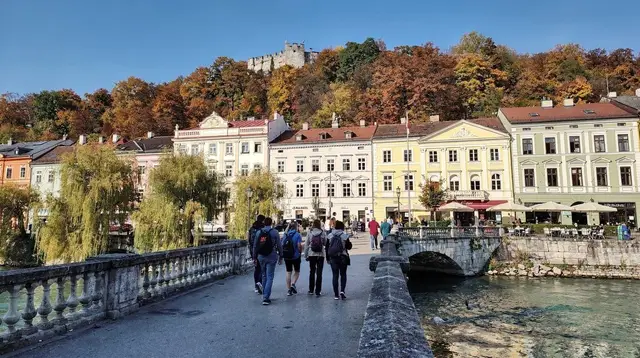
That distinction matters for anyone planning a trip around it. Ptuj is the oldest documented town in Slovenia, a Roman river crossing on the Drava that has been continuously inhabited for roughly two thousand years, with a hilltop castle, a walled old town, and Roman-era stonework still standing in its streets.
The carnival did not appear because Ptuj needed one; the carnival grew out of what the villages around it, and around neighboring Ormoz, had already been doing every winter for generations. This page is about that heritage specifically — what the Kurent is, why it is inscribed as intangible cultural heritage rather than sold as an invented attraction, when Kurentovanje happens, and how to see it properly if you build your Slovenia trip around the carnival season.
What a Kurent actually is
Strip away the crowds and the modern festival branding, and a Kurent is built from a handful of very specific, very old elements. The base is a full sheepskin cloak, worn shaggy side out, that covers the wearer from head to shin. On top sits a carved wooden mask — the korant or kurent mask — fitted with a snout, a long red tongue lolling out, and a pair of curved horns, sometimes flanked by feathers or ribbons depending on the village style.
Around the waist, a Kurent straps on ovceni zvonci, heavy bronze cowbells, usually three at a time, weighing several kilograms in total. The bells are not decoration: the entire point of the walk is the rolling, hip-driven gait that keeps them clanging continuously as the figure moves, a noise meant to physically drive winter out of a place.
Many Kurents also carry a jezevka, a wooden club or mace tipped with hedgehog skin and iron spikes. Older belief held that the spiked club could ward off evil spirits and misfortune from a household the Kurent visited — which is also why villagers traditionally welcomed Kurents into their farmyards rather than shooing them away. A Kurent rarely speaks; it grunts, growls, and rings its bells, moving in a half-dance, half-stagger that is exhausting to sustain for a full afternoon under a heavy sheepskin coat.
None of this reads like tourist theatre because it was not built as one. The costume elements — sheepskin, horns, bells, the spiked club — are a rural agrarian toolkit aimed at a specific job: chasing off the last of winter and inviting a good harvest and fertile year. Groups of Kurents historically went from house to house across the villages of the Ptuj-Ormoz area (Drava Statistical Region) in the weeks before Lent, and in many of those villages, they still do, independent of any organized city event.
The custom UNESCO recognized, not a festival brand
It is worth being precise about what carries the UNESCO inscription, because the distinction is exactly the trap this page is written to avoid. UNESCO’s Representative List protects the door-to-door rounds of the Kurents — the living custom practiced in specific villages, passed down through families and local groups who maintain their own mask-carving and costume-making traditions — rather than the public Kurentovanje festival that Ptuj now organizes and promotes each year. The city festival is the modern, visible showcase built around an older practice; the practice is what earned the heritage listing.
That sequencing runs the opposite way from a lot of “heritage tourism”: here the tradition came first, entirely outside of any tourism industry, and the organized event came later to give visitors a single time and place to witness something that otherwise happens scattered across dozens of villages on days that are not advertised. If you only see the parade in Ptuj’s old town, you are seeing a curated sample of something considerably larger and older that continues quietly in the surrounding countryside every year regardless of who is watching.
Kurentovanje: the festival in Ptuj
Kurentovanje is Ptuj’s public carnival, and it is where most visitors will actually encounter Kurents. It runs for roughly ten days, timed to end on Pust — Shrove Tuesday, the day before Ash Wednesday — which shifts with the date of Easter and can fall anywhere from early February to early March. Because the date moves every year, check the current Kurentovanje program before you build an itinerary around it rather than assuming a fixed calendar week.
During the festival, Ptuj’s old town closes its main streets to traffic for the parades. Groups of Kurents from villages across the region march alongside other traditional Shrovetide figures — orants (fertility figures carrying decorated eggs and baskets), pehta and baba characters, and increasingly, invited carnival groups from other countries — through streets lined with food stalls, mulled wine, and thousands of spectators. The largest parades typically fall on the final weekend and on Shrove Tuesday itself, when the numbers of both participants and visitors peak.
| What | Typical detail |
|---|---|
| Festival length | About 10 days, ending on Shrove Tuesday (Pust) |
| Timing | Moves yearly with Easter: early February to early March |
| Main parade days | Final Sunday and Shrove Tuesday |
| Setting | Ptuj old town, streets closed to traffic |
| Core figures | Kurents, orants, pehta, baba, plus guest carnival groups |
| Weather | Winter conditions: near or below freezing |
For the door-to-door village rounds rather than the city parade, timing and locations are set locally and are not centrally published the way the festival program is — a local guide who works with specific villages is the practical way to see that side of the tradition rather than only the Ptuj set-piece.
Meeting Kurents with a guide, not just from a barrier
Watching the parade from the street explains the spectacle but not much of the meaning behind it — why the bells, why hedgehog skin on the club, why sheepskin rather than any other material, why the rounds go to specific farms. A guided experience closes that gap. A local-led carnival experience in Ptuj puts you close to the Kurents themselves — hearing the bells at range, understanding the choreography of the walk, and getting the context a barrier-side view never provides. If your trip lands on the festival dates, this is the difference between watching a costume parade and understanding a ritual.
Outside the ten days of Kurentovanje, the tradition is still visible in Ptuj through the Kurent’s House (Hisa Kurentov), a small museum dedicated to the masks, costumes, and craft behind the figure. A guided walk through Ptuj’s old town with entry to the Kurent’s House is the reliable way to encounter the heritage on any date of the year, pairing the town’s Roman and medieval layers — its castle hill, its river crossing, its walled core — with the specific craftsmanship of mask-carving and sheepskin costume-making that keeps the custom alive between carnivals.
Beyond the carnival: Ptuj’s older layers
The Kurent tradition sits inside a town whose own history stretches back roughly two thousand years, to the Roman settlement of Poetovio on the Drava. Ptuj’s hilltop castle, its walled medieval old town, and Roman-era stonework scattered through its streets and museums are worth the visit even on a date with no parade scheduled. This page focuses on the festive heritage rather than a full city walk, but the two are inseparable in practice: the same narrow lanes that fill with bells and sheepskin every winter are the ones that have carried foot traffic since antiquity.
Ptuj also sits at the edge of the Haloze hills, one of Slovenia’s wine-growing landscapes, and the region rewards combining the carnival’s cultural weight with the area’s food and wine. A wine cellar tour through the Haloze hills near Ptuj is a natural pairing for a trip that already brings you this far east — the vineyards climb the same slopes that frame the town from a distance, and cellar visits run year-round, independent of carnival dates.
For a broader sense of what the region produces, see the overview of Slovenia’s wine regions, and for the country’s most famous single vine, the guide to Maribor’s old-vine wine tasting covers a very short detour from Ptuj.
How this heritage compares to Ljubljana’s UNESCO listing
Slovenia carries two very different UNESCO inscriptions within reach of a single trip, and it is worth not conflating them. The Kurent’s door-to-door rounds are intangible cultural heritage — a living custom, a practice people still do, not a building. Joze Plecnik’s urban work in Ljubljana — the Triple Bridge, the riverside markets, the National and University Library — is tangible heritage: fixed architecture inscribed for its design.
Visiting both on the same trip gives a useful contrast: one heritage listing you watch happen in real time on a cold February street, the other you walk through as stone and structure regardless of the season. If a broader tour of Slovenia’s UNESCO sites appeals, a guided UNESCO heritage tour based in Ljubljana covers the capital’s Plecnik landmarks as a companion piece to a Ptuj carnival trip.
Getting to Ptuj from Ljubljana
Ptuj sits roughly 140 km east of Ljubljana, near Slovenia’s border region with Croatia and Hungary, and it is comfortably a day trip or an overnight stop rather than a multi-day detour. By car, the A1 motorway covers most of the distance in about 1.5 hours; an electronic e-vinjeta is mandatory for any Slovenian motorway, so check the vignette guide before crossing the toll gantries, and see the car rental guide if you are picking up a vehicle for the trip.
Without a car, Slovenia’s train network connects Ljubljana to Ptuj with a change, usually at Pragersko or Maribor, in a broadly comparable travel time to driving once transfers are included.
During Kurentovanje itself, plan for reduced parking and closed streets in the old town on parade days, and arrive with enough buffer that a closed road does not cost you the parade’s start. Outside the festival window, Ptuj is a quiet, easy add-on to a wider eastern Slovenia route that might also take in Maribor or Celje.
When to go if the carnival is the point
If Kurentovanje itself is the reason for the trip, the only date that matters is Shrove Tuesday for that specific year, and the ten days that lead up to it — not a fixed week on the calendar. Build the trip around the current year’s confirmed program rather than a remembered date from a previous year.
For the wider seasonal picture of a February or early-March visit to Slovenia — what else is open, what is closed, and what the weather does elsewhere in the country at the same time — see the guide to Slovenia in winter and the month-by-month weather overview. Winter in the Julian Alps and winter in the flatter Drava valley around Ptuj are different climates entirely, and packing for one does not cover the other.
Travelers assembling a longer eastern loop sometimes fold Ptuj into a wine-focused route through the region; the Slovenian wine trail itinerary is one starting point for stitching Ptuj, Haloze, and Maribor together around a carnival-season visit or any other time of year.
Traditions and crafts worth watching for
Beyond the parade itself, Kurentovanje sits within a broader category of Slovenian folk custom that includes mask-carving, sheepskin tanning, and bell-founding as specialized, still-practiced crafts. Visitors interested in that thread rather than only the spectacle can look at the wider category of traditions and crafts activities across the country, or the history and heritage category for sites and experiences built around Slovenia’s older layers rather than its landscapes. Ptuj’s own activity listing at things to do in Ptuj rounds out the carnival-focused content on this page with the town’s other sights.
The takeaway
The Kurent is not a mascot invented to sell tickets; it is a sheepskin-and-horn figure from a specific corner of Slovenia, doing a job — driving out winter — that villages around Ptuj and Ormoz were already assigning it long before anyone organized a public festival. Kurentovanje in Ptuj is the visible, dated, bookable version of that custom, useful precisely because it gathers scattered village practice into ten days you can actually plan a trip around. See it as a window into something older and still living in the surrounding countryside, not as the whole of it, and the visit reads very differently than a photo of a horned costume ever could.
tours.history-heritage
Verified deep-linked GetYourGuide tours. Book through these links and we earn a small commission at no cost to you.
GetYourGuide does not provide a product photo for this activity — the image shows the meeting point, photographed by us.