Slovenia Without a Car: Is It Actually Possible?
Can you visit Slovenia's main sights without renting a car?
Yes. Ljubljana, Lake Bled and Postojna Cave are all connected by public bus or train in under 90 minutes each, and Ljubljana itself is fully walkable. A car mainly helps for remote Julian Alps valleys and rural wine roads, not for the country's headline stops.
The short answer: yes, more than most guides admit
Type “do I need a car in Slovenia” into any search engine and the loudest answers all say yes. Most of that advice comes from people who drove and never checked what the alternative actually looks like. The truth is quieter: Slovenia is roughly the size of Wales, its three headline stops — Ljubljana, Lake Bled and Postojna Cave — sit on the same public transport corridor, and none of them is more than about an hour from the capital by bus or train. A trip that never touches a steering wheel is not a compromise here. For a first visit built around the classics, it is a perfectly normal way to see the country.
Where the “you need a car” advice starts being right is at the edges of that corridor: Predjama Castle’s cliffside approach, the hairpins of the Vrsic Pass, the vineyard backroads of Goriska Brda. This guide draws that line clearly, so you can decide before you land whether to rent anything at all.
Why Slovenia’s size works in your favor
Slovenia covers about 20,271 square kilometers. From Ljubljana, Lake Bled is roughly 55 kilometers away, Postojna about 53 kilometers, and even Piran on the coast is only around 120 kilometers — distances that in a larger country would mean a real road trip, and here mean a short ride. That geography is the whole reason a car-free plan works: you’re never actually far from anything, you’re just choosing a different vehicle to close the gap. For a first-timer deciding how to structure the days, How Many Days in Slovenia and Ljubljana in Three Days both assume this same short hop logic and slot in well with a car-free plan.
Ljubljana: a capital built to be walked
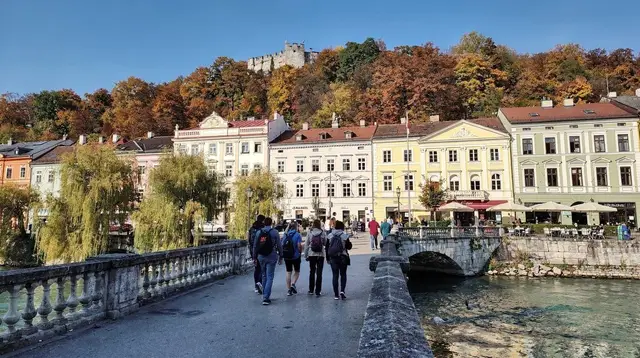
Start with the good news: the capital itself needs no transport plan at all. The historic core between the Triple Bridge and Presernov trg is closed to private traffic, and the castle hill, the riverside market and Metelkova all sit within a twenty-minute walk of one another. When the distance stretches past comfortable walking — out to Tivoli Park, say, or back from a late dinner — the city’s bus network takes over, paid with a rechargeable Urbana card rather than cash, which stopped working on board back in 2010.
For visitors who’d rather not think about fares at all, the Ljubljana Card bundles unlimited city buses with the castle funicular and entry, a river cruise and a bike rental into one pass, and Is the Ljubljana Card Worth It walks through when the math favors it. The full detail on buses, the free Kavalir shuttle and the Urbana card lives in Getting Around Ljubljana — worth reading before you arrive, not after.
If your trip revolves mainly around the capital and one or two nearby half-day trips, the Ljubljana City Card covering 30 attractions and public transport does double duty: it settles the bus question and the entry-fee question in a single purchase, which matters more when you’re not renting a car and can’t just drive to whatever’s included.
Reaching Lake Bled without driving
This is the trip car-free travelers worry about most, and it’s also the easiest to solve. Direct trains and buses run from Ljubljana to Bled in about 45 minutes to a little over an hour, depending on the service — trains land at Lesce-Bled, a short local bus ride from the lakeshore, while the direct bus drops you closer to the water at Bled Jezero. Neither option requires advance booking in the way Vintgar Gorge’s timed-entry ticket does once you’re there. The full timetable logic, including which station to pick and how to layer in Vintgar Gorge on the same day, is in How to Get to Bled Without a Car — this guide won’t repeat it step by step.
What public transport doesn’t solve neatly is the loop around Bled’s edges: reaching the pletna boat dock, walking the lake’s 6-kilometer perimeter, then continuing on to Vintgar Gorge or Radovljica in the same afternoon without backtracking. That’s the exact gap an organized day tour closes, since it strings the boat crossing, the church, the castle view and the gorge into one route with no timetable-watching. If a single day out to Bled is the whole plan, Bled Day Trip from Ljubljana lays out how a guided version compares to the DIY train-and-bus version.
One frequent point of confusion is worth flagging here rather than later: Bled and Bohinj are different lakes, twenty-some kilometers apart, and Bohinj’s bus connections from Ljubljana are thinner and slower than Bled’s. If Bohinj is on the list too, budget more transfer time than the distance on a map suggests, or fold it into a guided Bohinj Day Trip from Ljubljana instead.
Postojna, Predjama and the Karst without driving
Postojna Cave sits directly on the Ljubljana-Koper rail and road corridor, which makes it the single easiest big-ticket sight to reach without a car: trains and buses cover the roughly 53 kilometers in about 45 minutes to an hour, and the cave entrance is a short walk from the station in the town itself. Timed-entry tickets for the cave’s underground train ride are worth booking ahead regardless of how you arrive — that part has nothing to do with transport.
Predjama Castle is the wrinkle. It sits nine kilometers outside Postojna, built into a cliff face with no direct bus service connecting the two, so a purely public-transport day would need a taxi or a long walk to see both in one visit. This is the clearest example in this whole guide of a spot where an organized tour earns its price rather than merely adding convenience: nearly every group tour to Postojna already includes the short hop to Predjama, solving in one booking what public transport alone cannot. Postojna & Predjama Day Trip covers exactly this combination in more depth, and Getting to Postojna Without a Car has the train and bus specifics.
Skocjan Caves, further south and off the main rail line, are harder still by public transport — see Skocjan Caves Day Trip before assuming the same approach that works for Postojna will carry over.
Where public transport genuinely runs thin
Being honest about the limits matters more than padding out the good news, so here is the short list of places where Slovenia’s bus network stops being convenient:
- The Julian Alps’ high roads — the 50 hairpins of the Vrsic Pass and the drives around Kranjska Gora and the Soca Valley are built for cars; bus service exists but is sparse and seasonal, and the pass itself closes with the first real snow.
- Predjama Castle, as covered above, with no direct bus from Postojna.
- Velika Planina’s trailhead villages and the rural roads through Goriska Brda and the Vipava Valley wine country, where the appeal is precisely the kind of scattered, small-lane hopping that a timetable can’t match.
- Same-day round trips to the coast, which are physically possible but long — Piran is a genuinely full day out and back, better split across an overnight or handled as a guided loop.
For a trip that includes any of these, Car vs. Organized Tour in Slovenia and Renting a Car in Slovenia lay out the actual trade-off rather than treating a rental as automatic. If a short rental does end up making sense for two or three days in the Alps, remember the electronic vignette required on Slovenian motorways — Slovenia Vignette Guide covers the categories and current prices before you pick up the keys.
When an organized tour beats the timetable
Public buses and trains handle the point-to-point legs well. What they can’t do is chain several stops into one loop without dead time waiting at a transfer point — which is exactly what a day tour is built to solve. For the Karst and Predjama pairing above, or for reaching the coast and back in daylight, a guided option often costs less in time than it does in money.
The Slovenia in One Day tour is built for travelers with a single free day who want Bled, Postojna’s cave region and Ljubljana’s old town covered without juggling three separate tickets. Coming in from Zagreb without renting anything on either side of the border, the full-day best-of-Slovenia tour from Zagreb solves the cross-border leg and the Slovenian sightseeing in one booking — useful given that temporary border checks between Croatia and Slovenia remain in place through the end of 2026.
For the coast, where a same-day public transport round trip eats most of the daylight, the panoramic Slovenian coast tour to Piran covers the roughly 120-kilometer stretch without the return-bus math. And for the wine country east of the capital, where bus service is thinnest of all, the Ptuj wine-hopping tour reaches vineyards a timetable genuinely can’t.
Trains, buses, or both
Slovenia doesn’t force a single answer between rail and road. Trains are fast and comfortable on the corridor that matters most — Ljubljana to Postojna to Koper, plus the line toward Maribor — but they don’t reach Bled’s lakeshore, Bohinj, Kranjska Gora or most of the Karst villages directly. Buses fill essentially every gap trains leave, which is why most car-free itineraries end up mixing the two rather than committing to one.
Slovenia Train Guide and Slovenia Intercity Bus Guide cover the booking platforms, ticket types and seasonal timetables in full; this page is only about whether the network as a whole gets you where you’re going, and it does, for the destinations most visitors actually plan around.
| Destination | Without a car | Typical time from Ljubljana | Notes |
|---|---|---|---|
| Bled | Train or direct bus | 45 min – 1 hr 15 min | Two arrival points; pick the one closer to the lake |
| Postojna Cave | Train or bus | 45 min – 1 hr | Station is a short walk from the entrance |
| Predjama Castle | Taxi or organized tour | Add ~20 min from Postojna | No direct bus from Postojna |
| Piran / coast | Direct bus | 2 – 2.5 hrs | Long as a same-day round trip; consider staying over |
| Bohinj | Bus, fewer departures | 1.5 – 2 hrs | Slower and less frequent than the Bled route |
| Julian Alps (Vrsic, Soca Valley) | Limited seasonal bus | Varies widely | Realistically a car or organized tour route |
Arriving without a car in the first place
The plan holds together even before you reach Ljubljana itself. Public bus line 28 links Ljubljana Airport to the main bus station in roughly 45 to 55 minutes, departing every 30 to 60 minutes through the day — slower than a taxi or shuttle van, but perfectly workable if the first day has no fixed schedule. Ljubljana Airport Guide covers the shuttle and taxi alternatives and current fare ranges in more depth.
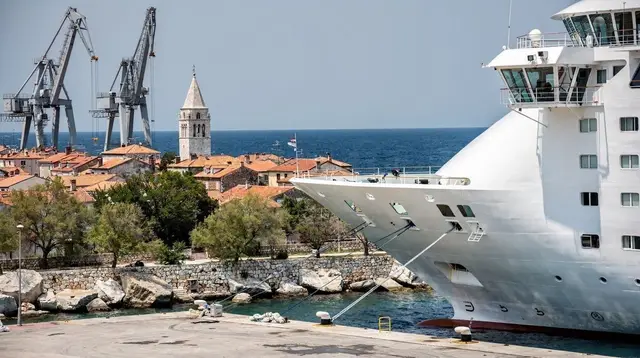
Arriving instead from Zagreb, Trieste or a cruise call at Koper works the same way: each has its own cross-border bus or train option, and Koper Cruise Port Guide is written specifically for the one-day version of that arrival.
What this actually costs versus renting
A week of trains and buses between Ljubljana, Bled and Postojna typically runs well under the cost of a rental car once you add the mandatory motorway vignette, fuel and parking — Bled’s central lot alone charges by the hour. It also removes two frequent car-related headaches entirely: there is no vignette to buy for a passenger on a bus, and no search for parking in Bled’s tightly managed center. Slovenia Daily Budget breaks down realistic transport costs alongside food and lodging if you’re building a full trip budget rather than judging this one question in isolation.
The realistic verdict
For a first trip anchored on Ljubljana, Lake Bled and Postojna Cave — the three stops that appear in nearly every Slovenia itinerary — public transport handles the job without asking you to drive on the right for the first time or hunt for parking in a medieval town center. The moment the plan stretches to the Vrsic Pass, the Soca Valley’s rafting put-ins, or the vineyard lanes of Goriska Brda, the calculation changes, and a short rental or a well-chosen organized tour becomes the more sensible tool rather than a concession. Decide which category your trip falls into before you land, and the “do I need a car” question answers itself.
Slovenia without a car: your remaining questions
Can I visit Lake Bled without renting a car?
Yes. Regular trains and buses run from Ljubljana to Bled in roughly 45 minutes to just over an hour, arriving at either Bled Jezero (lakeside) or Lesce-Bled (a short bus ride further out). Many visitors also book an organized day tour that includes the ride, a boat crossing to the island and a stop at Vintgar Gorge in one sitting.
Is it possible to see Postojna Cave without a car?
Yes. Postojna sits directly on the Ljubljana-Koper train and bus corridor, around 45 minutes to an hour from the capital, with the cave entrance a short walk from the station. Reaching neighboring Predjama Castle without a car is harder, since it has no direct public transport link, which is why most car-free visitors pair the two on an organized tour.
How do I get from Ljubljana Airport to the city without a car?
Public bus line 28 connects the airport to Ljubljana’s main bus station in roughly 45 to 55 minutes, running every 30 to 60 minutes through the day. Shuttle vans and taxis cover the same 25 kilometers faster for a higher fare.
Are trains or buses better for getting around Slovenia?
Trains suit the flat, well-served Ljubljana-Postojna-Koper line and the routes toward Maribor and Celje. Buses reach almost everywhere else, including Bled, Bohinj, Kranjska Gora and the Karst villages that trains skip, so most car-free itineraries end up mixing both.
Can I reach the Slovenian coast without driving?
Yes. Direct buses link Ljubljana to Piran, Portoroz and Koper in about two to two and a half hours, and Koper also sits on the rail line. It’s a longer day than Bled or Postojna, so an overnight stay or an organized coastal tour is usually more comfortable than a same-day round trip.
Do I need a car for a full week in Slovenia?
Not for a week built around Ljubljana, Bled, Bohinj, the Karst caves and the coast — all reachable by public transport or day tours. A car earns its cost mainly if the plan adds the Vrsic Pass, the Soca Valley or rural wine roads in the Vipava Valley and Goriska Brda, where bus service thins out.
What’s genuinely hard to reach without a car in Slovenia?
Predjama Castle, Velika Planina’s trailhead villages, the high Julian Alps roads around the Vrsic Pass, and the wine backroads of Goriska Brda and the Vipava Valley all have sparse or no direct bus service. These are the places where an organized tour or a short car rental genuinely changes what’s feasible in a day.
Is Ljubljana itself walkable without any transport at all?
Yes. The old town between the Triple Bridge and Presernov trg is closed to private cars, and most sights sit within a twenty-minute walk of each other. The free electric Kavalir shuttle and the citywide bus network, paid with an Urbana card, cover anything beyond comfortable walking distance.
Trip-planning essentials on GetYourGuide
Verified deep-linked GetYourGuide tours. Book through these links and we earn a small commission at no cost to you.
GetYourGuide does not provide a product photo for this activity — the image shows the meeting point, photographed by us.