Ljubljana, Lake Bled and Postojna Cave in 3 Days
Why This Trio Works in a Single Trip
Ask a dozen people what to see on a first trip to Slovenia and you will get the same three answers in some order: the capital, the lake, the cave. It is not a coincidence, and it is not just marketing — Ljubljana, Lake Bled and Postojna Cave sit inside a triangle small enough that you never need to pack a bag twice. Ljubljana to Bled is about 55 km, Ljubljana to Postojna about 53 km, and Bled to Postojna roughly an hour by car. That geography is the whole reason this itinerary works: one hotel, three very different days, and no time lost checking in and out.
This particular route deliberately leaves out the Adriatic coast and the deeper Julian Alps — Piran, Kranjska Gora and the Soca Valley each deserve at least a full day of their own, and cramming them in here would turn three unhurried days into three rushed ones. If you have a fourth day to spare, see Ljubljana in Four Days; if the mountains are the priority, the Julian Alps Adventure itinerary picks up where this one stops. For a first visit with limited time, though, this is the itinerary that answers the question “what should I actually see” without a debate.
You can do all three days with or without a rental car. Ljubljana itself is best on foot regardless — its old town is closed to traffic — and organized day trips to both Bled and Postojna run from the city center daily, which is the simplest option if you would rather not deal with parking or the electronic highway vignette. See Getting Around Slovenia Without a Car if that is your plan, or Renting a Car in Slovenia and the Slovenia Vignette Guide if you are driving yourself.
Before You Go: What to Book Ahead
Two things on this itinerary genuinely need advance planning, and everything else can be decided on the day.
Postojna Cave tickets are the one that trips people up. The official ticketing system requires choosing an exact date and time slot, which makes booking a day or two ahead a practical necessity rather than a suggestion — walk-up visitors in July and August routinely find the next available slot is hours away. If you would rather not manage the booking window yourself, an organized day trip to Postojna Cave from Ljubljana handles the timed entry as part of the package.
The second is Vintgar Gorge, which this itinerary does not include but which many travelers add onto their Bled day — it also runs on a timed-entry system and closes completely from roughly December to March, so check before assuming it is open. See the full list in What to Book in Advance in Slovenia.
Day 1: Ljubljana’s Old Town and Castle
Spend your first day entirely on foot in the capital. Ljubljana is small enough — around 285,000 people — that its historic core can be crossed in twenty minutes, which means you are never rushing between sights so much as strolling from one to the next.
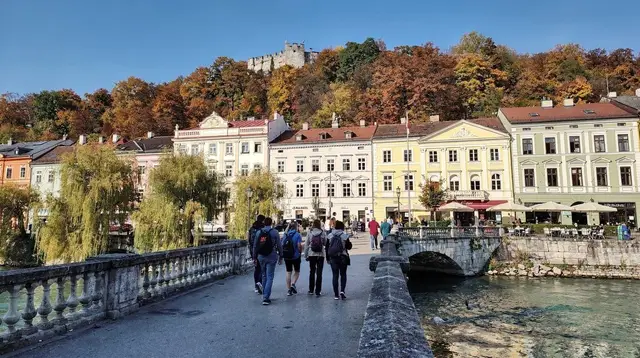
Start at Preseren Square and cross the Triple Bridge, one of architect Joze Plecnik’s signature works and the literal gateway into the old town. Plecnik reshaped this city more thoroughly than almost any architect has reshaped any European capital, and his work here — the bridge, the riverside embankments, the market colonnade, the National and University Library — was inscribed as a UNESCO World Heritage site on 31 July 2021. A slow walk through it is covered step by step in the Ljubljana Old Town Walking Guide and the dedicated Plecnik in Ljubljana guide.
From the old town, walk or ride the funiculaire up to Ljubljana Castle, perched on the hill above the Ljubljanica river. The funicular alone is 6 EUR return for an adult; a combined ticket covering the funicular and castle entry is 19 EUR. Walking up takes about fifteen minutes on marked paths and costs nothing, if you would rather save the funicular fare for later. The Ljubljana Castle guide breaks down what is included and what is worth skipping.
In the afternoon, browse the riverside market that Plecnik designed along the embankment, then cross back into Metelkova for a look at Ljubljana’s alternative, graffiti-covered side, or head to Tivoli Park if you want green space instead. If you plan to combine the castle with a guided walk, a river cruise and a handful of museums, work out the math with Is the Ljubljana Card Worth It — the Ljubljana Card bundles unlimited city buses, the funicular and castle entry, a guided city tour, a Ljubljanica river cruise, a bike rental and over twenty museums into one pass, and it pays for itself once you stack more than two or three paid sights into a single day.
If you would rather have a local narrate the city than read about it, a walking tour covers the same ground with running commentary on Plecnik’s design choices and the city’s history — the Ljubljana walking tour is built around exactly that first-afternoon orientation. For dinner, What to Eat in Ljubljana points you toward the riverside restaurants below the old town, and Where to Stay in Ljubljana is worth reading before you book, since staying inside or just outside the pedestrian zone makes the difference between a five-minute walk and a longer one on both other days.
Getting around the old town itself needs no plan at all beyond your own feet; if your legs need a break, the Kavalir — a small, free electric vehicle that seats up to five and runs from 6am to 10pm with no fixed stops — will pick you up if you flag it down.
Day 2: Lake Bled
Bled is the day this itinerary is built around, and it earns the reputation. The lake itself is small enough to walk around in about two hours — roughly 6 km — but most visitors spend the bulk of the day on the water and the hill rather than the shore path.
The classic move is the pletna boat out to the island: a traditional flat-bottomed boat rowed standing up by a local boatman, running around 20 EUR per adult round trip, with roughly a thirty-minute wait at the island before the return crossing. Bring cash, since boatmen are typically paid on the spot rather than through a ticket office. Once on the island, the Church of the Assumption charges a separate entry of around 12 EUR, which includes the bell tower and a small museum — note that these two figures are working estimates from consistent sources rather than a single published rate, since no operator publishes a centralized official price for the boatmen.
From the shore, look up at Bled Castle perched on its cliff — officially, adult entry is 19 EUR, with reduced rates for students, children and seniors. The Bled Castle guide has the full breakdown and the best photo angles, which the Best Photo Spots at Lake Bled guide expands on if photography is a priority for you.
If time allows after the lake, Vintgar Gorge is a short drive away and one of the most photogenic short walks in the country — a wooden walkway threaded along a narrow river canyon. It runs a timed-entry system with a single walking direction and mandatory helmets, and it is only open roughly April through November, so check the Vintgar Gorge guide before adding it to your day, since it will not fit alongside a full circuit of the lake if you are pressed for time.
Getting to Bled without your own car is straightforward: public buses run from Ljubljana’s main bus station, or an organized day tour to Lake Bled from Ljubljana handles transport both ways and usually stops at a viewpoint for photos before dropping you at the lakeshore.
If you are driving, How to Get to Bled Without a Car is written for the opposite case but its transit-timing notes are useful either way, and one clarification worth carrying in your back pocket: there is no entrance toll or congestion charge for driving into Bled — what does exist is paid parking in the central zone, so budget a few euros there rather than expecting a barrier at the town limits.
Day 3: Postojna Cave and Predjama Castle
Your last day heads underground. Postojna Cave is Slovenia’s most visited attraction for good reason: a network of caverns you enter partly by a small underground train, followed by a roughly ninety-minute walking tour past dramatic stalactite and stalagmite formations. Adult entry is 34.90 EUR for the cave alone.
The one rule that matters here: book a specific date and time before you go. The official ticketing system does not sell an open, walk-in ticket — you choose an exact entry slot when you book, which functions as a mandatory reservation in every practical sense. Arriving without one risks finding every slot for the day already gone, especially between June and September. The Postojna Cave Tickets and Tips guide walks through the booking screen step by step.
Pair the cave with Predjama Castle, just 9 km away and built directly into the mouth of a 123-meter cliff — it is the largest cave castle in the world, and almost every organized excursion visits both in the same day. A combined ticket for the cave and castle costs 49.90 EUR, a meaningful saving over the 58.90 EUR you would pay booking each separately. An organized tour covering both Postojna Cave and Predjama Castle is the easiest way to see both without juggling two separate timed bookings and the short drive between them.
Whatever you do, pack a light jacket. The cave sits at a constant 8 to 12 degrees Celsius year-round, and visitors in shorts and t-shirts in the middle of a Slovenian August are a running joke among the guides — dress for a cool spring evening, not for the weather outside.
If caves fascinate you and a fourth day is on the table, Skocjan Caves offers a genuinely different experience nearby — a vast natural underground canyon crossed by a suspended footbridge rather than a train ride, and UNESCO-listed since 1986. Photography is banned inside, unlike at Postojna, which the Postojna vs Skocjan Caves comparison covers in detail if you are deciding between the two.
Costs at a Glance
| Item | Price (adult, 2026) |
|---|---|
| Ljubljana Castle funicular return | 6 EUR |
| Ljubljana Castle + funicular combo | 19 EUR |
| Ljubljana Card, 24 hours | 41 EUR |
| Bled Castle entry | 19 EUR |
| Pletna boat to Bled island (return, estimate) | ~20 EUR |
| Church of the Assumption entry (estimate) | ~12 EUR |
| Vintgar Gorge (includes shuttle) | 15 EUR |
| Postojna Cave only | 34.90 EUR |
| Postojna Cave + Predjama Castle combo | 49.90 EUR |
Practical Notes for the Three Days
Slovenia uses the euro, so there is no currency conversion to plan around, and card payments are accepted almost everywhere except the pletna boatmen at Bled, who are typically paid in cash. If you are driving between any of these three stops, an electronic vignette is required on the highway network — a weekly pass for a standard car costs 16 EUR — and there is no paper sticker option anymore, only the electronic e-vinjeta registered to your plate. See the Slovenia Vignette Guide before you pick up a rental.
For a broader sense of how three days compares to a longer stay, How Many Days Do You Need in Slovenia lays out what gets added at four, five and seven days, and 3 Days vs 7 Days in Slovenia is a direct comparison if you are still deciding how long to stay. If your dates are flexible, Slovenia Weather by Month and Avoiding Crowds at Bled are both worth a look before you lock in flights, since Bled in particular changes character dramatically between a quiet October morning and a packed July afternoon.
Frequently Asked Questions About This 3-Day Slovenia Itinerary
Can you really see Ljubljana, Bled and Postojna in three days?
Yes. Ljubljana is about 55 km from Bled and 53 km from Postojna, and Bled to Postojna is roughly an hour’s drive, so all three fit comfortably around one base without wasted transit time.
Do you need a car for this itinerary?
No. Ljubljana’s old town is entirely walkable, and organized day trips run daily from the capital to both Bled and Postojna Cave, picking up centrally. A car gives more flexibility for stops like Predjama Castle but is not required.
Do you need to book Postojna Cave tickets in advance?
In practice, yes. The official booking system requires you to choose both a date and a specific entry time, so tickets are effectively timed-slot only. Booking a day or two ahead, especially in July and August, avoids arriving to find your preferred hour sold out.
Should you stay in Ljubljana for all three nights, or move to Bled?
For a three-day trip, staying in Ljubljana throughout is simpler and usually cheaper, since both Bled and Postojna are manageable as day trips. Moving your hotel for one night only makes sense if you want a sunrise or late-evening view of the lake without a bus schedule.
What’s the biggest mistake first-time visitors make on this route?
Underestimating Postojna Cave’s booking system and turning up without a timed slot, and packing only summer clothes for the cave, which sits at 8 to 12 degrees Celsius year-round regardless of how hot it is outside.
Is the Ljubljana Card worth buying for this itinerary?
It depends how much of Day 1 you spend on paid sights. The card bundles unlimited city buses, the castle funicular and entry, a guided walk, a river cruise, a bike rental and over twenty museums, so it pays off once you combine the castle with two or more other paid attractions in a day.
Can you combine Predjama Castle with Postojna Cave in one day?
Yes, and most organized excursions already do. The castle is only 9 km from the cave, and a combined ticket costs less than buying both separately, so pairing them is the normal way to spend Day 3.
What about Lake Bohinj or the Julian Alps — should they be added?
Not on a three-day trip. Bohinj and the Julian Alps each reward at least a full extra day of their own; see ljubljana-in-four-days or the dedicated Julian Alps itinerary if you can extend your stay.
tours.3 days
Verified deep-linked GetYourGuide tours. Book through these links and we earn a small commission at no cost to you.
GetYourGuide does not provide a product photo for this activity — the image shows the meeting point, photographed by us.