Renting a Car in Slovenia: Driving, Vignette and Pickup Guide
Do I need anything special to rent and drive a car in Slovenia?
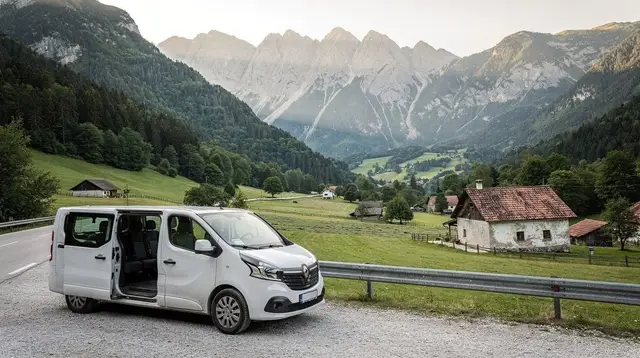
A valid driving licence and the usual rental paperwork are enough — Slovenia drives on the right, uses Type C and F plugs at 230V/50Hz, and almost every rental car comes without a motorway sticker. You must buy the electronic e-vinjeta before entering any motorway, since driving without one is fined from the first kilometer, not after a warning.
Slovenia rewards a car more than almost any other country its size. The distances are short enough that a rental sedan can put Bled, the Soča Valley and the Karst caves within the same week without ever repacking a bag, and the roads themselves are in good condition outside the high mountain passes. But the country also has one small, sharp trap built into its motorway system, and it catches first-time visitors constantly: you are expected to have paid for the road before you drive on it, and nobody checks you in at the border to remind you.
This guide covers the mechanics of renting and picking up a car in Slovenia — what to expect at the counter, what the road rules actually are, and the single administrative step that has to happen before you leave the rental lot. It does not cover the price of the vignette itself (that’s in our Slovenia vignette guide) or where to park once you’re in Bled (covered separately in parking in Bled). Think of this as the page between booking online and actually pulling out of the airport car park.
Should you even rent a car here?
Ljubljana itself is walkable and its old town is pedestrianized, so a car is dead weight for the first day or two of any trip. Where a car earns its keep is everything beyond the capital: the Julian Alps, the Karst caves region, and the string of small towns along the wine roads to the east are all awkward or slow by public transport, and a car turns a full-day round trip into a half-day one.
If your itinerary is Ljubljana, Bled and Postojna and back, you genuinely don’t need to drive — regional buses and trains cover that triangle reasonably well, and our guide to Slovenia without a car walks through the alternative. If your list also includes the Soča Valley, Kranjska Gora, Goriška Brda or the coast beyond Piran, a rental car saves hours every single day.
We compare the two approaches directly in car vs. organized tour in Slovenia, and if driving still feels like more hassle than it’s worth, a guided day out is a reasonable middle ground — the full-day best of Slovenia tour from Zagreb covers several of the same highlights without you touching a steering wheel.
Picking up the car: what to check before you drive off
Most visitors land at Ljubljana Airport and either pick up a car at the terminal or take a shuttle to a nearby rental compound — confirm which one your booking uses, since “airport pickup” sometimes means a five-minute walk and sometimes a ten-minute transfer. If you have a long layover or an early flight the next day, the airport business lounge is a fairly painless way to wait it out before or after the rental desk.
A few things worth confirming at the counter, before you sign anything:
- Winter tires, if you’re traveling between mid-November and mid-March — they’re a legal requirement in Slovenia during that window, not an optional upgrade, and matter most if your route includes mountain roads like the Vršič Pass.
- Existing damage, documented with your own photos of the whole car, not just the panel the agent points at.
- Cross-border terms, if any part of your route touches Croatia, Italy, Austria or Hungary. Many rental agreements restrict or surcharge driving into non-EU countries specifically, and Croatia is the one visitors most often plan to cross into without checking first.
- Whether the e-vinjeta is already included. Some agencies register their whole fleet for the motorway sticker and say so on the contract; a lot of others do not, and simply assume you’ll sort it yourself. Ask directly — don’t infer it from silence.
Driving on the right, and the rest of the basics
Slovenia drives on the right, same as every country that borders it — Italy, Austria, Hungary and Croatia all do too, so nothing changes if you’re driving in from Trieste, Venice or Zagreb. Standard European road rules apply: headlights on at all times, seatbelts mandatory in every seat, and a strict zero-tolerance approach to drink-driving that’s stricter than what many visitors are used to at home.
Electrical sockets in Slovenia are the two-pin Type C and Type F standard, running 230V at 50Hz — the same as Austria, Italy and most of the rest of continental Europe. It rarely matters inside the car itself, since almost every rental supplies a 12V socket or USB port for charging a phone or GPS, but it’s worth knowing if you’re bringing your own dash-cam charger or plan to charge devices at guesthouses along the way that don’t cater to non-European plugs.
The road network itself is compact and generally excellent: a proper motorway spine connects Ljubljana to Maribor, Koper and the Karst region, and secondary roads to Bled, Bohinj and the mountain valleys are paved and well signed even where they narrow to two lanes. The exception is the high mountain passes — the Vršič Pass in particular closes for winter and its fifty hairpin bends are not a route to attempt in fog, snow, or after dark on your first evening.
The e-vinjeta: the one thing you cannot postpone
This is the detail that catches out more first-time drivers in Slovenia than any other. The country has no toll booths and no cash tolls collected at barriers — instead, motorway use is paid for with an electronic vignette, the e-vinjeta, tied to your car’s number plate rather than a sticker on the windscreen. There’s nothing to display and nothing to scan; enforcement runs on automatic number-plate recognition cameras positioned along the motorway network, which check every passing plate against the vignette database in real time.
The practical consequence is simple and unforgiving: the vignette has to be active before you enter the motorway, not bought once you’re already on it. There’s no ten-minute grace period, no warning notice, and no way to register after the fact and have a fine waived because you “just forgot.” If a rental car crosses onto a motorway section without a valid e-vinjeta linked to its plate, the fine is issued for that crossing — full stop, regardless of how far you drove or whether you intended to buy one that afternoon.
We don’t repeat the current prices and categories here — those change and belong in one place, our complete vignette guide, which also covers how to buy it online before you even land, or at a filling station right after pickup. What matters for a rental specifically is timing: buy it, or confirm your rental company already has, before you pull out of the lot, not after your first stop for coffee. Slovenia’s own account of why this catches so many visitors off guard is worth a read too — see the vignette nobody explains before you cross the border.
If your plan is to skip motorways entirely and stick to secondary roads, you technically don’t need a vignette at all — but in a country this size, avoiding motorways usually costs you more time than the vignette itself would ever cost in money, and it’s easy to end up on a short motorway stretch without realizing it, especially around Ljubljana’s ring road.
Fuel and running the car day to day
Fuel stations are common along motorways and in every town of any size, and self-service pumps that take a card are standard — cash-only stations are rare outside the smallest villages. There’s no separate road toll beyond the vignette itself: once it’s active, motorway use is unlimited for its validity period, and tunnels including the Karavanke are covered under the same system.
Parking is the other recurring cost of a self-drive trip, and it varies sharply by destination — central Ljubljana, Bled and Piran all charge for parking in their historic cores, while rural stops near Postojna or the Soča Valley are often free at trailheads and smaller attractions. We cover Bled specifically, since it’s the single most confusing case in the country, in parking in Bled.
Crossing borders with a rented car
Slovenia has been in the Schengen area since December 2007, but that does not mean every border crossing is now a formality. Temporary checks have been reinstated on the Slovenian side of the borders with Croatia and Hungary, first introduced in October 2023 and repeatedly extended — currently through 21 December 2026. In practice, that means you should carry your passport or ID and your rental paperwork in the car whenever your route touches Zagreb or crosses toward Hungary, even though Croatia itself has been a Schengen member since January 2023. Our piece on the return of Croatian border checks covers the background if you’re curious why this reappeared.
The border with Italy, by contrast, has no routine checks at all — driving between Trieste and Ljubljana, or continuing on to Venice, is normally a non-event apart from the vignette requirement kicking in once you’re on Slovenian motorways.
Car, train, bus, or organized tour?
None of these options is universally “best” — it depends entirely on your itinerary. Here’s a rough comparison for the destinations most visitors are weighing a car against:
| Destination from Ljubljana | By car | By train/bus | Organized alternative |
|---|---|---|---|
| Bled | ~45–60 min, flexible timing | Direct bus or train, ~1 hr | Bled day trip |
| Postojna & Predjama | ~45 min, easy parking | Bus or train, less frequent | Karst caves in one day |
| Piran & the coast | ~1.5 hrs, coastal roads narrow in towns | Bus is direct, no parking hassle | round-trip transfer to Piran or Izola |
| Soča Valley / Bovec | ~2 hrs via mountain roads | Very limited public transport | Julian Alps adventure itinerary |
| Ptuj & the wine east | ~1.5–2 hrs | Train to Maribor, then local transfers | wine hopping in Ptuj |
For visitors who want the scenery of a road trip without the vignette, parking and border-check logistics, a single guided day like Slovenia in One Day or a coastal run such as the panoramic Slovenian coast tour covers a lot of the same ground while someone else deals with the e-vinjeta entirely. See getting around Ljubljana for how the city itself works once you’re back from a day out, and what to book in advance in Slovenia for the handful of tickets (Vintgar, Postojna) worth reserving before you set off, whichever way you’re getting there.
Quick pre-departure checklist
- Driving licence valid for the length of your stay, plus an International Driving Permit if your rental company’s terms call for one.
- Rental agreement confirms (in writing) whether the e-vinjeta is included or your responsibility.
- If it’s yours to buy: sorted before you leave the rental lot, not after your first stop.
- Passport or ID in the car for any route touching the Croatian or Hungarian border.
- Winter tires confirmed if traveling mid-November through mid-March.
- Cross-border terms confirmed in writing if your route leaves Slovenia at any point.
Renting a car in Slovenia: your questions answered
Do rental cars in Slovenia already include the vignette?
Sometimes, but never assume it. Some larger agencies register their fleet for the e-vinjeta automatically and mention it in the contract; many others hand you the keys and leave the vignette entirely to you. Ask explicitly at the pickup counter and get the answer in writing on your rental agreement, not a verbal reassurance.
Can I buy the vignette after I’m already on the motorway?
No. The e-vinjeta has to be valid before you enter, and enforcement is by automatic number-plate cameras that check the exact time you drove past. There is no grace period and no way to regularize the crossing after the fact — see our dedicated guide to what it costs and how to buy it.
Is Slovenia right-hand or left-hand drive?
Right-hand traffic, like the rest of continental Europe. If you are picking up in Trieste, Venice, Zagreb or Budapest to drive into Slovenia, nothing changes at the border — all of Slovenia’s neighbors also drive on the right.
Will I need an International Driving Permit?
Licences issued by EU/EEA countries, the UK, the US, Canada, Australia and most other countries are accepted on their own for a short stay. Requirements do shift, so confirm with your specific rental company when you book rather than assuming your home licence covers everything.
What plug type do I need for a phone charger or GPS in the car?
Slovenia uses Type C and F sockets at 230V, 50Hz, the same standard as Austria, Italy and most of continental Europe. Most rental cars supply a 12V cigarette-lighter socket or USB port as well, so this mostly matters for charging devices once you stop for the night.
Do I need a 4x4 to drive to Bled, the Julian Alps or the coast?
No. The roads to Bled, Bohinj, Postojna, the coast and even most of the Julian Alps are paved and well maintained year-round. A standard rental car is fine outside winter; if you’re driving mountain passes like Vršič in snow season, ask specifically about winter tires, which are mandatory by law from mid-November to mid-March.
Are there tolls on Slovenian motorways besides the vignette?
No separate tolls — the e-vinjeta is the only motorway charge, and it covers unlimited use for its validity period. The Karavanke and other tunnels are included; only a handful of specific structures elsewhere in Europe use separate toll booths, and Slovenia isn’t one of them.
Can I drive a Slovenian rental car into Croatia, Italy or Hungary?
Usually yes, but it depends entirely on your rental agreement, not on Slovenian law. Cross-border driving into non-EU countries in particular can require prior written authorization and sometimes extra insurance, so confirm this with your rental company before you book if your route crosses a border.
Transfers and transport passes on GetYourGuide
Verified deep-linked GetYourGuide tours. Book through these links and we earn a small commission at no cost to you.
GetYourGuide does not provide a product photo for this activity — the image shows the meeting point, photographed by us.