The Slovenia Vignette: e-Vinjeta Prices and Rules
Do I need to buy a vignette to drive on Slovenia's motorways?
Yes. Slovenia's motorway toll is a fully electronic e-vinjeta, not a sticker: category 2A (cars up to 1.30 m above the front axle) costs 16 EUR for a week or 32 EUR for a month, while category 2B (taller vehicles up to 3.5 t) costs 32 EUR for a week or 64.10 EUR for a month. Buy it online at evinjeta.dars.si or register your plate at a petrol station before you enter the motorway.
There Is No Sticker to Look For
If you have driven in Austria or Switzerland before, you already have a habit that will not serve you well at the Slovenian border: pulling in at the first petrol station to peel a colored sticker onto the windscreen. Slovenia had that system once. It does not anymore. Since 2022 the country’s motorway toll, the e-vinjeta, exists only as a digital record tied to your license plate number, checked automatically by cameras as you drive. There is nothing to display, nothing to scrape off when you sell the car, and — this is the part that catches people out — nothing physical to buy at a roadside kiosk either. You register a plate, pay online or at a till, and the system does the rest.
This page is only about that toll: what it costs, which of the two categories applies to your vehicle, and how to buy it before you need it. It does not cover the separate question of renting a car in Slovenia — insurance, deposits, cross-border clauses — or the country’s general driving rules, both of which deserve their own reading if you are new to driving here.
Who Actually Needs One
The e-vinjeta covers motorways (avtocesta) and expressways (hitra cesta) only — the fast, grade-separated roads that link Ljubljana to Kranjska Gora, to the coast, to Maribor, and to the border crossings with Italy, Austria, Croatia, and Hungary. Ordinary national roads, the route around Lake Bled, the mountain road up to the Vrsic Pass, or any street inside Ljubljana itself require no vignette at all.
In practice, almost every visitor ends up needing one anyway, because the fastest way from any of the three usual entry points — Trieste, Zagreb, or an Austrian crossing near Karavanke — into Ljubljana or onward to Bled or Postojna runs on motorway for at least part of the journey. If your itinerary genuinely stays on secondary roads the whole time, or you are not driving at all, our guide to getting around Slovenia without a car covers the alternative.
2A or 2B: Reading Your Own Vehicle Correctly
Slovenia sorts vehicles into two vignette categories, and the split is not about the car’s length, engine size, or number of seats — it is about height, measured above the front axle.
| Category | Height above front axle | Typical vehicles | Max weight | 1 week | 1 month |
|---|---|---|---|---|---|
| 2A | Up to 1.30 m | Cars, motorcycles, small hatchbacks and sedans | — | 16.00 EUR | 32.00 EUR |
| 2B | Over 1.30 m | Campervans, large vans, tall SUVs, pickups | Up to 3.5 t | 32.00 EUR | 64.10 EUR |
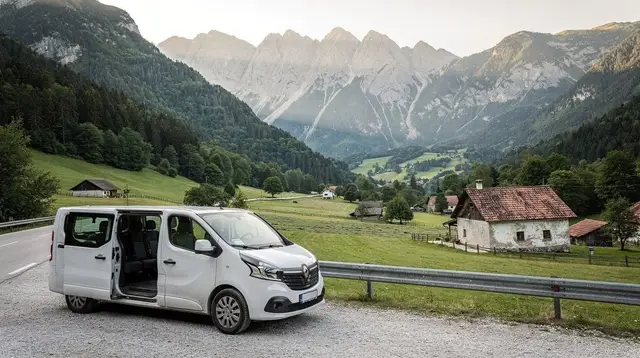
A standard rental sedan, hatchback, or mid-size SUV almost always falls into 2A. Category 2B catches vehicles most travelers do not think of as “trucks” at all — a motorhome, a nine-seat airport van, or a jacked-up 4x4 with roof storage can all cross the 1.30 m line. If you are unsure which category your specific rental model falls into, ask the rental desk directly rather than guessing: buying the wrong category does not protect you from a fine if a camera reads your plate as belonging to a taller vehicle class.
There is no daily rate in either category. The week is the shortest block sold, which matters if your plan is a quick loop such as the Ljubljana day trip from Trieste or a single crossing from Zagreb — you are paying for a full week of coverage even for one afternoon on the motorway, so it is worth timing a longer Slovenian loop to fall inside that same week if you can.
Buying the e-Vinjeta: Online or at the Pump
Two channels exist, and both register the same information: your plate number, your vehicle’s category, and the period you want.
Online, in advance. The official site is evinjeta.dars.si, run by DARS, the Slovenian motorway operator. You enter your plate number, choose 2A or 2B, select a week or a month, and pay by card. This can be done from your phone before you leave your last hotel, or from the car park at the border itself — there is no minimum lead time, though it is worth allowing the vignette to become active before your wheels actually touch the motorway, since some drivers buy it a few minutes too late and cross the first tolled stretch unregistered.
At a petrol station or border shop. Stations near the main crossings from Italy, Austria, and Croatia can register a plate on the spot, generally faster than queuing for a paper receipt used to be under the old sticker system. This suits drivers who would rather hand over a card in person than trust a form on a phone screen, or who only realize they need one once they are already at the pump.
Either way, the record that matters is the plate number itself. If you swap rental cars partway through a trip — a common scenario on a longer loop through Bled, Postojna, and Piran — the vignette does not transfer with you; it stays attached to the original plate, and the replacement car needs its own.
The Mistake Everyone Makes at the Border
The single most repeated error is looking for something to buy at a petrol station the way Austria and Switzerland still require, then either giving up and driving on unregistered because “surely someone would have told me,” or wasting twenty minutes at the wrong kind of counter. Slovenia’s system genuinely has no physical object attached to it anymore — no sticker, no ticket, no barcode to stick anywhere. If a station attendant hands you nothing more than a printed confirmation of your plate and category, that is correct; the confirmation is not the vignette itself, the database entry is.
The second most common mistake is assuming the vignette is bundled with an Austrian or Croatian one because all three countries are close together and Schengen makes the borders feel seamless. It is not. Slovenia’s toll system is separate from Austria’s vignette and from Croatia’s distance-based motorway tolls, and each has to be paid on its own terms as you enter that country. Anyone driving a loop through more than one of these countries in the same trip should plan for each system separately rather than assuming one payment covers the route.
Enforcement and What a Fine Actually Looks Like
Slovenian motorways use automatic number-plate recognition cameras tied directly into the e-vinjeta database, which is why there is no toll booth to stop at and nothing for a border officer to check by eye. The system flags an unregistered plate the moment it passes a gantry, and the fine that follows is issued without warning and set well above the cost of simply buying the correct vignette in the first place. Paying for the week you needed, before you needed it, is cheaper in every single case than risking the alternative.
Arriving From Italy, Austria, or Croatia
Where you cross the border changes almost nothing about the vignette itself, but it does change how early you should buy it.
Coming from Trieste or elsewhere in northeastern Italy, the motorway starts almost immediately after the crossing, so buy online before you leave Italian soil or stop at the first Slovenian services — see getting to Ljubljana from Trieste for the rest of that route.
Coming from Austria through the Karavanke tunnel toward Kranjska Gora or Ljubljana, the same logic applies: buy before the tunnel if you can, since the motorway begins right on the Slovenian side.
Coming from Zagreb, remember that temporary border checks between Slovenia and Croatia have been reinstated and extended repeatedly in recent years, so budget a little extra time at that crossing regardless of your vignette status — full details are in getting to Ljubljana from Zagreb.
None of these routes require the vignette to be bought inside Slovenia specifically. As long as your plate is registered and active by the time you reach the first tolled stretch, it makes no difference whether you paid from a phone in Trieste, an Austrian rest stop, or a Slovenian petrol station.
If You’d Rather Not Deal With Any of This
Not every visitor wants to manage a plate registration, a rental contract, and an unfamiliar motorway network on the same trip, and there is no penalty for skipping the driver’s seat entirely. A private driver removes the vignette question altogether — on a route like the two-day private driver transfer between Zagreb, Bled, and Plitvice, the toll is the driver’s problem, not yours.
Along the coast, a round-trip transfer from Koper to Piran or Izola with running commentary covers the same ground a rental car would, minus the plate paperwork. Inside the capital itself, where a car is a liability rather than a convenience, a private guided walk through Ljubljana’s old town or, for a first orientation to the whole country in a single day, a guided Slovenia in One Day tour both sidestep motorways completely.
For a longer stay without a car at all, our guide to Slovenia without a car lays out how trains, intercity buses, and organized day trips substitute for a rental across most of the country, and car versus organized tour in Slovenia compares the two approaches directly if you are still deciding which way to go before you book anything.
Slovenia Vignette: Common Questions
Do I need a vignette to drive inside Ljubljana itself?
No. The e-vinjeta only applies to motorways and expressways between towns. Ljubljana’s own streets, and the roads into the old town, carry no vignette requirement at all — though most of the historic center is closed to cars regardless, vignette or not.
What happens if I drive on the motorway without one?
Slovenian motorways are monitored by automatic number-plate cameras linked to the e-vinjeta database, and a missing vignette produces an on-the-spot fine that is well above the price of the pass itself. There is no grace period and no warning notice before the fine is issued.
Can I still buy a sticker vignette anywhere in Slovenia?
No, and this is the single most common point of confusion for drivers arriving from Austria or Switzerland, where a physical windscreen sticker is still standard. Slovenia has been fully electronic since 2022 — the vignette is tied to your license plate number, not to a piece of paper on your glass, so there is nothing left to display.
How do I know whether my car needs category 2A or 2B?
The dividing line is the height of the vehicle measured above the front axle, not overall vehicle length or engine size. A standard hatchback, sedan, or compact SUV under 1.30 m at that point is 2A; a campervan, large van, or tall 4x4 above that height, up to 3.5 tonnes, is 2B. Rental companies can confirm the exact category for an unfamiliar model.
Does the Slovenian e-vinjeta also cover tolls in Croatia, Austria, or Italy?
No. It is valid only on Slovenian motorways and expressways. Austria’s own vignette, Croatia’s distance-based tolls, and Italy’s toll booths are entirely separate systems, each requiring its own payment, so crossing any of those borders means budgeting for that country’s system as well.
Is there a one-day option for a single motorway crossing?
No. The shortest period sold is one week, at 16 EUR for category 2A or 32 EUR for category 2B, even if you only plan to use the motorway for a single afternoon between, say, Trieste and Ljubljana. There is no cheaper short-stay rate.
Does my rental car already come with a vignette included?
It depends entirely on the rental company, and this guide does not cover rental terms — see our separate guide to renting a car in Slovenia for what to check on the contract before you drive off. Some companies pre-register their fleet plates, others leave it entirely to the renter, so always ask explicitly at pickup rather than assuming.
Where exactly do I buy the e-vinjeta before crossing the border?
The official channel is evinjeta.dars.si, which takes a card payment and your plate number in a couple of minutes and works from a phone in the car park before you set off. Petrol stations near the main border crossings from Italy, Austria, and Croatia can also register a plate on the spot if you would rather pay in person.
Transfers and transport passes on GetYourGuide
Verified deep-linked GetYourGuide tours. Book through these links and we earn a small commission at no cost to you.
GetYourGuide does not provide a product photo for this activity — the image shows the meeting point, photographed by us.