Koper Cruise Port Guide: Reaching Ljubljana, Bled and Beyond
Can I visit Ljubljana or Bled during a short cruise stop in Koper?
Ljubljana is roughly 100 km and about 1h15 by road, so it fits into a half-day call with margin. Bled is closer to 140 km and 1h45-2h each way, which only works with a long, guaranteed-return organized excursion. In both cases, plan the return time first and work backward, not the other way around.
Slovenia’s window on the Adriatic
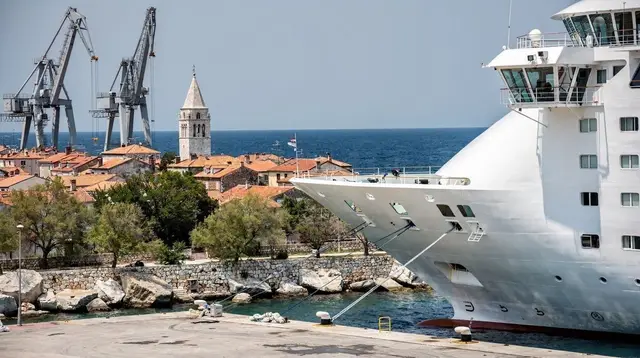
Koper is Slovenia’s only real commercial port, and by extension its only cruise port. Everything about the town reflects that double role: a working harbor of container cranes and car carriers on one side, and, a short walk away, a compact Venetian-era old town of narrow lanes and a cathedral square that could pass for a smaller cousin of Piran. For cruise passengers, though, Koper’s real significance is what it is not — it is not Ljubljana, not Bled, not the karst caves. It is the point from which those places are reached, and the single most consequential planning decision of a Koper call is how realistically you size that reach.
This guide does not walk you through what to do once you arrive at Ljubljana or Bled or Postojna — those destinations, and the excursions built around them, are covered guide by guide elsewhere on this site. What it covers is Koper itself, as a departure point: the actual distances, the actual travel times, and the single mistake that undoes more cruise stopovers here than any other.
The mistake that undoes a Koper stopover
Slovenia is small — 20,271 km², a shade smaller than Wales — and every guide to the country, including several on this site, makes a point of how much of it fits into a day trip from the capital. That fact is true, and it is also the wrong fact to import into a cruise stop. It describes distances measured from Ljubljana, which sits close to the geographic middle of the country. Koper does not sit in the middle. It sits on the coast, at the western edge, and the places most cruise passengers want to see — Ljubljana’s old town, the lake at Bled, the show caves of the karst — are all inland from it, in the direction away from the sea.
The result is a trap that catches people who have read exactly the right things about Slovenia and applied them to the wrong starting point. “It’s a tiny country, so surely I can do Ljubljana and Bled in an afternoon” is a sentence that works from a hotel in the capital and fails from a cruise berth in Koper. The fix is not to distrust the country’s size — it genuinely is compact — but to always measure from Koper specifically, and to build every plan backward from the ship’s departure time rather than forward from what looks appealing on a map.
How far things actually are from Koper
| Destination | Approximate distance | Approximate drive time |
|---|---|---|
| Ljubljana | ~100-105 km | 1h15-1h30 |
| Postojna Cave | ~55-60 km | 45min-1h |
| Predjama Castle | ~65 km | 1h-1h15 |
| Škocjan Caves | ~35-40 km | 40-50min |
| Bled | ~135-140 km | 1h45-2h |
| Piran | ~18 km | 25-30min |
| Portorož | ~15 km | 20-25min |
| Izola | ~7 km | 10-15min |
| Trieste, Italy | ~20 km | 25-30min |
These are road-trip estimates for a private car or coach in ordinary traffic, not published schedule guarantees, and they hold for the outbound leg only. The return leg is where cruise timing goes wrong: traffic around Ljubljana’s ring road at the end of the afternoon, a slow group at a cave entrance, a queue for the funicular at Ljubljana Castle, or simply a group photo stop that runs ten minutes over. None of that shows up in a distance table, and all of it eats into the margin between “back on the coast” and “back on the ship.”
What realistically fits in a single call
Cruise calls at Koper typically run somewhere between six and ten hours in port, though the schedule for your specific sailing is the only number that matters — check it, don’t estimate it. Working backward from a typical call, here is a rough sense of what different destinations demand:
- Ljubljana, at roughly 1h15-1h30 each way, needs about three hours of driving alone, leaving a workable two-to-four hour window in the city itself even on a shorter call. It is the best-fitting interior destination from Koper, which is why it anchors most half-day excursions sold from the port.
- Postojna Cave and Predjama Castle, closer at 45 minutes to just over an hour each way, pair well together and leave comfortable time for the cave tour itself, which runs roughly 90 minutes, plus a walk around the castle.
- Bled is the destination people most want and most often underestimate. At 1h45-2h each way, a round trip already consumes 3.5-4 hours before accounting for anything at the lake — the walk around the shore, the boat out to the island, or the funicular-free climb to the castle. It only makes sense on a longer call, and only with an organized excursion that publishes a firm return time rather than a rough estimate.
- The coast itself — Piran, Portorož and Izola — is the low-risk option. All three sit within half an hour of the port, which means even a delay of thirty or forty minutes rarely threatens the return.
If your call is on the shorter end, or if this is your only stop in Slovenia and you would rather not gamble it, the coastal towns deserve more consideration than they usually get. Piran in particular offers a genuinely different atmosphere from Koper’s own old town — Venetian balconies, a Renaissance square named for local violinist Giuseppe Tartini, and sea views toward Croatia and Italy on a clear day — without the travel-time exposure of an interior excursion.
Guided excursion or independent travel: what changes when the clock is the enemy
Every cruise port creates the same choice — book an organized shore excursion, or head out independently by taxi, rental car, or public transport — and Koper sharpens that choice more than most, because the penalty for miscalculating is not a wasted afternoon but a missed ship.
An organized excursion that departs directly from the pier removes the two riskiest variables from the equation: it commits to a return time, and it accounts for known road conditions on that day. A tour built specifically for cruise passengers, such as a full-day trip pairing Bled and Ljubljana with a guide, timed around the ship’s schedule, is priced and paced with exactly this constraint in mind — it is the kind of excursion where the operator has already done the backward planning described above, so you don’t have to.
Independent travel is entirely workable for the coast, where distances are short enough that a taxi delay or a missed bus is recoverable. It is much harder to recommend for Bled specifically, where public transport from Koper does not run directly and involves at least one change, adding uncertainty on the one route where uncertainty is most costly.
For readers weighing the two approaches in general, the comparison of a rental car against an organized tour anywhere in Slovenia is covered in more depth in our guide on choosing a car versus an organized tour; the conclusion skews further toward organized transport for cruise stopovers than it does for open-ended trips, precisely because of the fixed return deadline.
If you do decide to self-drive from the port, remember that Slovenia’s motorway network requires an electronic vignette (e-vinjeta) the moment you join it, sold by duration rather than by kilometer, with no roadside toll booths to catch you if you skip it. Our vignette guide explains the categories and current rates; renting a car for a few hours at Koper without one is a real, ticketed risk, not a formality.
Ljubljana from Koper: the excursion that actually fits
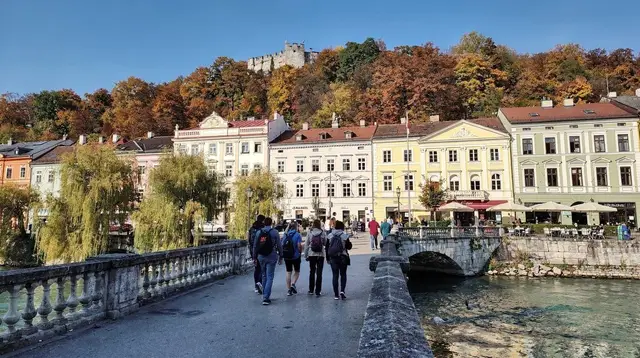
Given the numbers above, Ljubljana is the destination most Koper stopovers should be built around if the interior is the goal at all. A private transfer or small-group tour, such as a private guided walk through the capital’s old town, typically covers the Triple Bridge, Prešeren Square, the riverside market halls designed by Jože Plečnik, and a look up at Ljubljana Castle on its hill above the Ljubljanica — enough to get a genuine sense of the city without needing the full day that Ljubljana rewards on a longer independent stay.
Travelers who prefer to set their own pace once there, rather than follow a group, sometimes combine the transfer with a self-guided option like a short walking tour with a local guide covering the old town’s key sights, which compresses well into a half-day window.
Whichever format you choose, the planning principle stays the same: fix the time you must be back at the ship, subtract the return drive plus a buffer of at least 30-45 minutes for the unexpected, and treat whatever remains as your actual time in Ljubljana — not the reverse calculation of “how much can I see” followed by hoping the drive back cooperates. For a broader sense of what a first visit to the capital covers, our guide to Ljubljana’s old town is a useful reference before you book.
Postojna and Predjama: the efficient pairing
If the goal is checking off a landmark Slovenian sight rather than the capital itself, Postojna Cave and Predjama Castle are the more forgiving choice from Koper, simply because they are closer. The cave’s underground train, the walkway through its largest chambers, and the short onward hop to the castle built into a cliff face fill a half-day comfortably, with less exposure to the traffic variability that affects the Ljubljana road at peak times.
Readers planning that pairing independently, rather than through a cruise-specific excursion, can check current ticket and reservation details in our Postojna Cave guide — tickets there require a fixed time slot, which is one more reason to book before you leave the ship rather than on arrival.
Staying on the coast: the low-risk alternative
Not every Koper call needs to reach inland at all, and for shorter port days it arguably shouldn’t. A short excursion covering Piran, Portorož and Izola — the three towns that make up Slovenia’s compact 46 km of coastline — delivers Venetian architecture, a genuinely different pace from the port town of Koper itself, and none of the return-time exposure of a trip toward Ljubljana or Bled.
A private option such as a private roundtrip along the coast departing directly from the port can be timed tightly around your specific call, and for something more distinctive than a straightforward drive, a short cruise along the coast aboard one of Slovenia’s oldest working boats turns the transfer itself into part of the experience rather than dead time between the ship and the sight.
This coastal option is worth taking seriously even for travelers who arrived hoping specifically for Ljubljana or Bled. A six-hour call with an uncertain traffic forecast is, in practical terms, safer spent thirty minutes from the ship than three hours from it.
Practical notes for a Koper stopover
A handful of details are specific to arriving by ship rather than by car or train, and worth knowing before you leave the cabin:
- Currency: Slovenia uses the euro, has done since 2007, and nothing about arriving from a ship changes that — no on-board currency exchange is needed for a shore excursion.
- Koper’s own old town is walkable directly from most berths in 10-15 minutes, so a spare hour before or after an excursion is enough to see Tito Square, the cathedral, and the loggia without needing transport at all.
- Mobile signal and maps: coverage along the Koper-Ljubljana and Koper-Postojna routes is reliable, so offline map downloads are a precaution rather than a necessity, but worth having given how much this guide leans on precise timing.
- Border awareness: none of the excursions described here cross a border, since Ljubljana, Bled, Postojna and the coast are all within Slovenia. If a shore excursion is instead sold as a Slovenia-Croatia or Slovenia-Italy combination, build in extra buffer — temporary checks remain in place at Slovenia’s land borders and can add delay that a same-country excursion never faces.
- Booking ahead: excursions and cave tickets both benefit from advance booking rather than arranging things on the pier, especially in summer. Our guide on what to book in advance across Slovenia covers this more broadly, and it applies with extra force to a cruise stop, where there is no second day to try again if the first-choice tour is sold out.
None of this is complicated, and Koper itself is an easy, low-stress port to work from. The one thing worth carrying off the ship is the discipline this guide keeps returning to: measure from Koper, not from Ljubljana, and let the ship’s departure time set the plan rather than the other way around.
tours.city-sightseeing
Verified deep-linked GetYourGuide tours. Book through these links and we earn a small commission at no cost to you.
GetYourGuide does not provide a product photo for this activity — the image shows the meeting point, photographed by us.