Ljubljana in One Day
Most European capitals resist being seen in a day. Ljubljana doesn’t — its entire historic core sits inside a loop of the Ljubljanica River that a reasonably fit walker crosses end to end in twenty minutes. That size is the whole premise of this itinerary: a single day, mostly on foot, built for someone who lands in the morning and flies or boards a train out that evening.
A Day Built Around the River and the Castle
This itinerary keeps to the capital itself. It does not attempt Lake Bled or the karst caves — both are real full-day trips from Ljubljana, and squeezing either one into a day that also includes the city leaves you rushing both. If you have more time, the two- and three-day versions of this itinerary — Ljubljana in two days and Ljubljana in three days — add exactly those trips at a pace that doesn’t feel like a sprint.
What you can comfortably fit into one day: the old town between the Triple Bridge and Preseren Square, the funicular or footpath up to Ljubljana Castle, a walk along the quays that architect Joze Plecnik shaped almost single-handedly, the Central Market, and — if your day started early enough — a short add-on to the medieval town of Skofja Loka, twenty-some kilometers away.
If you’re coming straight from the airport, read the Ljubljana airport guide before you leave; it covers the bus into town and roughly how long to budget, which matters when your whole day is this tightly planned. And if you’re wondering whether a day is even the right amount of time, this first-timer’s guide to Ljubljana lays out what a longer stay would add.
Day 1
Morning: Preseren Square, the Triple Bridge, and the Market
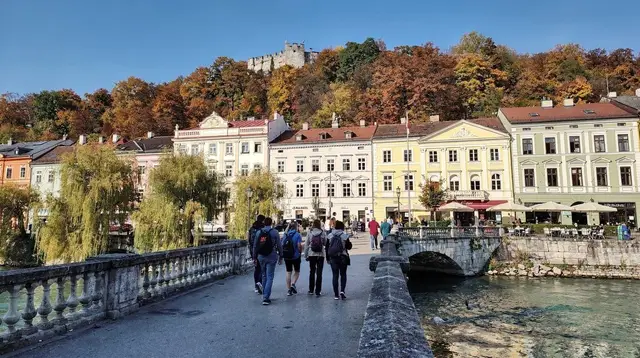
Start at Preseren Square, the small, pink-facaded plaza that is Ljubljana’s obvious center of gravity — the pastel Franciscan Church behind you, the river in front. From here, the Triple Bridge (Tromostovje) is Plecnik’s signature move: what was once a single crossing became three parallel pedestrian bridges fanning out toward the old town, a piece of urban design now inscribed as part of Plecnik’s UNESCO-listed work in Ljubljana, recognized by UNESCO on 31 July 2021.
Cross into the old town proper and follow the riverside embankments — also Plecnik’s design — south toward the Central Market, an open-air and covered market that runs along the river most mornings. It’s a good, unhurried stop for a coffee and a pastry before the day’s one climb. A short detour into the old town’s back streets is worth the extra ten minutes: this is where Ljubljana’s Baroque and Art Nouveau facades sit shoulder to shoulder, largely untouched by the traffic you’d expect in a capital, because there mostly isn’t any — the historic center is closed to private cars.
If you’d rather have a local narrate this stretch instead of reading plaques, a short guided walk covers the same ground with context you’d otherwise miss.
a guided walking tour through Ljubljana’s old townMidday: Up to Ljubljana Castle
From the market, it’s a short walk to the base of Castle Hill. This is the one point in the day where it’s worth being clear about the options, because it’s also the itinerary’s most common misconception: the funicular is not the only way up. A signed footpath climbs from the old town to the castle gate in about fifteen minutes and costs nothing. It’s a genuinely pleasant walk through trees, not a chore — take it if the weather’s decent and you’re not carrying luggage.
The funicular is simply the faster, less tiring option, and it’s what most visitors choose:
| Option | Adult price | Time |
|---|---|---|
| Funicular round trip only | 6.00 EUR | ~1 minute each way |
| Combined ticket: funicular + castle entry | 19.00 EUR | — |
| Footpath on foot | Free | ~15 minutes uphill |
However you get up, the castle itself rewards the climb: a watchtower with a full view over the old town’s terracotta roofs to the Alps on a clear day, a small history exhibition, and enough space to sit for ten minutes without another visitor in sight — this is not a castle that draws Prague- or Salzburg-sized crowds. If your day includes more than one paid sight, it’s worth checking whether the Ljubljana Card pays for itself before you buy the funicular ticket separately — the card bundles the funicular and castle entry with city buses and a museum allowance.
a 24-hour Ljubljana Card covering the funicular, castle entry, and city transportEarly Afternoon: Down to the River and Metelkova
Come down (on foot this time, if you took the funicular up — it’s a different, equally short route, and gives you a second look at the town from a lower angle) and spend the next hour along the river. The stretch of embankment between the Triple Bridge and the Dragon Bridge is Plecnik’s most concentrated body of work in one walk: balustrades, lampposts, and steps down to the water that all share the same design language, deliberately built to bring people down to river level rather than just past it.
If you have any appetite left for one more stop before lunch fatigue sets in, the National and University Library a few streets back from the river is Plecnik’s most architecturally dense building — its lobby alone is worth five minutes even if you don’t linger in the reading rooms.
Lunch is best kept close to the river rather than chasing a specific restaurant across town — the colonnade by the market and the streets just south of it have the highest density of solid, quick options, and losing thirty minutes walking to a recommendation three neighborhoods away is the easiest way to blow this itinerary’s schedule.
Late Afternoon, Option A: More of Ljubljana
If your flight or train isn’t until evening, the simplest way to fill the remaining hours is to slow down rather than add a new destination. Metelkova, the former army barracks turned alternative art and nightlife quarter just north of the center, is worth twenty minutes even by daylight for its murals and sculpture, in a very different register from the old town’s Baroque squares. Tivoli Park, the city’s main green space, is a five-minute walk further and a good place to sit if the day has been hot.
For anyone deciding this single day was really a preview and wants to plan a longer return trip, where to stay in Ljubljana and getting around the city are the two guides worth bookmarking before you go.
Late Afternoon, Option B: An Add-On to Skofja Loka
This option only makes sense if you started early and don’t need your evening — it turns a city day into something closer to a city-plus day. Skofja Loka is a well-preserved medieval town roughly twenty kilometers from Ljubljana, easily reached within about half an hour, with a castle, a cobbled main square, and none of the crowds of the capital’s old town. It’s genuinely a different pace from the rest of this itinerary — quieter streets, a smaller scale — which is exactly why it works as a late-afternoon change of register rather than a second full sightseeing block.
A guided option pairs the town’s history with a taste of a genuinely local specialty:
a Skofja Loka walking tour that includes a traditional honey bread workshopTreat this as optional. If you take it, you’ll want to be back in Ljubljana with enough margin for dinner and, if relevant, your onward connection — don’t cut it close against a flight or the last convenient train.
Evening: A Last Walk Before You Go
Whichever afternoon option you took, end the day back along the river. The old town looks different after dark — the castle and the church facades are lit, the outdoor cafe tables along the embankment fill up, and the pace drops noticeably from the daytime market bustle. A slow dinner near the river, followed by a last unhurried walk across the Triple Bridge, is a better close to the day than trying to fit in one more sight.
Practical Notes for This Day
A few logistics decide whether this day runs smoothly or turns into a scramble:
| Practical point | What to know |
|---|---|
| Getting into the old town | Closed to private cars; walk in from wherever you’re staying or arriving |
| Bus payment | Cash isn’t accepted on board; you need an Urbana card (2 EUR) or the app |
| Free shuttle | The electric Kavalir runs 6:00–22:00 in the center, no fixed stops, hail it |
| Castle access | Funicular (6 EUR return) or a free 15-minute footpath — not funicular-only |
| Luggage | Left-luggage counter at the train station, a short walk from the old town |
| Weather buffer | The castle hill and riverside have little shade — bring water in summer |
If you’re arriving by car rather than public transport or a connecting flight, note that a day trip built around a single city center doesn’t need one — parking near the pedestrianized core is limited and mostly unnecessary for this itinerary.
What This Day Leaves Out
Being honest about scope is part of what makes a one-day plan work. This itinerary deliberately does not include:
- Lake Bled — 55 km away, and the lake, the island, and the castle together fill a full day on their own. See Bled as a day trip if you can add a second day.
- The Postojna and Predjama caves — roughly an hour from Ljubljana, and worth a dedicated day rather than a rushed afternoon. Covered in the Postojna and Predjama day trip guide.
- Lake Bohinj, the Julian Alps, and the coast — each is its own trip, not an add-on to a capital-city day.
None of these are places you can convincingly “also see” on the same day as Ljubljana’s old town and castle. Trying tends to mean rushing the castle, missing lunch, or arriving at Bled with an hour before you have to turn back — worse than simply returning another time with a full day to give it.
FAQ: Visiting Ljubljana in a Single Day
Is one day really enough for Ljubljana?
For the old town, the riverside, and the castle, yes. It is not enough time to also add Bled or Postojna — those need a separate full day each, ideally two if you can spare them.
Do I need the funicular to reach Ljubljana Castle?
No. The funicular is the fastest and least tiring option, but a signed footpath climbs from the old town to the castle gate in about fifteen minutes, on foot and free of charge.
What’s the fastest way to get around the old town?
Walking. The historic center is closed to private cars, flat, and small enough that a taxi rarely saves time. The free electric Kavalir shuttle is useful if you’re tired or short on time between the station and the river.
Is the Ljubljana Card worth buying for a single day?
It depends on how many sights you plan to pack in. It bundles unlimited city buses, the funicular and castle entry, a guided city walk, a river cruise, and access to more than twenty museums — worth it if you intend to see several of those, less so if your day is mostly a walk and a coffee.
Can I combine Ljubljana with Skofja Loka in the same day?
If you arrive early and don’t need the evening, yes — Skofja Loka is close enough for a short add-on. If your day is genuinely just a few hours between connections, skip it and keep the itinerary to the capital.
Where should I eat lunch on a one-day visit?
The Central Market colonnade and the streets around Petkovskovo nabrezje have the highest concentration of quick, good options within a few minutes’ walk of the Triple Bridge, so you lose no time crossing town.
Is Ljubljana walkable with luggage between trains?
The old town itself is walkable with a bag, but it’s more comfortable to leave luggage at the train station’s left-luggage counter first — it’s a five-minute walk from the edge of the historic center.
tours.1 days
Verified deep-linked GetYourGuide tours. Book through these links and we earn a small commission at no cost to you.
GetYourGuide does not provide a product photo for this activity — the image shows the meeting point, photographed by us.