Ljubljana Old Town Walking Guide: A First Loop on Foot
Can you walk Ljubljana's Old Town in one loop?
Yes. The historic center is closed to private cars and compact enough to walk end to end in about twenty minutes. A relaxed first loop past the Triple Bridge, the riverside, the market, and the old streets below the castle hill takes roughly two to three hours with stops.
Ljubljana’s historic center is one of the easiest in Europe to get your bearings in, mostly because you cannot drive through it. The old town sits in a tight bend of the Ljubljanica river, wedged between the water and the wooded hill that carries the castle, and the whole pedestrian core can be crossed on foot in about twenty minutes. That single fact should shape your first hours in the city more than any list of sights: leave the rental car at the hotel or in an edge-of-center garage, and plan your first outing as a walk, not a drive.
Why This Loop Works as a First Orientation Walk
A newly arrived visitor usually wants two things at once: to see the postcard views, and to understand how the city fits together before committing to anything that costs money or requires a ticket. This loop does both. It follows a natural, mostly flat route along the river and through the old streets, touching every landmark you will hear about elsewhere on this site without going inside any of them. Think of it as a reconnaissance pass. Once you have walked it, decisions about the castle, a river cruise, or a museum stop become much easier to fit into a longer stay — see Ljubljana in One Day if you want the fuller version with those extras built in.
The route below assumes you are starting near Prešeren Square, which is where most hotels, the main bus station, and the train station all funnel arriving visitors. If you are still deciding where to base yourself, Where to Stay in Ljubljana covers the neighborhoods within easy walking distance of this loop.
The Car-Free Center: What It Actually Means for You
Ljubljana’s downtown pedestrian zone is not a symbolic “old town” designation with cars quietly ignoring it. It is a genuine traffic restriction, enforced with bollards and access control, covering the streets on both banks of the Ljubljanica around Prešeren Square. Private vehicles simply cannot enter most of it, which is precisely why the area feels so different from other European capitals: no honking, no exhaust, cafe tables spilling onto the cobblestones without a curb in sight.
The mistake to avoid is assuming you can drive in “just to drop a bag” or “just to save fifteen minutes” — you cannot, and the barriers are not decorative. If you arrive by car, park at the edge of downtown or in one of the garages near the train station and cover the last stretch on foot. For getting around beyond this one walk, Getting Around Ljubljana lays out the buses, the Ljubljana Card, and when a car actually helps versus when it just becomes a parking headache. If you are staying car-free for your whole trip, Slovenia Without a Car goes into how far that strategy can reasonably take you.
One genuinely useful compromise exists for anyone who cannot manage a twenty-minute walk comfortably: the Kavalir, a small free electric shuttle that circulates through the pedestrian center roughly from 6am to 22h. It has no fixed stops or timetable — you hail it on the street or call for a pickup — and it seats up to five people, with a couple of the vehicles enclosed and heated for winter. It will not replace this walking loop, but it is worth knowing about for a tired afternoon or if you are traveling with someone who has limited mobility. Accessibility in Slovenia covers this and other mobility considerations in more depth.
Starting Point: Prešeren Square and the Triple Bridge
Begin at Prešeren Square, the pink Franciscan Church behind you, the statue of the poet France Prešeren facing the river. This is the city’s most photographed corner, and for good reason: it is the hinge between the newer nineteenth-century blocks and the medieval streets on the far bank.
Cross via the Triple Bridge, three linked pedestrian bridges fanning out from the same point on the near bank to the same point on the far one. It looks unusual because it is: a single crossing was widened into three separate spans, an idea associated with the city’s most influential architect, whose broader body of work along this river and elsewhere in the center is detailed on its own in Plečnik’s Ljubljana and in the page on the 2021 UNESCO heritage listing his urban design earned. This walk will point out his fingerprints as they come up, but it deliberately does not try to be that deep dive — treat the two pages as a natural next stop after this one.
The Riverside: Where Ljubljana Actually Lives
Once across the Triple Bridge, resist the pull toward the old streets for a moment and turn onto the riverside promenade instead. The embankments on both sides of the Ljubljanica, lined with plane trees, cafe terraces, and market stalls, are where the city spends its afternoons and evenings, and walking even a short stretch of them tells you more about daily Ljubljana than any single monument does.
Follow the near bank south past a run of outdoor cafes toward the market. If you want to see the river from the water rather than the bank, a short boat trip covers the same stretch at a slower pace — Ljubljanica River Cruise explains when it is worth adding, though it is a separate activity from this walk and not something to squeeze in on a first pass.
The Central Market
The market runs along the river just past the Triple Bridge, split between an open-air produce section and a covered colonnade with fish, cheese, and small food stalls. Mornings are the liveliest time, when stallholders from the surrounding countryside sell fruit, honey, and cut flowers, and it is also one of the best places to get a sense of what actually lands on a Slovenian table. If food is a priority for your trip, What to Eat in Ljubljana picks up from here with specific dishes and where to find them nearby.
The market building itself, with its long covered colonnade facing the river, is another Plečnik design, though again this walk treats it as a landmark to note rather than a subject to unpack — that belongs on the dedicated architecture page.
Into the Old Streets: Mestni Trg, Stari Trg, Gornji Trg
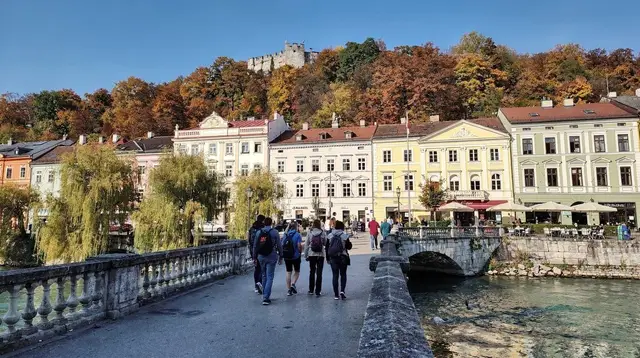
From the market, double back across the river — the Cobblers’ Bridge (Čevljarski most), a smaller and quieter crossing than the Triple Bridge, is the pleasant way to do it — and head into the string of three connected squares that form the spine of the old town: Mestni trg, Stari trg, and Gornji trg. Despite the name “squares,” these read more like a single gently curving street lined with pastel Baroque facades, arcaded ground floors, and small shopfronts.
This stretch is the most atmospheric part of the walk and the slowest to move through, not because of distance but because there is something to look at every few steps: the Town Hall and its inner courtyard on Mestni trg, the Robba Fountain just outside it, narrow lanes climbing toward the castle hill on your left. If you want to go into any of the buildings rather than just past them, Ljubljana Museums Guide lists which ones along this route are worth the stop.
At the end of Gornji trg, the street narrows and starts to climb — this is one of several footpaths up to the castle, free and roughly fifteen minutes on foot, though this guide stops here and leaves the hill itself to Ljubljana Castle Guide, where the funicular, the combined ticket, and what is actually up there are covered properly.
Back Toward Prešeren Square: The Dragon Bridge
To close the loop, retrace your steps to the river and cross back near the market, then walk along the near-bank embankment back toward the Triple Bridge, or extend slightly to see the Dragon Bridge, a short walk east along the river, guarded by four green copper dragon statues that have become almost as recognizable a symbol of the city as the castle itself. It is a worthwhile five-minute detour rather than a core stop, best added if you still have energy once you are back near Prešeren Square.
A Suggested Timing for the Loop
| Segment | What you see | Rough time |
|---|---|---|
| Prešeren Square to Triple Bridge | Orientation, first photos | 10 min |
| Triple Bridge to the market | Riverside cafes, embankments | 20 min |
| Central Market | Stalls, colonnade, river views | 20-30 min |
| Cobblers’ Bridge to Gornji trg | Mestni trg, Stari trg, Gornji trg | 45-60 min |
| Optional detour | Dragon Bridge | 10-15 min |
| Total, relaxed pace | 2-3 hours |
These are walking and looking times, not ticketed-attraction times — nothing on this loop requires a ticket, so the range mostly reflects how many cafe stops and photo pauses you allow yourself.
Beyond This Loop: Metelkova and Tivoli Park
Two areas sit just outside the strict old-town core and are easy to fold into a longer version of the same walk. Metelkova, a former military barracks turned alternative art and nightlife district a short walk northeast of the center, is covered in colorful murals and squats by day and turns into the city’s clubbing hub after dark — worth a detour if that kind of scene interests you, easy to skip if it does not.
Tivoli Park, the city’s main green space, opens up just west of the old town and offers a genuinely quiet contrast after the cobblestones and crowds of the market — a good place to sit down before doubling back. Neither area is essential to the core loop above, but both extend naturally from it if you have more than a couple of hours to spend.
Making This Part of a Longer First Day
This walk pairs naturally with the castle hill above it and, if you have transport sorted, a first day trip out of the city. First Time in Ljubljana sets this walk in the context of a full arrival day, and Ljubljana in Two Days shows where the castle, a museum, and a short trip toward Bled fit around it. If you would rather not navigate on your own, a guided version of essentially this same route exists as a structured tour — useful less for finding your way and more for the stories and context a local guide adds to streets you would otherwise just be photographing:
a guided walk through the Old Town in French, and for a longer, broader introduction that pairs the old streets with the riverside and the market in one outing, a half-day walking tour with a local guide.
If your schedule allows a second day, the same walking mindset — leave the car, move on foot or by transit — carries over well to a trip outside the city, whether that is the caves southwest of Ljubljana on a guided day trip to Postojna Cave and Predjama Castle or a quieter valley to the north; see Logar Valley Hiking for that option on your own steam.
A Few Practical Notes Before You Go
Wear shoes that handle cobblestones comfortably; the old streets are attractive but uneven underfoot, and heels or thin-soled sandals will not thank you by the end of the loop. Bring cash in small denominations if you plan to buy anything at the market stalls, since not every vendor takes cards. And if you are visiting during the holiday season, the same streets take on a different character entirely — see Ljubljana Christmas Market for how the layout and crowds shift from late November.
For orientation beyond this single walk, [Ljubljana Old Town Walking Guide] pairs well with a broader look at how much of the city and its region you can realistically fit into your trip — How Many Days in Slovenia and Slovenia Daily Budget are the two questions most first-time visitors ask right after this one. And if you happen to be picking up a few words before you go, Slovenian Language Phrases covers exactly enough to greet a market vendor properly.
Old Town Walk: Common Questions
Can you drive into Ljubljana’s Old Town?
No. The historic center is a pedestrian zone closed to private cars, with only limited exceptions for residents and deliveries. Park on the edge of downtown and walk in, or use the free Kavalir electric shuttle.
How long does it take to walk across the Old Town?
About twenty minutes from one end to the other at a normal pace. A first-time walking loop that stops at the main squares, the riverside, and the market usually runs two to three hours.
What is the Kavalir and how do I use it?
The Kavalir is a free electric shuttle with no fixed stops that runs through the pedestrian center roughly from 6am to 22h. You hail it on the street or call for a pickup, and it can carry up to five passengers.
Is the Ljubljana Old Town walk suitable for a first day in the city?
Yes, it is the natural first activity after arriving, since it does not require tickets or planning and orients you toward the castle hill, the river, and the main sights you will return to later.
Do I need tickets for this walk?
No. Walking the Triple Bridge, the riverside promenades, the market, and the old streets is free. Tickets only come into play for separate attractions such as the castle funicular or a river cruise.
Is the Old Town walk stroller and wheelchair friendly?
Mostly yes on the flat riverside and market areas, though some of the older side streets have uneven cobblestones. The steep path up to the castle itself is a separate, more demanding climb, not part of this loop.
What is the best time of day to walk the Old Town?
Morning is quietest, before tour groups arrive at the market and the Triple Bridge. Early evening, when the riverside cafes fill up and the streetlights come on, is the most atmospheric.
tours.city-sightseeing
Verified deep-linked GetYourGuide tours. Book through these links and we earn a small commission at no cost to you.
GetYourGuide does not provide a product photo for this activity — the image shows the meeting point, photographed by us.