Where to Stay in Ljubljana
Where should I stay in Ljubljana?
Stay inside or within a short walk of the car-free historic center, between the Triple Bridge, Preseren Square and Ljubljana Castle, since almost everything worth seeing sits inside that twenty-minute walking radius. Budget-conscious travelers do just as well a few streets out in Tabor or near the train and bus station, both still walkable to the old town.
Ljubljana is not a city that rewards spreading out. With around 285,000 residents, it is one of the smaller capitals in Europe, and its historic core can be crossed on foot in about twenty minutes. That single fact should drive almost every accommodation decision here: the neighborhood you pick matters less for the address itself and more for how many of those twenty minutes you spend walking to see things, rather than walking back to where you sleep.
Why Ljubljana’s Size Changes the Rules for Choosing a Base
In a larger capital, choosing a neighborhood usually means weighing a metro line, a commute time and a price bracket against each other. Ljubljana collapses most of that calculation, because /destinations/ljubljana/ itself is small enough that almost any hotel inside the ring formed by the old town, Tabor, Bezigrad and the station area is within a fifteen-minute walk of the Triple Bridge. The real variable is not distance in kilometers, it is whether you are inside the pedestrian zone, at its immediate edge, or a bus ride away from it.
That pedestrian zone is not a minor detail. The historic center is closed to private cars, a policy the city has enforced for years and steadily expanded rather than relaxed. Visitors who book a hotel outside the center on the assumption that they will simply drive in and park nearby often end up doing exactly what a centrally based visitor does anyway: walking, or taking a bus, or riding the free electric Kavalir shuttle that circulates through downtown from 6am to 10pm.
The car, in that scenario, becomes dead weight that still needs a parking space. If a rental car is part of your plan at all, it earns its cost on the day trips out of the city, not on getting around inside it, a distinction covered in /guides/slovenia-without-a-car/ and /guides/getting-around-ljubljana/.
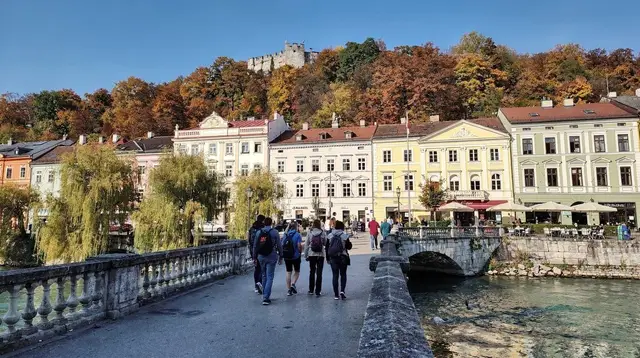
The Old Town: Between the Triple Bridge and Preseren Square
This is the neighborhood most visitors picture when they imagine Ljubljana, and for a short stay it is usually the right call. Staying here means /destinations/ljubljana-castle/ is a steep but short walk or a six-minute funicular ride away, the riverside cafes along the Ljubljanica are a few steps from most front doors, and the architectural legacy of Joze Plecnik, from the Triple Bridge to the market colonnade, surrounds you rather than requiring a trip.
For a first visit, this proximity is worth more than almost any other feature a hotel can offer; see /guides/first-time-in-ljubljana/ and /guides/ljubljana-old-town-walking-guide/ for how compact the actual sightseeing loop is. Much of what’s covered in /guides/what-to-eat-in-ljubljana/ is within a few minutes of an old-town address as well, so a central room also means not having to plan a separate trip out for dinner.
The trade-offs are predictable for a small, popular historic core: this is the most expensive part of the city to sleep in, rooms tend to be smaller and older buildings mean some noise carries from the square below, especially on summer weekend nights. Streets closer to Preseren Square itself are livelier and louder; streets a block or two toward Vodnikov trg or the market are quieter while staying just as walkable. If Plecnik’s urban design is part of why you are visiting at all, a guide to his legacy at /guides/plecnik-ljubljana-guide/ is worth reading before you book, since several of the buildings he shaped sit within a few minutes of old town hotels.
On or Near Ljubljana Castle Hill
A smaller number of guesthouses and apartments sit on the slopes below the castle itself, or immediately at its base. The appeal is obvious from any photograph of the city: waking up under the castle walls, with views over the old town’s rooftops. The catch is equally obvious once you are carrying luggage: every trip back “home” involves a climb, whether on foot or by timing the funicular’s operating hours. For most travelers, staying in the old town below and treating the castle as a half-day outing, funicular included, delivers the same closeness at a fraction of the daily effort. For what that outing actually involves, from tickets to what’s inside the walls, see /guides/ljubljana-castle-guide/.
Tabor and the Station Area: The Practical, Cheaper Choice
North and northeast of the old town, past the market and across the ring road, sit Tabor and the streets around Ljubljana’s combined train and bus station. This is where budget-minded travelers, and anyone planning day trips that leave from the station, tend to end up. The walk to Preseren Square from here is flat and takes ten to twelve minutes, prices run noticeably lower than inside the old town, and if your plans include buses or trains toward Bled, Postojna or the coast, you are sleeping a few minutes from where those depart.
The area trades atmosphere for convenience: it sees more traffic noise, fewer cafes worth lingering in, and less of the postcard scenery that makes the riverside so photogenic. It suits a short, efficiency-minded stay, or a traveler splitting a longer Slovenia trip who does not want to pay old-town prices for a bed used mainly for sleeping between day trips.
Metelkova and Its Immediate Surroundings
A few streets from the station, the former military barracks of Metelkova have been an alternative culture and nightlife complex for decades, covered in murals and packed with small clubs and bars. Staying in the streets around it puts you close enough to the old town to walk in comfortably, while giving you a livelier, younger scene on your own doorstep at night. It is not the neighborhood for travelers prioritizing quiet, particularly on weekends, but it is one of the more distinctive bases in the city and rarely commands old-town prices.
Tivoli Park and the Green Edge of the Center
West of the old town, the streets bordering Tivoli Park offer a different trade: more space, more greenery, and a calmer register than the historic core, at the cost of a slightly longer walk in, typically fifteen to twenty minutes to Preseren Square. This suits families, longer stays, or anyone who finds a park more restful than a square full of outdoor tables. It remains squarely within easy walking or short bus range of everything covered in /guides/getting-around-ljubljana/, so it is not a compromise on access, only on immediacy.
Bezigrad and the Northern Residential Streets
Further out, Bezigrad and the surrounding residential district are where longer-term visitors and those on tighter budgets often land, drawn by lower prices and a more local, less tourist-facing feel. The center is reachable by a short bus ride rather than entirely on foot, which is a fair trade for travelers staying five nights or more, but it starts to work against a two- or three-night visit where every extra transit minute cuts into sightseeing time. If your stay is short, the money saved here rarely outweighs the walking time lost.
Staying in Ljubljana with Children
Families weighing the same neighborhoods face one extra variable: how much walking young children can manage between a hotel and the sights. The old town’s flat, car-free streets make it forgiving even with a stroller, and Tivoli Park’s edge adds a genuine green-space option a short walk from the center, a factor covered more broadly in /guides/visiting-slovenia-with-children/.
Ljubljana Zoo and the free Kavalir shuttle, detailed in /guides/ljubljana-zoo-and-kavalir-for-kids/, sit close enough to either an old-town or a Tivoli-adjacent base that neither location forces a long trip for a family afternoon. A broader rundown of what keeps children entertained around the capital and beyond is in /guides/best-slovenia-activities-for-families/.
Where Not to Stay: Chasing a Parking Space
The clearest mistake in choosing a Ljubljana base is picking a hotel on the outskirts because it advertises free parking, on the assumption that a rental car will make the center’s closed streets irrelevant. It will not: the old town’s pedestrian zone does not open for hotel guests, and a car parked at a peripheral hotel still leaves you walking in, taking a bus, or paying for downtown parking anyway on the days you actually want to be near the sights.
If you are renting a car at all, the better plan is to pick it up on the day you leave for a destination like /destinations/bled/ or the Postojna cave region, not to base your whole stay around where you can leave it overnight. A short excursion like the Bled lake day tour from Ljubljana or the Postojna Cave day trip from Ljubljana starts from the city center anyway, which is one more reason a central hotel serves you better than a peripheral one with a parking lot.
Comparing the Main Areas
| Area | Walk to Preseren Square | Vibe | Price level | Best for |
|---|---|---|---|---|
| Old town (Triple Bridge–Preseren Square) | 0–5 min | Historic, lively, riverside | High | First-time visitors, short stays |
| Castle hill | 5–10 min (uphill) | Scenic, quiet at night | Mid to high | Views, not for heavy luggage |
| Tabor / station area | 10–12 min | Practical, busier streets | Low to mid | Budget stays, early departures |
| Metelkova and around | 8–12 min | Alternative, nightlife | Low to mid | Younger travelers, culture |
| Tivoli Park edge | 15–20 min | Green, calm | Mid | Families, longer stays |
| Bezigrad | Short bus ride | Local, residential | Low | Longer stays on a budget |
Making the Most of a Central Base
Once you have settled on a neighborhood inside or close to the old town, a city pass can make sense of the sightseeing that follows: the Ljubljana City Card covering 30 attractions and public transport bundles museum entries with the same buses you would otherwise pay for individually, and whether it pays off for your specific plans is broken down in /guides/is-ljubljana-card-worth-it/.
Travelers arriving straight from the airport should also read /guides/ljubljana-airport-guide/ before booking, since the transfer time from Brnik barely changes whichever central neighborhood you choose, so it should not be a factor in picking one over another.
A central base also puts Ljubljana’s museums within easy reach for a rainy afternoon or a quiet evening after a day trip; see /guides/ljubljana-museums-guide/ for which ones reward the visit. The same compactness makes the city genuinely bikeable, and short-term rental bikes are common enough that /guides/cycling-in-ljubljana/ is worth a look even for visitors who did not plan on cycling.
For anyone building a longer route around the country rather than a single Ljubljana stay, it is worth deciding how many nights the capital itself deserves before booking anything: /guides/how-many-days-in-slovenia/ and the day-by-day breakdowns at /itineraries/ljubljana-in-two-days/ and /itineraries/ljubljana-in-three-days/ give a realistic sense of what fits. A rough daily budget for the city, useful for weighing an old-town room against a cheaper one in Tabor, is laid out in /guides/slovenia-daily-budget/.
Booking Timing and Advance Planning
Ljubljana’s small stock of old-town rooms fills up faster than the city’s size suggests, and the general advice in /guides/what-to-book-in-advance-slovenia/ applies as much to a central bed as to a cave ticket or a lake boat ride. Summer is the tightest stretch, when the city fills with its own visitors alongside travelers passing through toward the coast or the Julian Alps, a pattern covered in /guides/slovenia-in-summer/; booking a central room weeks rather than days ahead is the safer habit in that window, even though the neighborhood trade-offs themselves stay the same year-round.
Seasonal Notes on Choosing a Neighborhood
Timing shifts the calculation slightly. Around the winter holidays, the /guides/ljubljana-christmas-market/ stalls fill the riverside and Preseren Square through December, which makes an old-town base especially rewarding but also noisier and pricier than the rest of the year; a room near Tabor or Tivoli Park during that stretch buys some quiet at a short walking cost. In peak summer, when Ljubljana’s own heat combines with the crowds heading onward to the coast or to Bled, the same logic applies in reverse: central hotels fill first and earliest, so booking well ahead matters more than the choice of neighborhood itself.
Day Trips Change Nothing About Where to Sleep
It’s worth being direct about one thing this guide does not cover: once you are settled into a base, deciding which day trips to take, whether toward the Julian Alps, the Karst caves, or the coast, is a separate question addressed across /day-trips/ rather than here. Excursions like the Logar Valley day trip from Ljubljana depart from the city center regardless of which of the neighborhoods above you choose, so nothing about your day-trip plans should pull you toward a hotel further from the old town. If anything, it argues the other way: the closer you are to the center, the less time you lose getting to the pickup point on an early morning departure.
Final Take
For most visitors, the decision comes down to a short list: the old town for a first visit or a short stay where proximity to everything matters most, Tabor or the station area for a cheaper, still-walkable alternative, and Tivoli Park’s edge or Bezigrad for a calmer or longer stay where a short bus ride is an acceptable trade for lower prices. What should not factor in, in a city whose historic heart is closed to cars, is the availability of a parking space.
Trip-planning essentials on GetYourGuide
Verified deep-linked GetYourGuide tours. Book through these links and we earn a small commission at no cost to you.
GetYourGuide does not provide a product photo for this activity — the image shows the meeting point, photographed by us.