First Time in Ljubljana: A Complete Orientation Guide
What should I understand about Ljubljana before my first visit?
Ljubljana is a small, walkable capital built around the Ljubljanica river and topped by a hilltop castle, with a pedestrian old town you can cross in about twenty minutes. Its historic center was largely shaped by one architect, Joze Plecnik, whose urban work is a UNESCO World Heritage site, and the whole country is compact enough to use the city as a base for day trips.
Getting Your Bearings Before You Start Sightseeing
Most travelers arrive in Ljubljana having barely heard its name pronounced out loud, and that alone tells you something: this is a capital that rewards a few minutes of orientation before you start walking. It is small — roughly 285,000 people, one of the tinier capitals in Europe — and almost everything a first-time visitor wants sits inside a compact loop along a single river. Understanding that loop, and how the city fits into the rest of Slovenia, will save you more time on day one than any single attraction.
This guide does not walk you through the castle in detail (that lives on Ljubljana Castle and its own dedicated guide) or turn-by-turn through the old town’s streets (covered separately at the old town walking guide). What it does is answer the questions that come before those: where is the center, how do the pieces relate to each other, and what should you decide before you pick a single museum or restaurant.
The River Is the Map
Ljubljana grew up around the Ljubljanica, a slow, green river that loops through the center on its way to join the Sava and eventually the Danube. If you remember one fact about the city’s layout, make it this: nearly everything a first-time visitor cares about sits within a few hundred meters of this river, and the river itself is the easiest landmark to navigate by.
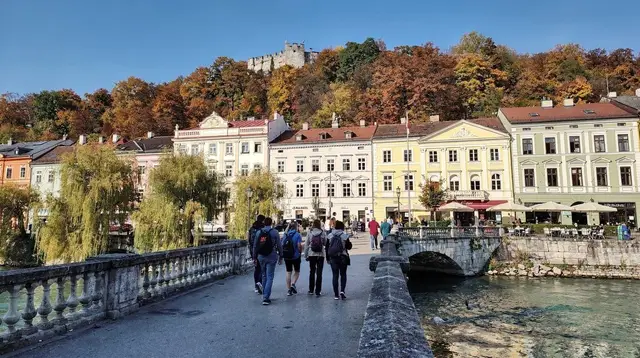
On one side of the water is the old town proper, a dense knot of baroque facades and narrow streets pressed against the base of Castle Hill. On the other side is Preseren Square, the city’s most photographed public space, named after Slovenia’s national poet and anchored by a pink Franciscan church. The two banks are connected by a handful of bridges, the most famous being the Triple Bridge — three parallel spans that funnel pedestrians across the river at slightly different angles, a design so distinctive it has become shorthand for the city itself.
Above all of this, on a wooded hill, sits the castle, reachable by funicular or by a fifteen-minute walk up several marked paths. You do not need to go into the castle itself to understand its role in the city’s geography: it is the reference point that tells you which way is “up” and which way is “toward the river” no matter where you are standing in the Ljubljana old town.
A City Shaped by One Architect
What makes Ljubljana’s center unusual among European capitals is how much of it carries the signature of a single person. The architect Joze Plecnik redesigned much of the city in the early twentieth century — the Triple Bridge, the stone embankments and market colonnades along the Ljubljanica, the National and University Library, several churches, and the Zale cemetery complex on the city’s edge. This body of work was inscribed as a UNESCO World Heritage site on 31 July 2021, under the title “The works of Joze Plecnik in Ljubljana — human centred urban design.”
For a first-time visitor, the practical upshot is that you do not need to seek out Plecnik’s work as a separate itinerary item — you are looking at it the moment you cross the river or walk along the central market. If the subject interests you beyond a passing mention, both a dedicated Plecnik guide and a closer look at the UNESCO listing go into the individual buildings and the listing itself in more depth.
Beyond the Plecnik-era core, two other pockets are worth knowing about before you arrive. Tivoli Park is the city’s large green lung, a short walk northwest of the center, good for a quiet afternoon away from the old town crowds. Metelkova, a former military barracks turned alternative art and nightlife squat, sits near the train station and offers a rougher, more countercultural contrast to the manicured riverside — worth a look even if just walking through during the day.
How to Move Around on Your First Day
The single most useful thing to know about central Ljubljana is that it is a pedestrian zone. Regular car traffic is banned from the historic core, which is part of why the city feels unusually calm for a capital. If you are staying inside or near this zone, you likely will not need public transport at all for sightseeing — everything from the train station to the castle base is within a twenty- to thirty-minute walk.
For the moments when you do want a lift across the pedestrian zone, look for the Kavalir: a small, free electric vehicle that carries up to five passengers with no fixed stops or schedule. You simply hail one or call for it, and it runs from around 6am to 10pm, with a couple of enclosed, heated vehicles kept in service through the winter.
If your accommodation sits outside walking distance, or you plan to head to the bus or train station, you will use Ljubljana’s city buses, run by LPP. One detail catches many first-time visitors off guard: cash has not been accepted on board since 10 May 2010. You will need an Urbana card (the card itself costs 2 EUR, topped up separately) or a contactless bank card; a single ride runs in the neighborhood of 1.30 EUR, though it is worth checking lpp.si for the current fare before you travel. The full mechanics of getting around, including how the Kavalir and buses fit together, are laid out at the getting-around guide.
Should You Buy the Ljubljana Card?
Many first-time visitors ask about the Ljubljana Card before they have even landed, and it is worth understanding what it actually bundles rather than assuming it is automatically worthwhile. As of 2026 it costs 41 EUR for 24 hours, 49 EUR for 48 hours, and 54 EUR for 72 hours for an adult, with reduced pricing for children aged 6 to 14. In exchange, it covers unlimited city buses, the funicular ride up Castle Hill and entry to the castle itself, one guided city walk, a river cruise on the Ljubljanica, a bicycle rental, entry to more than twenty museums and galleries, the zoo, and the cable car up to Velika Planina.
The card tends to pay for itself once you add up the castle admission, a cruise, and two or three museums — a calculation simple enough to do on the spot with whatever you already plan to see. If you are undecided, a dedicated cost breakdown walks through the arithmetic in more detail, and what to book in advance for Slovenia covers what else is worth reserving before you land.
Arriving: The Airport and the First Hour
Ljubljana’s airport, commonly called Brnik after the town it sits near, is about 25 km northwest of the city center. The public bus, line 28, connects the airport to the main bus station in roughly 45 to 55 minutes, running every 30 to 60 minutes between about 5am and 9:30pm. Fares differ slightly between weekdays and weekends, so rather than quote a single number here, check ap-ljubljana.si before you fly, or read the fuller walkthrough at the airport guide.
If you are renting a car for the wider trip rather than just the city, note that Slovenia’s motorway system runs on an electronic vignette rather than a toll booth — worth sorting out before you leave the airport rental counter, and covered separately at the vignette guide. Inside Ljubljana itself, though, a car is more liability than asset: parking is limited, the center is pedestrian, and walking or the free Kavalir will get you everywhere faster.
Money, Language, and Small Practicalities
Slovenia adopted the euro on 1 January 2007, making it the first of the ten countries that joined the EU in 2004 to enter the eurozone — a genuine convenience compared to some neighboring countries where currency conversion is still part of every transaction. Card payment is widely accepted, including on city buses, though carrying some cash is still useful for smaller vendors at the central market or for tipping.
Slovenia has been an EU member since 1 May 2004 and part of the Schengen area since 21 December 2007, but this is one place where a first-time visitor’s assumptions can go wrong: temporary border checks were reintroduced on Slovenia’s borders with Croatia and Hungary in October 2023, and as of this writing they have been extended repeatedly, currently through 21 December 2026. If your trip includes arriving overland from Zagreb, do not assume a check-free crossing simply because both countries are in the EU — see the current border-check situation for the latest.
On language: Slovene is the official language, and while English is widely spoken in tourism-facing businesses in Ljubljana, a handful of basic phrases go a long way, especially outside the capital. A short glossary is available at a short language guide. Slovenia is also, reassuringly, one of the safer destinations in Europe for visitors of all kinds; practical notes are gathered at safety notes for Slovenia.
The Name Trap: Ljubljana, Not Lubiana or Laibach
If there is one factual trap specific to writing or reading about this city in English, it is the name itself. Lubiana is the Italian form of the city’s name, still used in Italian-language contexts, and Laibach is the historical German name, tied to the centuries when the city sat within German-speaking administrations and empires. Neither belongs in English travel writing today. The only correct English spelling is Ljubljana, pronounced roughly “lyoo-BLYA-na.”
This is not a pedantic point. Using an old colonial-era or imperial-era name for a city that has been the capital of an independent country since 1991 reads, at best, as outdated, and at worst as a small but real disrespect — rather like calling modern-day Bratislava by its old German name in a contemporary guide. If you want the fuller story of how the city shed these older names, the fuller story is here. And while you are correcting assumptions: Slovenia is not Slovakia, a mix-up common enough that it has its own explainer.
Deciding How Long to Stay
Because Ljubljana’s core is so compact, first-time visitors often underestimate how quickly they can “see” it and overestimate how much time they need to actually enjoy it. Two full days is a comfortable amount of time to walk the old town at an easy pace, go up to the castle, browse the riverside market, and still have room for a museum or a long lunch by the water. A single day works if you are treating Ljubljana as a base and spending the rest of your trip on day excursions.
For structured options, a one-day itinerary and a two-day itinerary lay out hour-by-hour plans, and if you are weighing the capital against a longer countrywide trip, how many days you need in Slovenia addresses that bigger question directly. One practical way to get an efficient first look at the city’s highlights without over-planning is a guided overview tour — a guided walk through Ljubljana’s history and old town highlights covers the essentials in a single outing, which can be a useful anchor for your first afternoon.
Day Trips Are Part of the Ljubljana Experience
Because Slovenia is so small, treating Ljubljana purely as a city destination misses much of the point. Within about an hour’s drive sit some of the country’s best-known sights: Lake Bled, with its island church and cliffside castle, and the karst region around Postojna, home to a vast show cave and the cliffside Predjama Castle. Slightly farther afield, the Julian Alps around Kranjska Gora and the Soca Valley offer a completely different, mountain-and-white-water side of the country.
You do not need to rent a car to reach any of these. Organized day tours run daily from the capital, and this is where booking ahead genuinely saves time compared to arranging trains, buses, and timed cave tickets yourself. For the lake, a day tour to Lake Bled departing from Ljubljana handles the transport and timing in one booking.
For the caves, a day trip from Ljubljana to Postojna Cave is worth booking in advance, since the cave’s own ticketing requires a fixed date and time slot. And if the mountains are more your pace, a full-day tour covering the best of the Julian Alps is a practical way to see Kranjska Gora and the alpine valleys without driving yourself over the Vrsic Pass’s fifty hairpin turns.
If you are coming from outside Slovenia altogether — say, on a stopover from Zagreb, Trieste, or Venice — Ljubljana also works well as the day-trip destination itself; see arriving from Zagreb, arriving from Trieste, and arriving from Venice for that direction of travel.
Where to Stay for a First Visit
For a first stay, proximity to the pedestrian core matters more than almost anything else, since it is what lets you walk to dinner, the market, and the castle base without needing transport at all. The tradeoffs between the old town, the area around the train station, and quieter residential pockets are covered in full at where to stay in Ljubljana — worth reading before you book, since the “old town” listing on a booking site does not always mean what it implies.
Frequently Asked Questions About Visiting Ljubljana for the First Time
Is Ljubljana a good base for exploring Slovenia?
Yes. Slovenia covers only 20,271 square kilometers, and from Ljubljana, Bled is about 55 km away, Postojna about 53 km, Piran around 120 km, and Maribor about 130 km. Nearly every major sight in the country is reachable as a day trip from the capital.
How many days do I need for a first visit to Ljubljana?
Two full days let you cover the old town, the castle hill, and the riverside markets without rushing, though even one focused day is workable if you are combining the city with day trips. For a longer stay that mixes the capital with excursions, see How Many Days Do You Need in Slovenia? for a fuller breakdown.
Is the old town in Ljubljana closed to cars?
Yes, the historic center is a pedestrian zone closed to regular car traffic. Locals and visitors who need a lift across it can flag down the Kavalir, a free electric shuttle that carries up to five passengers with no fixed stops, running from 6am to 10pm.
Is Lubiana or Laibach the correct name for the city?
No. Lubiana is the Italian form and Laibach is the historical German name; neither is used in English today. The only correct spelling in English is Ljubljana, and using the older names in a modern travel context reads as outdated or, to Slovenes, mildly tone-deaf.
Is the Ljubljana Card worth buying?
It depends on how many paid sights you plan to visit in a day, since the card bundles unlimited city buses, the castle funicular and entry, a guided walk, a river cruise, and more than twenty museums into one price. The full cost breakdown is covered separately in Is the Ljubljana Card Worth It?.
How do I get from Ljubljana Airport into the city?
The airport, also called Brnik, sits about 25 km northwest of the center. Public bus line 28 connects it to the main bus station in roughly 45 to 55 minutes, with departures every 30 to 60 minutes between around 5am and 9:30pm; full details are in Ljubljana Airport to City Center.
Do I need a car to visit Ljubljana and its surroundings?
Not for the city itself, which is fully walkable and served by buses, but a car opens up more flexibility for day trips to places like Bled, Postojna, or the Karst. Many visitors instead combine walking in Ljubljana with organized day tours; see Slovenia Without a Car for the alternative.
Trip-planning essentials on GetYourGuide
Verified deep-linked GetYourGuide tours. Book through these links and we earn a small commission at no cost to you.
GetYourGuide does not provide a product photo for this activity — the image shows the meeting point, photographed by us.