Walking Jože Plečnik's Ljubljana
What does the Plečnik walk in Ljubljana actually cover?
It follows the outdoor work of architect Jože Plečnik in central Ljubljana: the Triple Bridge, the Ljubljanica embankments, the Central Market colonnade, the Shoemakers' and Trnovo bridges, and several squares. This inscribed UNESCO ensemble is free to see and fits into two to three unhurried hours on foot, with Žale cemetery as a separate short trip by bus.
A Route, Not a Checklist
Most visitors experience Ljubljana’s old town as a pleasant blur — a bridge here, a market stall there, a castle view from below. This walk asks for a slightly different kind of attention. It follows one architect’s outdoor work through the city centre, stop by stop, so that the bridges, the riverbanks, the market colonnade and a handful of squares read as pieces of a single design rather than unrelated sights that happen to be pretty.
That architect is Jože Plečnik, and his urban work in Ljubljana was inscribed on the UNESCO World Heritage List on 31 July 2021, under a title that says more than most heritage listings bother to: a human-centred urban design. The inscription doesn’t cover a single building. It covers an ensemble — squares, parks, the river embankments, the bridges, the market, and the funerary complex at Žale — built or reshaped by one person over roughly three decades in the twentieth century.
This guide sticks to the outdoor route through that ensemble. For the history and significance of the UNESCO listing itself, the dedicated heritage guide covers that ground properly; this page is about walking, not about the committee meetings that got the site listed.
Who Plečnik Was, in One Paragraph
Jože Plečnik was a Ljubljana-born architect who trained in Vienna, worked in Prague, and returned to his home city in the 1920s to more or less reshape its public spaces for the rest of his working life. He wasn’t handed a blank site — he was asked to rework an existing, fairly ordinary provincial capital, and he did it through additions and interventions rather than demolition: a colonnade added to a market street, a set of terraces built down to a riverbank, a bridge widened into three. That approach is exactly why the work rewards walking rather than a single photograph. Each piece only makes sense next to the ones around it.
The Walk: Prešeren Square to the Triple Bridge
Start where most people start anyway: Prešeren Square, the wide plaza in front of the pink Franciscan Church, at the edge of the pedestrianised centre described in the old town walking guide. From here, the Triple Bridge — Tromostovje — is the first and most recognisable Plečnik intervention. It began as a single stone bridge; Plečnik didn’t tear it down, he added two pedestrian bridges alongside it, angled slightly outward, turning one crossing into three converging on the same point. The result solved a practical traffic problem of the 1930s and produced the single most photographed spot in the city in the same move — a fair summary of how Plečnik tended to work.
Stand at the centre of the Triple Bridge for a minute before moving on. This is also the spot where the old town’s car-free zone becomes obvious: no traffic crosses here, only the small electric Kavalir shuttles that serve the pedestrianised streets, a detail covered in more depth in the piece on the car-free city centre.
Along the Ljubljanica: Plečnik’s Embankments
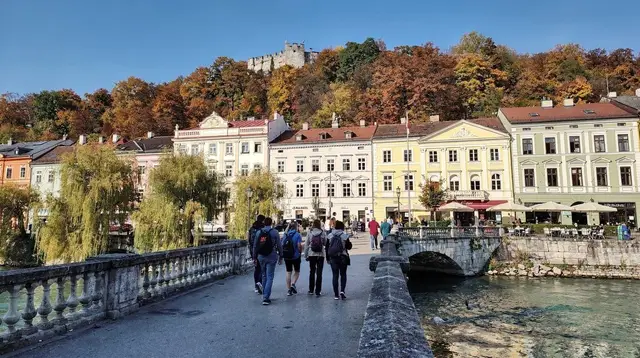
Cross onto either bank and the walk continues along the river itself. Before Plečnik, the Ljubljanica’s banks were closer to a working waterfront than a promenade. He terraced them, added stone balustrades, planted rows of willows and pollarded trees, and set benches and lamp posts to a consistent design that still stands. Walk either the Cankarjevo nabrežje side or the opposite bank and the effect is the same: a continuous, walkable riverside room, at once a flood-control structure and a public space, that turns the river into the spine of the old town rather than its back door.
This stretch is also where a river cruise offers the opposite angle on the same work — sitting at water level looking up at the embankments and bridges rather than walking along the top of them. Doing both, on the same visit or on separate days, is the closest thing this walk has to a bonus round.
The Central Market and Its Colonnade
Follow the riverbank north from the Triple Bridge and the embankment walk runs directly into the Central Market — Plečnik’s covered market colonnade, a long arcaded structure that runs along the river’s edge on the town side. Before this addition, market trading in Ljubljana happened in the open, exposed to weather. Plečnik roofed a long stretch of stalls under a covered arcade, gave it a riverside colonnade with a row of columns facing the water, and tied the whole structure back into the embankment walk so that market, riverbank and bridge form one continuous public sequence rather than three separate errands.
The market itself is at its liveliest in the morning, with produce, flowers and small food stalls under the arcade and along the open-air stands beside it — worth timing this stop for if the schedule allows, though the architecture itself is visible and worth seeing at any hour. For food to actually eat nearby, the what-to-eat guide has market-adjacent recommendations.
Bridges Beyond the Triple: Shoemakers’ and Trnovo
The Triple Bridge gets the postcards, but Plečnik touched more than one crossing over the Ljubljanica. A short walk downstream from the market, the Shoemakers’ Bridge — Čevljarski most — carries his signature colonnade treatment: a row of stone columns lining a pedestrian bridge, named for the shoemaker guild that once traded on this stretch of riverbank. Further south, near the edge of the old town, the Trnovo Bridge is a smaller, quieter piece of the same body of work, a triple-arched crossing that locals use far more than visitors do.
Neither of these is a long detour from the central route, and both matter precisely because they show the same design language repeated at a smaller scale — this was never a one-bridge project.
Squares and Parks: Congress Square, Vodnik, and the Edge of Tivoli
Away from the water, Plečnik’s touch shows up in the city’s squares as much as its crossings. Congress Square, on the southern edge of the old town, carries his landscaping and paving work alongside the older buildings framing it. Vodnik Square, tucked behind the market, is a smaller, quieter example of the same instinct for turning leftover urban space into a proper public room. Neither square demands much time on its own, but both sit naturally on a route that already runs between the market and the river, and both are the kind of detail a self-guided walk catches that a rushed itinerary skips entirely.
If the walk still has legs left, the approach to Tivoli Park at the western edge of the centre — not part of the UNESCO ensemble itself, but shaped by the same era of civic planning — makes a pleasant, green way to end the central portion of the day, before circling back toward wherever you’re staying; the where-to-stay guide covers old-town options within easy walking distance of every stop on this route.
What This Walk Skips — and Where to Find It
Two pieces of Plečnik’s Ljubljana deserve more space than a walking route can give them, so this guide leaves them out on purpose rather than rushing past them.
The first is the National and University Library, arguably Plečnik’s single best-known building and very much part of the same UNESCO listing — its brick-and-stone facade and dramatically lit reading room are worth a dedicated stop with proper time, not a glance from the street. The full library guide covers opening hours, what to look for inside, and how it fits into a longer old-town day.
The second is the UNESCO inscription itself: why it took until 2021, what “human-centred urban design” is meant to convey as an official heritage category, and how Ljubljana’s listing compares to the more familiar single-monument inscriptions most travellers are used to. That story lives in the UNESCO heritage guide, not here — this page is deliberately about the legwork, not the paperwork.
Žale: The Cemetery as Architecture
The last stop on a complete Plečnik itinerary sits well outside the old town: Žale, Ljubljana’s main cemetery, a few kilometres northeast of the centre and reached by public bus rather than on foot. It’s easy to assume a cemetery has no place on a sightseeing route, and that assumption is exactly what this walk pushes back on — Žale’s entrance complex, a set of pavilions and an arcaded garden known as the Garden of All Saints, is considered one of Plečnik’s most complete and unified designs, built as a proper civic gateway between the city of the living and its dead rather than a purely functional entrance.
Because it sits apart from everything else on this route, treat Žale as its own short outing rather than an add-on squeezed in at the end of a long walking day — go with some energy left, and allow time to look at the pavilions rather than just pass through the gate. Getting around by public transport more generally, including the bus network that serves Žale, is covered in the guide to getting around Ljubljana.
Planning the Walk
| Stop | Where | What to look for | Cost |
|---|---|---|---|
| Triple Bridge | Prešeren Square | Three bridges converging on one point | Free |
| Ljubljanica embankments | Both riverbanks, old town | Terraced quays, balustrades, willows | Free |
| Central Market colonnade | Riverside, north of the Triple Bridge | Covered arcade, riverside columns | Free |
| Shoemakers’ Bridge | South of the market | Colonnaded pedestrian bridge | Free |
| Trnovo Bridge | Southern edge of old town | Triple-arched crossing | Free |
| Congress Square & Vodnik Square | Central old town | Paving and civic landscaping | Free |
| Žale cemetery | A few km northeast, by bus | Entrance pavilions, Garden of All Saints | Free (bus fare only) |
The central stops — everything above Žale in this table — sit close enough together to link into one continuous route of two to three hours, which slots easily into a broader one-day itinerary or a slower car-free weekend built around the pedestrian centre.
Anyone new to the city can also fold this walk into general orientation using the first-timer’s guide, and families with children who need a break partway through will find the zoo and the free Kavalir shuttle covered in the guide for kids in Ljubljana — a useful pressure valve if little legs give out before the architecture tour does.
For a version of this same ground with more context, more stories, and fewer wrong turns, a local guide adds real value here — Plečnik’s work is subtle enough that it’s easy to walk straight past a detail that a guide would stop and point out.
a private guided walk through Ljubljana’s old town, built around your own pace covers this route with room to linger, while a set-departure walking tour with a local guide is the lower-cost way to get the same context on a fixed schedule. Either pairs naturally with time spent afterward at the city’s museums or simply wandering the things to do in Ljubljana at your own pace.
Frequently Asked Questions About Walking Plečnik’s Ljubljana
How long does the Plečnik walk take in Ljubljana?
The central stretch — Triple Bridge, the river embankments, the Central Market and the nearby bridges and squares — takes about two to three hours at a slow pace with stops. Add Žale cemetery as a separate half-day if you go that far.
Is walking the Plečnik sites in Ljubljana free?
Yes. Every stop on this route is an outdoor public space — a bridge, a quay, a market colonnade, a cemetery gate — with no entrance fee. The only cost is the bus fare if you ride out to Žale rather than walk.
Do I need a guide to see Plečnik’s work in Ljubljana?
No, the central route is easy to follow on foot with a map, since almost everything sits within the compact old town. A guide adds context on Plečnik’s ideas and shows details a first-time visitor would otherwise miss, which is where a private city tour or a walking tour with a local guide earns its price.
Is the Plečnik walk only about the bridges over the Ljubljanica?
No. The bridges are the most photographed part, but the UNESCO inscription covers a wider ensemble — the river embankments and willows, the Central Market colonnade, several city squares and parks, and the Žale cemetery complex on the edge of town.
Can I combine the Plečnik walk with the National and University Library?
Yes, the library building sits inside the same old town and is one of Plečnik’s best-known works, but it deserves its own visit rather than a rushed stop — see the dedicated library guide for opening hours and what to look for inside.
Is Žale cemetery worth the trip out from central Ljubljana?
For anyone genuinely interested in Plečnik’s architecture, yes — the entrance complex and All Saints’ Garden are considered one of his most complete designs. It sits away from the old town, so it makes sense as a separate stop by bus rather than an add-on to the central walk.
Is the Plečnik walking route accessible with a stroller or wheelchair?
The riverside embankments and the market area are flat and paved, and manageable with a stroller or wheelchair. A few of the older bridges and cemetery paths have uneven stone surfaces, so expect some slower going rather than a fully smooth ride.
tours.museums-art
Verified deep-linked GetYourGuide tours. Book through these links and we earn a small commission at no cost to you.
GetYourGuide does not provide a product photo for this activity — the image shows the meeting point, photographed by us.