Getting to Ljubljana from Zagreb: Border Crossing Guide
How do I get from Zagreb to Ljubljana, and is the border still controlled?
Zagreb and Ljubljana sit roughly 140 km apart, about 1.5 to 2 hours by car or direct bus. Even though both countries are in the Schengen area, Slovenia reintroduced temporary checks at its border with Croatia in October 2023, and they have been extended repeatedly, currently through 21 December 2026 — carry a passport or ID card and allow extra time.
Two capitals, one border that still has a checkpoint
Zagreb and Ljubljana are two of the closest capital cities in Europe, roughly 140 km apart, and for a while it looked like the drive between them would become as uneventful as crossing a state line. Croatia joined the Schengen area on 1 January 2023, and on paper that should have meant an open border with Slovenia, which has been inside Schengen since 2007.
In practice, it did not last: in October 2023 Slovenia reintroduced temporary controls at its borders with Croatia and Hungary, and those controls have been renewed repeatedly since, currently extended through 21 December 2026. So the honest answer to “is the border open” is: open to Schengen-style free movement in principle, but with real document checks in practice. Anyone planning a trip that combines Croatia and Slovenia needs to plan around that fact, not around the headline about Schengen membership.
This page focuses narrowly on the logistics of that one crossing — the routes, the transport options, what the border stop actually involves, and what to buy in advance if you are driving. It does not compare Zagreb and Ljubljana as destinations; if that is what you are after, see Ljubljana vs Zagreb instead. Here, the assumption is that you already know you are going from one city to the other and need the practical route.
How far is it, really
The most direct road route between the two capitals runs roughly 140 km, largely on motorway on both sides of the border. Driving time without any delay is typically 1.5 to 2 hours. That estimate does not include the border stop itself, which can range from a couple of minutes on a quiet weekday morning to a much longer wait during a summer holiday weekend rush. If you are timing a day trip or a transfer to catch a flight out of Ljubljana airport, build in a buffer rather than cutting it close — a “should take two hours” trip can become a “took three hours” trip on the wrong afternoon.
The most common approach road crossing sits near Bregana on the Croatian side, feeding into the Slovenian motorway network south of Ljubljana. Whichever operator or route you use — self-drive, bus, or organized tour — this is the general corridor most journeys follow.
The border checks: what actually changed and why it matters
It’s worth being precise about this, because a lot of outdated content online still describes the Croatia-Slovenia border as fully open post-Schengen. Here is the sequence:
- Croatia became a full Schengen member on 1 January 2023, which in theory removed systematic border controls with neighboring Schengen states.
- In October 2023, Slovenia reinstated temporary controls specifically on its borders with Croatia and Hungary, citing irregular migration pressure along that corridor.
- Those temporary measures have been extended multiple times since, and are currently prolonged through 21 December 2026, according to the Slovenian government.
What this means for a traveler: you should expect a stop staffed by border police, a request to show a passport or national ID card, and occasionally a few questions about your trip. It is not the same as a pre-Schengen full customs stop, but it is also not nothing — do not assume you can breeze through without identification just because both countries are technically in the same free-movement area. Carry a passport (or ID card, for EU/EEA citizens) for every person in the vehicle or on the bus, including children, and keep it accessible rather than buried in checked luggage.
Driving from Zagreb to Ljubljana
Self-driving is the most flexible option, especially if your Slovenia visit includes stops beyond Ljubljana itself — Lake Bled, the Julian Alps or the Karst caves are all easy add-ons with your own car and much harder to reach efficiently by public transport.
Two things to sort out before you leave Zagreb:
The vignette. The moment your wheels touch a Slovenian motorway, you need a valid e-vinjeta — Slovenia has gone fully electronic, so there is no sticker to display, but the vehicle’s plate needs to be registered against a paid vignette in the system. For a standard passenger car (category 2A, under 1.30 m at the first axle), it costs 16 EUR for a week or 32 EUR for a month.
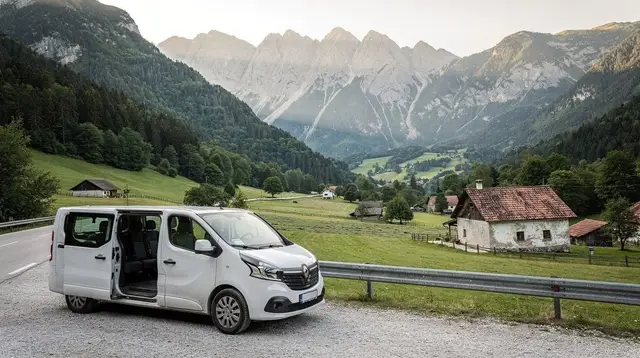
Taller vehicles — campervans, larger SUVs, vans — fall into category 2B and pay 32 EUR for a week or 64.10 EUR for a month. Buy it online before you cross, or at a service station on either side of the border; driving without one is enforced and fined. Full details and purchase are at evinjeta.dars.si — see also our Slovenia vignette guide for the complete rundown.
The rental car question. If you are picking up a rental car in Zagreb specifically to cross into Slovenia, confirm with the rental company that cross-border travel is permitted and covered by insurance — this is standard for Croatia-Slovenia but always worth a two-minute check before you drive off. For general guidance on driving in the country once you’re across, see renting a car in Slovenia.
Once you’re through the border and into Slovenia, the motorway delivers you close to Ljubljana itself, or you can peel off toward Lake Bled, Postojna Cave and Predjama Castle without going into the city center at all — a useful option if Ljubljana isn’t your only stop that day.
Bus: the most predictable option
International coach operators run the Zagreb-Ljubljana route multiple times daily, arriving at Ljubljana’s central bus station, which sits right beside the main train station a short walk from the old town. A bus removes the vignette question and the parking search entirely, and the fare is generally the most budget-friendly way to make the trip. The trade-off is the same one every road option faces: the scheduled journey time does not include the border stop, so a bus that is timetabled for roughly two hours can run somewhat longer depending on the queue that day.
For onward travel once you’re in the city, see getting around Ljubljana, and if you’re planning to skip a rental car for your whole Slovenia trip, Slovenia without a car covers how far that strategy can take you. General coach network context for the wider country is in our Slovenia intercity bus guide.
Train: fewer departures, same border reality
A direct rail service connects Zagreb and Ljubljana, jointly operated by the two countries’ railways, with a journey time in the range of two to two and a half hours. Frequency is limited to a small number of departures a day rather than an hourly shuttle, so this is a route to book and time around rather than turn up and go. The border check applies on the train as it does on the road — an officer typically moves through the carriages rather than requiring passengers to disembark, but the same identification rules apply. If you’re weighing train against other transport for the wider trip, our Slovenia train guide covers the national network in more depth.
Organized day tours: no logistics to manage
For visitors based in Zagreb who want to see Ljubljana, Lake Bled or the Karst caves without dealing with the vignette, the border stop, or parking in an unfamiliar city, a guided day tour from Zagreb removes essentially all of that friction — a driver handles the crossing and the route, and you’re dropped where the sightseeing happens. A few options that run this corridor:
a combined day trip to Ljubljana and Postojna Cave from Zagreb pairs the capital with the karst caves in a single outing, useful if you only have one day to spare and want both. For travelers prioritizing the lake over the caves, a day trip covering both Ljubljana and Lake Bled from Zagreb is the more scenery-focused version of the same idea. If you’d rather set your own pace and skip a shared coach entirely, a private day tour to the Bled and Ljubljana highlights from Zagreb puts the schedule in your hands.
This kind of tour makes the most sense as a single-day outing. If your plan is a longer Slovenia stay — several nights around Ljubljana, the Julian Alps or the coast — driving yourself, or taking the train or bus one-way and renting locally, tends to work out more flexible and often cheaper per day than repeated day-tour bookings. See multi-day tours from Ljubljana if you want a guided structure without committing to self-drive.
Comparing the options at a glance
| Option | Approx. journey time | Border handled by | Best for |
|---|---|---|---|
| Self-drive | 1.5–2 hours + border wait | You (passport/ID + vignette) | Flexibility, side trips to Bled or the Karst |
| Direct bus | ~2 hours + border wait | Driver (passengers show ID) | Budget, no vignette or parking to arrange |
| Direct train | ~2–2.5 hours | Onboard border check | No driving, but limited daily departures |
| Organized day tour | Full-day itinerary, round trip | Guide/driver | Zero logistics, single-day Ljubljana or Bled visit |
What to have ready before you leave Zagreb
A short checklist tends to prevent most of the friction at this particular border:
- A valid passport or national ID card for every traveler, kept accessible rather than packed away.
- If driving: a purchased e-vinjeta valid for your vehicle category and dates, bought before you reach a Slovenian motorway.
- A time buffer of at least 30–45 minutes beyond the scheduled or estimated driving/journey time, to absorb whatever the border queue looks like that day.
- Confirmation from your rental company, if applicable, that cross-border travel to Slovenia is permitted under your rental agreement.
- A realistic expectation: the checks are a document stop, not a full customs inspection, but they are real and have been extended into 2026 — don’t plan around the idea that Schengen membership alone removed them.
For what to book ahead of time for the Slovenian side of the trip more broadly — cave tickets, Bled boat crossings, timed entries — see what to book in advance in Slovenia, and for a general safety picture of the country once you’ve crossed, safety in Slovenia.
Zagreb-Ljubljana border crossing: frequently asked questions
Is there still a border checkpoint between Croatia and Slovenia?
Yes. Slovenia reinstated temporary controls at its borders with Croatia and Hungary in October 2023, and they have been prolonged several times, most recently through 21 December 2026. Schengen membership on both sides has not removed the checks, so expect a stop and a document check when crossing near Bregana or on other Zagreb-Ljubljana routes.
How far is it from Zagreb to Ljubljana?
The direct road distance is roughly 140 km, mostly on the A2/A1 motorway network on the Croatian side and the A1 in Slovenia. Driving time is typically 1.5 to 2 hours without traffic, plus whatever time the border stop adds.
Do I need my passport to cross from Croatia to Slovenia?
Bring a valid passport or national ID card for every traveler, including children, even though both countries are EU and Schengen members. With temporary checks in place, officers can and do ask to see it.
Can I take a direct train from Zagreb to Ljubljana?
There is a direct rail connection between the two capitals, run jointly by Croatian and Slovenian railways, with journey times of around two to two and a half hours. Departures are limited to a handful a day, so check current timetables and book ahead rather than assuming a frequent shuttle-style service.
Is there a direct bus from Zagreb to Ljubljana?
Yes, international coach operators run the Zagreb-Ljubljana route multiple times a day, arriving at Ljubljana’s central bus station next to the train station. It is usually the most predictable option price-wise, though the border stop can still add time on top of the scheduled journey.
Do I need a vignette to drive from Zagreb to Ljubljana?
Yes. As soon as you join a Slovenian motorway you need a valid e-vinjeta, bought online or at a service station before you drive. A standard car (category 2A) costs 16 EUR for a week or 32 EUR for a month; taller vehicles over 1.30 m, like campervans, fall into category 2B at 32 EUR a week or 64.10 EUR a month.
How long does the border crossing usually take?
It varies with traffic and time of day: sometimes it is a brief document check that adds only a few minutes, and at busy summer weekends or holiday departures it can add half an hour or more. There is no published guarantee either way, so building in a buffer is safer than timing a trip to the minute.
Is it better to book an organized day tour from Zagreb instead of driving myself?
For a single day trip, an organized tour removes the vignette purchase, the parking search and the uncertainty of the border stop, since a professional driver handles all of it. For a multi-day Slovenia visit, renting a car or taking the train/bus usually works out more flexible and often cheaper per day.
Transfers and transport passes on GetYourGuide
Verified deep-linked GetYourGuide tours. Book through these links and we earn a small commission at no cost to you.
GetYourGuide does not provide a product photo for this activity — the image shows the meeting point, photographed by us.