Ljubljana vs Zagreb: Splitting Your Time Between Two Capitals
Is Ljubljana or Zagreb better for a short trip?
Ljubljana is smaller, greener and easier to see in a day or two, with a walkable riverside old town; Zagreb is larger, with more museums and a livelier big-city feel that rewards two or three days. Most combined itineraries give Ljubljana one to two days and Zagreb two to three, using Ljubljana as the base for Slovenia's day trips.
Ljubljana and Zagreb sit less than 140 km apart, share a border crossing, and appear together on more Central European itineraries than almost any other capital pair on the continent. They also get compared constantly, usually by travelers standing in one city trying to decide how many nights to give the other. This page does not walk you through the road, bus or train connection between them — that logistics question has its own guide. It answers a different question: once you’re deciding how to split a combined trip, what does each city actually offer, and where does the extra night pay off?
Two Capitals, Two Very Different Scales
The single biggest difference between Ljubljana and Zagreb is size, and it shapes almost everything else on this page. Ljubljana is home to about 285,000 people, one of the smallest national capitals in Europe — small enough that its entire historic core, from the Triple Bridge to Preseren Square to the base of the castle hill, can be crossed on foot in twenty minutes.
Zagreb’s metro area holds roughly 800,000 people, nearly three times as many, and its center is correspondingly larger: the hilltop Upper Town (Gornji Grad) with its cathedral and Stone Gate, connected by funicular to the grid-planned Lower Town (Donji Grad) with its green horseshoe of parks and its own set of major museums.
Neither scale is objectively better; they suit different travel styles. Ljubljana rewards travelers who want to see everything on foot without consulting a map twice, who like a city small enough to feel finished after a day and a half. Zagreb rewards travelers who want more museums, more neighborhoods, and a bigger-city rhythm — market halls, tram lines, a livelier nightlife scene spread across more blocks. If your trip is built around Slovenia’s countryside — Lake Bled, the Julian Alps, the Karst caves — Ljubljana naturally becomes your base and Zagreb becomes the shorter stop bracketing the trip.
Historic Centers: A Single Architect vs. Two Distinct Towns
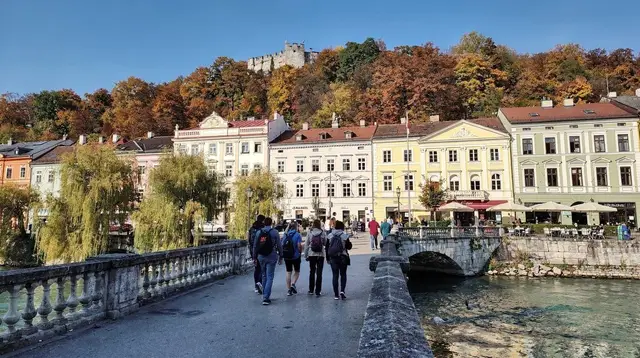
Ljubljana’s center carries an unusually unified signature. Almost every landmark along the Ljubljanica — the Triple Bridge, the riverside market colonnade, the National and University Library, the churches and the Zale cemetery complex — was designed or reshaped by one architect, Joze Plecnik, whose urban work across the city was inscribed as a UNESCO World Heritage Site on 31 July 2021. Walking the old town means walking through a single coherent vision, from the pedestrianized riverbanks up toward the castle on its hill above the rooftops.
Zagreb’s center tells a more layered story, because it is literally two historic towns fused into one. The Upper Town preserves a medieval street plan around St. Mark’s Church with its tiled roof, the Lotrscak Tower, and the Stone Gate shrine, all connected to the modern city by one of the world’s shortest funiculars. The Lower Town, laid out in the 19th century under Austro-Hungarian planning, arranges its major cultural institutions around a horseshoe of parks known as Lenuci’s Horseshoe. Where Ljubljana offers depth through one architect’s obsessive consistency, Zagreb offers breadth through centuries of overlapping development. Both reward slow walking; Zagreb simply needs more of it to see the same proportion of what’s there.
Museums, Culture and Nightlife
This is where Zagreb’s size becomes a genuine advantage. The city holds substantially more museums than Ljubljana, including two with cult reputations well beyond Croatia: the Museum of Broken Relationships, built entirely from donated objects and the stories behind failed relationships, and the Museum of Illusions. Add the Mimara Museum, the Archaeological Museum, and a contemporary art museum, and a culture-focused traveler can fill three full days without repeating themselves.
Ljubljana’s museum scene is smaller but not thin — the National Museum, the City Museum, and the National Gallery cover the essentials in an afternoon or two, and Plecnik’s own former house is a museum in itself. Where Ljubljana pulls ahead is atmosphere rather than institutional count: the riverside cafe terraces, the open-air Central Market, and Metelkova, the former military barracks turned alternative art and nightlife squat, give the city a bohemian, small-scale energy that punches above its size. Zagreb’s nightlife runs bigger and later, spread across more districts; Ljubljana’s is more concentrated and easier to stumble into without planning.
Food and Drink
Both capitals sit at a crossroads of Central European, Mediterranean and Balkan influences, and neither will disappoint a curious eater. Zagreb’s food scene benefits from scale: more restaurants, more price points, a stronger Austro-Hungarian thread of strudels, cured meats and hearty stews, plus a serious cafe culture along Tkalciciceva Street.
Ljubljana’s food scene is smaller in raw numbers but dense in a walkable radius — the Central Market’s open-air food stalls along the river, the Odprta Kuhna open kitchen market on Fridays in season, and a wine list drawing on Slovenia’s own vineyards in the Vipava Valley and Goriska Brda, both an easy day trip from the capital. If sheer restaurant variety matters most, Zagreb wins on volume; if you prefer everything within a ten-minute riverside walk, Ljubljana wins on convenience.
Day Trips: Where Ljubljana’s Small Country Pays Off
This is the comparison’s clearest asymmetry, and it comes down to geography rather than either city’s own merits. Slovenia covers just 20,271 km2 — roughly the size of Wales — which means almost the entire country sits within day-trip range of its capital. From Ljubljana, Lake Bled is about 55 km away, Postojna Cave about 53 km, and the Julian Alps closer still. A traveler based in Ljubljana can book a single day trip and see a glacial lake with an island church, a 900-year-old cliffside castle, or a cave system with an underground train, and be back for dinner.
Zagreb’s own day trips exist — Plitvice Lakes National Park chief among them — but Croatia is a larger, more elongated country, and Plitvice alone typically runs three to four hours round trip by car, longer by public transport. This is the practical argument for weighting a combined itinerary toward Ljubljana nights if day trips are a priority: not because Slovenia’s sights are better, but because its compact size lets you fit more of them into fewer travel hours. Several operators sell the Ljubljana side as an excursion from Zagreb itself, which suits travelers based in Croatia who want a single day in Slovenia rather than a full change of base.
For travelers who want to sample Slovenia’s countryside without committing extra nights in Ljubljana, a guided day trip from Zagreb covers the essentials in one outing. A day tour to Bled and Ljubljana from Zagreb pairs the lake and the capital in a single itinerary, while a day trip to Postojna Cave and Ljubljana swaps the lake for the underground cave system if caves rank higher on your list. Travelers who prefer a smaller group can look at a full-day tour covering Bled and Ljubljana departing directly from Zagreb.
Crossing the Border: What Schengen Did and Did Not Change
Croatia joined the Schengen Area on 1 January 2023, and it’s tempting to assume that means the Ljubljana-Zagreb border is now as invisible as the one between, say, Austria and Germany. It isn’t, and getting this wrong is the most common planning mistake for this specific trip. Slovenia reintroduced temporary border controls at its crossings with Croatia and Hungary in October 2023, citing migration management, and those controls have been renewed multiple times since. As of this writing they are extended until 21 December 2026, according to Slovenia’s government (gov.si).
In practice this means a traveler moving between the two capitals — by car, by bus, or even sometimes by train — can still be stopped and asked for a passport or national ID card at the Slovenian side of the crossing, despite both countries technically belonging to the Schengen Area on paper. It is not the hard, queue-for-an-hour border of pre-2013 Croatia, and most crossings are quick, but it is genuinely not the “no checks at all” experience that Schengen membership implies. Background on the reinstated checks is worth a skim before you travel, and it’s a useful data point regardless of which direction you’re heading — Zagreb to Ljubljana or the reverse.
How to Split Your Time in a Combined Trip
There’s no single correct ratio, but a few patterns cover most travelers well.
| Trip length | Ljubljana | Zagreb | Notes |
|---|---|---|---|
| 3 days total | 1 night | 2 nights | Ljubljana as a fast overnight stop, Zagreb as the anchor |
| 5 days total | 2 nights | 3 nights | Room for one Slovenia day trip plus Zagreb’s museums |
| 7 days total | 3–4 nights | 3 nights | Enough time for Bled or the Julian Alps plus a relaxed Zagreb pace |
| Day trip only | 0 nights (day trip) | Base city | Best if Slovenia is a bonus, not the focus |
Travelers whose main interest is countryside and outdoor scenery — lakes, alpine passes, caves — generally do better weighting the split toward Ljubljana, since that unlocks Slovenia’s day-trip network. Travelers whose main interest is museums, city walking and nightlife density tend to enjoy Zagreb’s extra size more. A trip built purely around efficiency, with Slovenia treated as a single excursion rather than a base, can also skip an overnight in Ljubljana entirely and book a day trip to Ljubljana from Zagreb, or a version that layers in Lake Bled on the same outing, such as a private day trip from Zagreb to Ljubljana and Lake Bled.
It’s worth remembering, too, that Ljubljana wasn’t always known by that name in every language a traveler might encounter in old guidebooks or maps — Italian sources historically used “Lubiana” and German ones “Laibach,” names tied to the region’s shifting history rather than to the independent country Slovenia has been since 25 June 1991, following a ten-day war that was brief by regional standards.
That history, distinct from Croatia’s own longer and harder path to independence, is part of why the two capitals feel different in tone even sitting so close together — worth a read for anyone curious about Slovenia’s path to independence before comparing the two cities on the ground.
Getting the Balance Right
If there’s one piece of advice that resolves most Ljubljana-versus-Zagreb indecision, it’s this: let the countryside decide, not the cities. Both capitals are enjoyable, walkable, and roughly comparable in cost and quality of experience — neither is a clear “skip this one” case. What tips the balance is what sits around each capital. Slovenia’s compact geography means a Ljubljana base multiplies quickly into lakes, mountains and caves within a single day; Croatia’s larger geography means Zagreb’s own day-trip options take a bigger bite out of your schedule. Decide first how much countryside you want to see, then let that number of days point you toward the city that unlocks it.
Frequently Asked Questions About Comparing Ljubljana and Zagreb
Is Ljubljana or Zagreb bigger?
Zagreb is considerably bigger, with roughly 800,000 people in its metro area against about 285,000 in Ljubljana. Zagreb’s center also spreads further, split between the Upper Town and the grid-planned Lower Town, while Ljubljana’s old town is a single compact loop around the Ljubljanica river.
How many days should I spend in each city?
A common split is one to two days in Ljubljana, since its center is walkable in an afternoon, and two to three in Zagreb, which has more museums and a larger historic core. Add extra Ljubljana nights only if you plan day trips to Lake Bled, Postojna Cave or the Julian Alps.
Do I still need to cross a border checkpoint between Ljubljana and Zagreb?
Croatia joined the Schengen Area on 1 January 2023, which removed routine border checks on paper, but Slovenia reintroduced temporary checks at its Croatian and Hungarian borders in October 2023. Those checks have been renewed repeatedly and are currently extended until 21 December 2026, so carry a passport or ID card and expect the possibility of a stop.
Which city has better food?
Zagreb has a broader restaurant scene given its size, with strong Austro-Hungarian influences, while Ljubljana’s food scene is smaller but dense and walkable, concentrated along the river and around the Central Market. Neither city disappoints; Ljubljana simply fits its highlights into fewer steps.
Is Ljubljana or Zagreb a better base for day trips?
Ljubljana is the stronger base for day trips because Slovenia is small enough that Lake Bled, Postojna Cave, and the Julian Alps sit within an hour or two of the capital. Zagreb’s own day trips, such as Plitvice Lakes, tend to run three to four hours round trip.
Can I visit both cities without renting a car?
Yes. Buses and some train services connect Ljubljana and Zagreb directly, and both old towns are fully walkable once you arrive, so a car is optional rather than necessary for this specific comparison.
Which city is cheaper?
Ljubljana and Zagreb sit close together on daily budget, both cheaper than Vienna or Venice but no longer the bargain either was a decade ago. Slovenia’s adoption of the euro in 2007 makes Ljubljana slightly easier to budget precisely, since there is no currency conversion to track.
Popular Ljubljana experiences on GetYourGuide
Verified deep-linked GetYourGuide tours. Book through these links and we earn a small commission at no cost to you.
GetYourGuide does not provide a product photo for this activity — the image shows the meeting point, photographed by us.