Paragliding in the Soča Valley: Tandem Flights Over Bovec
When is the best time to go paragliding in the Soča Valley?
Late spring through early autumn (May to September) gives the most reliable flying days, with calmer air in the early morning and late afternoon. This is not the same calendar as whitewater rafting, which peaks earlier in spring when the river runs highest from snowmelt.
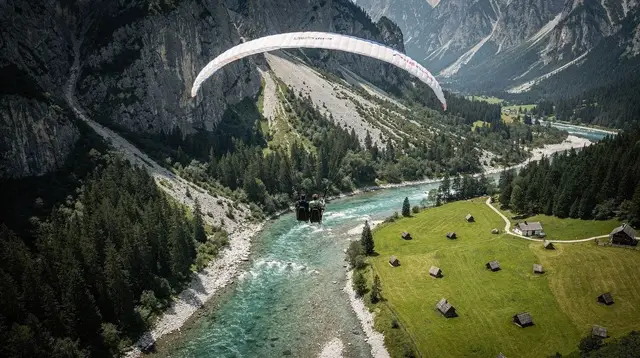
The Soča Valley is famous for what happens on its water: an emerald-green river that draws rafters, canyoners and kayakers from across Europe. Less talked about is what happens above it. From the slopes around Bovec, tandem paragliding pilots launch into the same mountain air that frames every postcard of the valley, and for a few minutes a passenger sees the whole system at once — the river, the gravel bars, the forested walls of the Soča Valley, and the peaks of the Julian Alps behind it. This guide is about that flight on its own terms, not as an add-on to the water sports that share its territory.
Why Paragliding Over the Soča Valley Is Different
Most visitors arrive in Bovec with a rafting trip or a canyoning descent already booked, and it is easy to assume paragliding slots into the same few adrenaline days without much extra thought. It does not, structurally. Rafting and canyoning depend on what the river is doing — its level, its speed, its temperature. Paragliding depends on what the sky is doing — wind strength, wind direction, thermal activity, cloud base.
These are two different natural systems that happen to sit on top of each other in the same valley, and treating them as one calendar is the single most common planning mistake for anyone trying to pack both into a short trip. A day that is perfect for whitewater can be grounded for flying, and the reverse happens just as often.
The other distinction is the vantage point. Rafting and canyoning put you inside the Soča river canyon, close to the rock and the current. Paragliding takes you above the whole valley at once — Kobarid, Tolmin, the forested ridgelines, and on a clear day the beginning of the road up toward the Vršič Pass. If the water sports are about immersion, the flight is about scale.
Where Tandem Flights Take Off
Bovec is the base for almost all Soča Valley paragliding, the same small town that anchors things to do around Bovec for every other adventure sport in the area. Pilots choose their exact launch point on the day, picking a hillside that matches the wind direction and the conditions the mountains are giving them that morning. This is normal practice everywhere paragliding is flown, not a sign of a disorganized operation — a fixed launch site regardless of wind would simply be less safe.
Landing is typically in the valley floor near Bovec, close to the river itself, which means the flight begins on a mountainside and ends more or less back where the day started. Transport to the launch point is arranged by the operator as part of the booking; passengers do not hike up carrying gear.
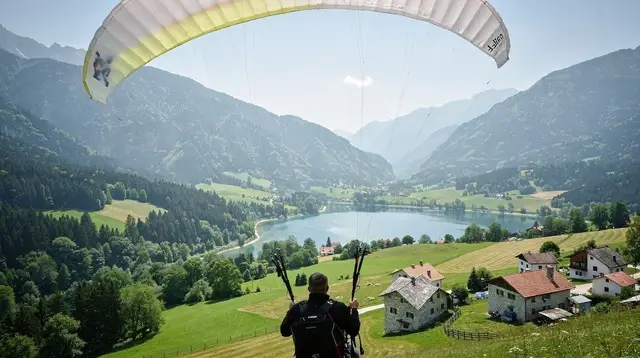
a tandem flight launching directly above the Soča Valley near Bovec is the most direct way to see this landscape from the air, and it is bookable as a standalone half-day activity rather than a multi-day course.
Some operators frame the same activity as a flight over the wider Julian Alps rather than the valley specifically, which usually describes the same region seen from a slightly different angle or launch point. a tandem paragliding flight over the Julian Alps around Bovec is worth comparing against the valley-specific option when a operator’s exact launch site matters to you.
Best Season for Flying, and Why It Isn’t the Rafting Season
This is the point worth repeating, because it is the trap the whole guide is built to avoid. Rafting on the Soča is at its most exciting in spring, when snowmelt from the surrounding peaks pushes the river to its highest and fastest. By late summer the same river has dropped and warmed considerably, calmer but still enjoyable. That is a water-level calendar.
Paragliding follows an air calendar. Reliable thermals — the rising columns of warm air that keep a paraglider aloft and give pilots room to work with — build through late spring and stay strongest into early autumn, roughly May through September. Within that window, early morning and the last hours before evening tend to offer the smoothest, least turbulent air, while the middle of a hot summer day can produce thermals strong enough that some pilots prefer to wait them out. Winter is generally unworkable for tandem flying in this terrain, for reasons that have nothing to do with the river being frozen or low.
The practical upshot: if a trip is built around one specific week, check paragliding conditions and rafting conditions separately rather than assuming a good water week is automatically a good flying week, or the other way round. Anyone building a broader Slovenia timeline should also read when to visit the Soča Valley and Slovenia’s weather by month before locking dates, and treat any single day in the valley as tentative until the operator confirms it on the morning itself.
What a Tandem Flight Actually Involves
A booking starts with a check-in, usually in or near Bovec, followed by a fitting for the harness and helmet and a short briefing on the takeoff run and landing. No previous flying experience is expected or required — the pilot controls the wing, the passenger’s job is mainly to run a few steps at launch and to sit back and enjoy the rest.
Transport up to the chosen launch point follows, and from there the flight itself begins with a short running takeoff downhill until the wing lifts both pilot and passenger off the ground. Flight duration is not fixed in advance; it depends on the thermals available that day and how the pilot chooses to use them, so one flight might be a fairly direct glide down to the valley floor while another catches enough lift to stay up considerably longer. Landing is a gentle run-out on flat ground near the river, at which point the equipment comes off and the experience is over.
Most operators offer photo or video packages taken from a camera mounted on the pilot or the wing, worth asking about at booking if a record of the flight matters to you, since a passenger’s hands are generally not free to hold a phone or camera mid-flight.
Weight, Age and Fitness Requirements
Tandem paragliding operators in the Soča Valley set practical limits designed around safety rather than arbitrary rules: a minimum age for younger passengers, a maximum weight the wing and harness are rated for, and sometimes an upper age limit or a request to disclose relevant health conditions such as heart or back problems. These limits vary between operators and are listed with each specific booking, so check them against your own situation rather than assuming eligibility. A reasonable level of general fitness helps with the takeoff run, but this is not a technical or physically demanding activity for the passenger — the pilot does the flying.
What to Wear and Bring
Closed, sturdy shoes with good grip are the one non-negotiable item, needed for the running takeoff and the landing on uneven ground. Beyond that, dress for a temperature drop: it is noticeably cooler in the air than on the valley floor, so a light jacket over a t-shirt is a sensible baseline even on a warm Bovec afternoon. Avoid loose scarves, dangling jewelry or anything that could catch in the lines of the wing. Sunglasses help with wind and glare; a GoPro or action camera mount, if the operator allows it, is worth asking about in advance rather than at check-in.
Combining Paragliding With the Rest of the Valley
Paragliding pairs naturally with a longer stay in the Soča Valley rather than a single rushed day, precisely because its own weather window does not always align with the day a rafting or canyoning trip is confirmed. Building in a spare day — or scheduling the flight on a separate morning from the water activities — is the simplest way to avoid disappointment if one gets rained or winded out.
For travelers who want the valley’s water sports alongside the flight rather than instead of it, both Soča river rafting and canyoning in Slovenia are covered in their own dedicated guides, and a guided day exploring the Soča Valley’s viewpoints and turquoise pools is a good lower-key complement on a day when the wind keeps pilots grounded.
Travelers who want to see more of the valley at a gentler pace between adrenaline activities can also consider an e-bike route along the Soča Valley, which needs neither strong thermals nor high water to be worthwhile.
Anyone planning a broader loop through this corner of Slovenia should also look at the Julian Alps adventure itinerary, which sequences Bovec-based activities with the rest of the region, and at hiking around the Vršič Pass for a non-flying way to reach a comparable view of the mountains on foot. Broader browsing of adrenaline options in the valley is collected under paragliding and adrenaline activities and the general things to do in the Soča Valley hub.
If Bovec Is Grounded: Flying Elsewhere in Slovenia
Because Soča Valley flying depends on mountain wind conditions that can shut down for a day or two at a time, it is worth knowing there is a second, unrelated option elsewhere in the country. Tandem paragliding is also flown above Lake Bled, launching from the hills around the lake rather than from the Julian Alps.
The scenery is different — an alpine lake and its island rather than a river canyon — and the flying conditions are a separate microclimate from Bovec, so a bad flying day in the Soča Valley does not necessarily mean a bad one at Bled. a tandem paragliding flight above Lake Bled is worth keeping as a backup, or as the primary option for visitors whose itinerary does not stretch as far as Bovec or Kranjska Gora in the first place.
Booking Timing and Practical Notes
Because launches depend on same-day wind readings, most operators confirm the exact time only a few hours ahead, and some build in a full-day window rather than a fixed slot so they can move a passenger to a better hour if conditions shift. Booking a flight for the first full day of a Bovec stay, rather than the last, leaves room to shift to a second day if the first is cancelled — a buffer that a fixed-departure rafting trip does not always allow for in the same way. Anyone traveling on a tight schedule around Bovec, Kobarid and Tolmin should read this flexibility into the itinerary from the start rather than discovering it after a cancellation.
Cancellations for weather are common enough in mountain paragliding generally that they should not be read as a sign of a poorly run operation; they are the normal cost of an activity that depends on conditions a company cannot control. What separates a well-run operator is clear communication about the decision and a straightforward rebooking or refund process when a flight cannot go ahead.
Paragliding in the Soča Valley: FAQ
What is the best time of year for paragliding in the Soča Valley?
Roughly May to September, when mountain thermals are stable enough for tandem flights. Early morning and late afternoon slots tend to have calmer, smoother air than the middle of a hot summer day.
Is the paragliding season the same as the rafting season in Bovec?
No, and this is the trap to avoid. Rafting on the Soča depends on the river’s water level, which is highest in spring from snowmelt and drops through summer. Paragliding depends on wind and thermal conditions in the mountains above, which follow a separate calendar. Booking both on the assumption that one good week guarantees the other is a common planning mistake.
Do I need any experience to go tandem paragliding in Bovec?
No. Tandem flights are flown with a licensed pilot in control, so no training or previous flying experience is required. A basic level of fitness helps with the short running takeoff and landing, but this is an activity most healthy adults can do.
How long does a tandem paragliding flight over the Soča Valley last?
Flight time varies with the day’s conditions and the pilot’s judgment, from a short direct glide to a longer flight if thermals allow extra time in the air. The full outing, including transport to the launch point and the briefing, takes up a good part of a morning or afternoon.
What should I wear for paragliding in the Julian Alps?
Closed, sturdy shoes are essential for the takeoff run and landing. Bring a layer for wind chill even on a warm valley day, since temperatures drop with altitude, and avoid loose scarves or accessories that could catch in the lines. Operators provide the harness and helmet.
Can a paragliding flight be cancelled or rescheduled because of weather?
Yes. Wind strength, direction and visibility in the mountains decide whether a launch is safe, and pilots make that call on the day, sometimes within a few hours of the scheduled time. Building a buffer day into a Soča Valley itinerary makes a cancellation easy to absorb rather than a lost activity.
Is paragliding suitable for children or older travelers?
Many operators set a minimum age and a maximum weight for tandem passengers, and some set an upper age limit or ask about health conditions such as heart or back problems. Check the specific conditions listed with the booking rather than assuming a family member is automatically eligible.
What if I am staying near Lake Bled instead of Bovec?
Tandem paragliding is also flown above Lake Bled itself, launching from the hills around the lake rather than the Julian Alps. It is a different, gentler backdrop than the Soča Valley but a convenient option for visitors who are not making the trip out to Bovec.
tours.paragliding-adrenaline
Verified deep-linked GetYourGuide tours. Book through these links and we earn a small commission at no cost to you.
GetYourGuide does not provide a product photo for this activity — the image shows the meeting point, photographed by us.