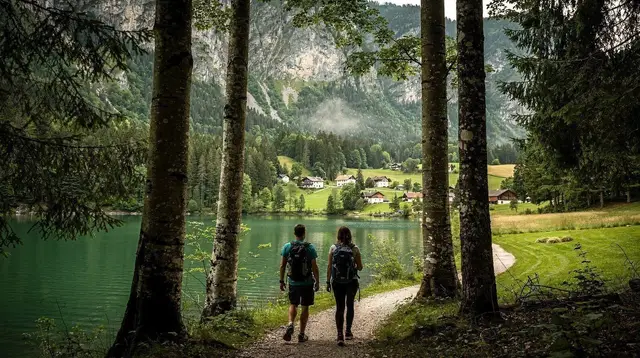
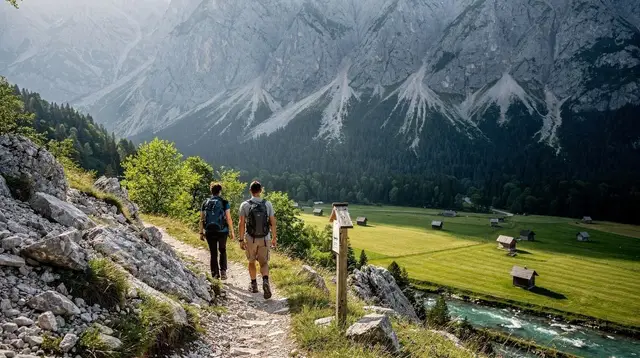
Where Tolmin Fits on the Map
Most visitors reach the Soča Valley by driving north from Ljubljana, spending a day or two around Bovec for rafting and canyoning, then working their way south through Kobarid before the road turns back toward the capital. Tolmin is that last town before the valley opens out again into ordinary Slovenian countryside — a market town on the Soča and Tolminka rivers, with none of the adrenaline-sports buzz of its northern neighbors and a slower rhythm to match.
This page treats Tolmin as exactly that: an endpoint, not a destination to build a whole itinerary around. For a fuller picture of the valley’s turquoise water, canyons and adventure sports, see the dedicated Soča Valley page, and for the small town with the open-air First World War museum and the confluence viewpoint, see Kobarid. Here, the focus stays on what makes Tolmin itself worth the stop: its own short gorge, a couple of swimming spots the crowds have not fully found, and a genuinely good excuse to try Slovenian brandy before getting back on the road.
Getting to Tolmin
Driving is by far the practical option. From Ljubljana, the shortest route runs via Idrija and over the Soča Valley’s southern hills, taking roughly an hour and a half in normal traffic — check the current Slovenia vignette guide before you leave, since the e-vinjeta is checked electronically and there is no toll booth to remind you. Coming from Bovec or Kobarid, Tolmin sits about 20-25 minutes further south along the valley road, a natural last leg before you climb out toward Idrija or continue to the coast.
Public transport exists but is thin: a handful of daily buses connect Tolmin with Ljubljana and with Bovec, and none of them make day-tripping without a car comfortable if your schedule is tight. Anyone weighing the tradeoffs between self-driving and a guided loop through the valley should read car versus organized tour in Slovenia before booking anything.
Budget-wise, Tolmin tends to cost less than a night in Bovec or Bled during peak season, simply because it sees a fraction of the day-trip traffic those two draw. The general figures in the Slovenia daily budget guide apply reasonably well here, and if anything can be trimmed further given the more modest range of restaurants and accommodation on offer compared with the valley’s busier towns.
The Tolmin Gorges
The Tolmin Gorges (Tolminska korita) are the reason most people who do stop in Tolmin actually stop. A signed loop trail, walkable in about an hour and a half at an easy pace, follows the Tolminka and Zadlaščica rivers through a narrow limestone gorge, crossing a suspension bridge that is one of the highest of its kind in the country. It is shorter, gentler and far less visited than the Vintgar Gorge near Bled, and it does not require the timed-entry booking that Vintgar does — a real point in its favor if your route is loose and you just want to stretch your legs between driving stints.
A short walk from the gorge entrance, the Devil’s Bridge (Hudičev most) spans a dramatic cut in the rock, and in warmer months the pools below the gorge and along the Tolminka fill with locals and the occasional traveler who has heard about them by word of mouth rather than found them in a guidebook. Bring water shoes if you plan to get in — the riverbed is rocky, not sandy.
The Soča and Tolminka: Swimming, Not the Valley’s Big Water Sports
It is worth being precise about what Tolmin does and does not offer on the water. The serious rafting, canyoning and kayaking operators are based upstream in Bovec, where the river gradient and the tour infrastructure are built for it — see the full Soča River rafting guide and the kayaking guide for what that actually involves. Tolmin’s stretch of the Soča and Tolminka is calmer: shallow pools for a swim, flat banks for a picnic, and a much quieter atmosphere than the put-in points further north.
That does not mean the season logic is different here. A common mistake is to assume spring is the pleasant time to enjoy the river simply because the weather is warming up. In fact spring is when the Soča system runs highest and coldest, swollen with snowmelt from the surrounding peaks — excellent for rafting operators who want strong water, uncomfortable for anyone hoping to wade in and relax.
If a lazy afternoon by the water is the point of stopping in Tolmin, aim for summer, when the flow has dropped and the water has had time to warm, and check the best time for the Soča Valley guide for month-by-month detail. If instead you want the adrenaline version, spring’s high water is actually when operators in Bovec are busiest — see rafting season in the Soča Valley for that side of the calendar, and canyoning in Slovenia for the sport that pairs with it.
| Season | What it means in Tolmin |
|---|---|
| Spring (April-May) | River running high and cold; good for organized rafting upstream, too cold for casual swimming |
| Summer (June-August) | Warmest water for swimming and paddling around town; also the busiest months on the roads |
| Early autumn (September-October) | Lower water, mild days, the calmest and most pleasant stretch overall |
| Winter (December-February) | Quiet and cool; the gorge trail stays open but is best walked with sturdy shoes |
The Edge of Triglav National Park
Tolmin sits close to the southern boundary of Triglav National Park, Slovenia’s only national park and the protected core of the Julian Alps, whose reach extends much further north to Mount Triglav itself and the lakes around Bled and Bohinj. Few visitors realize the park stretches this far south, since the postcard image of Triglav National Park is usually the turquoise lakes and high peaks well north of here — see the Triglav National Park page and the hiking Mount Triglav guide for that fuller picture.
Around Tolmin the terrain is gentler: forested hills, the gorge itself, and trails that see a fraction of the foot traffic found near the trailheads around Bohinj, which makes the area a reasonable pick for travelers who want a quieter taste of the park’s landscape without committing to a serious mountain hike. Anyone interested in what lives in this quieter southern flank of the park may also want the wildlife and nature watching guide for what to look out for in this part of Slovenia.
Brandy, Cheese and a Reason to Sit Down
Tolmin gives its name to tolminc, a protected mountain cheese made in the surrounding hills, and the region is one of the centers of Slovenian fruit-brandy production — plum, pear and grape distillates that show up on menus with far less fanfare than Italy’s grappa or France’s eau-de-vie, despite being made the same way.
A short stop at a local gostilna for tolminc cheese, a plate of štruklji or the region’s own take on dumplings, and a small glass of domača žganja is arguably a better use of an hour in Tolmin than trying to pack in more sightseeing. This is not a wine region in the way Goriška Brda or the Vipava Valley are — those lie further west and are worth their own detour — but the food culture in Tolmin’s hills is a genuine, low-key highlight.
Tolmin as a Base, Briefly
Because it sits at the quiet end of the valley, Tolmin works reasonably well as an overnight base for travelers who want easy access to both the adventure-sports side of Bovec and the historical sites around Kobarid, without paying the higher accommodation prices or dealing with the summer crowds of either town. It is not set up for nightlife or a wide restaurant scene, and anyone hoping for the postcard alpine views of Kranjska Gora or the Vršič pass should keep driving north rather than expect them here.
For a full sense of how the northern and southern ends of this itinerary compare, the Julian Alps adventure itinerary lays out a realistic multi-day loop, and the seven-day Slovenia itinerary shows where a stop like Tolmin fits into a longer trip.
Travelers assembling a longer trip rather than a single overnight can also look at the multi-day tours from Ljubljana that loop through the Soča Valley, or consider a private guide or custom tour if the goal is to see Tolmin, Bovec and Kobarid in one well-paced day rather than juggling the drive and the timing of activities alone.
Anyone tempted to skip the drive back and forth and book the water activities as a single package from Ljubljana can look at the day tour covering the best of the Julian Alps, which threads together the region’s highlights including this southern stretch of the valley without the need to plan the route yourself.
Bringing the Water Sports Along
If Tolmin is your last stop before Ljubljana rather than your first, it is worth booking any Soča activities before you arrive rather than hoping to arrange something on the spot in a smaller town. A half-day Soča River experience combining a short rafting or paddling session with the valley’s scenery is the simplest way to get on the water without full sports gear or prior experience, and it can usually be scheduled from either Bovec or the Tolmin area depending on where you are staying that night.
For a rougher, more physical run with photos to take home, the rafting tour through the Bovec and Kobarid stretch covers the section of river most people picture when they imagine the Soča, and it makes sense as a last adventure before the drive south through Tolmin and on to the capital.
For travelers who want the gear question settled before they even arrive, the guided Soča Valley body-rafting trip with all equipment included removes the need to pack or rent a wetsuit, mask and fins separately — useful if Tolmin is your first stop in the valley rather than your last.
Neither of these requires more than a swimsuit, a towel and closed-toe shoes for the shuttle — operators supply wetsuits, helmets and life vests for cold water, which, per the season note above, is most of the year on this river.
Practical Notes Before You Leave the Valley
Fuel up and buy your vignette before crossing back onto Slovenia’s main road network if you have not already — see the Slovenia vignette guide for current categories and prices, since fines for driving without one are issued automatically at electronic checkpoints.
If Idrija is on your route out of the valley, its mercury-mining history and its own culinary specialty, žlikrofi dumplings, make a worthwhile short stop; the Idrija lace and žlikrofi guide covers both. And if the whole valley loop has left you wondering whether a car was really necessary, Slovenia without a car is a fair-minded look at where public transport genuinely works in this country and where, as in Tolmin’s case, it does not quite.
Tolmin and the Soča Valley: Common Questions
Is Tolmin worth a special trip from Ljubljana?
Not on its own. Tolmin makes sense as a stop on a Soča Valley loop that already includes Bovec or Kobarid, either on the way in or, more often, on the way back toward Ljubljana. A dedicated round trip just to see Tolmin is a long drive for a short gorge walk.
How is Tolmin different from Kobarid and Bovec?
Bovec is the adventure-sports hub with the widest range of rafting, canyoning and kayaking operators. Kobarid centers on First World War history and a striking river confluence. Tolmin is quieter than both, with its own short gorge, calmer swimming spots, and a more agricultural, food-and-brandy character rather than an adrenaline or historical one.
Can I do the Tolmin Gorges without booking in advance?
Yes. Unlike the Vintgar Gorge near Bled, the Tolmin Gorges do not require a timed-entry reservation as of the 2026 season. There is an entrance fee payable on-site, and the trail is straightforward walking rather than technical hiking.
Is spring a good time to swim near Tolmin?
No, and this is a common misunderstanding. Spring snowmelt makes the Soča and Tolminka run high and cold, which is good for rafting operators seeking strong water but too cold and fast-moving for casual swimming. Summer, once the flow has settled and the water has warmed, is the better window for a swim.
Does Tolmin have its own rafting and canyoning operators?
Some smaller operators run trips from the Tolmin area, but the concentration of rafting, canyoning and kayaking companies is in Bovec, further north. Most visitors book their water activities there and treat Tolmin as a calmer stop before or after.
What food is Tolmin known for?
Tolminc cheese, a protected mountain cheese from the surrounding hills, and locally distilled fruit brandies, particularly plum and pear. The wider Soča Valley shares Slovenia’s broader alpine and Adriatic-influenced cuisine, but Tolmin’s cheese and brandy are specifically tied to this area.
Is one night in Tolmin enough?
Yes, more than enough for most travelers. A morning walk through the Tolmin Gorges, a lunch stop for tolminc cheese and a glass of local brandy, and an afternoon swim in summer cover what the town offers before continuing the drive.
How far is Tolmin from the coast or from Ljubljana?
Tolmin sits roughly 1.5 hours from Ljubljana by car and is closer to the coast than Bovec is, though most travelers doing a valley loop return to Ljubljana rather than continuing on to Piran or Koper from here without backtracking.
Is Tolmin inside Triglav National Park?
Not entirely, but it sits right at the park’s southern edge. The high-alpine scenery most visitors associate with Triglav National Park — the peaks, Lake Bled and Lake Bohinj — lies further north, while the Tolmin area represents the park’s quieter, lower-elevation southern reaches.
Is Tolmin cheaper than Bled or Bovec?
Generally, yes. Tolmin sees far less day-trip traffic than either Bled or Bovec, and accommodation and restaurant prices reflect that lighter demand. The difference is modest rather than dramatic, and it narrows in the busiest summer weeks.