Canyoning in Slovenia: Bovec's Narrow Alpine Gorges
What is canyoning like in Slovenia?
Slovenian canyoning takes place mostly around Bovec, in narrow tributary gorges that feed the Soča river rather than in the Soča itself. Guided groups descend by a mix of walking, sliding, jumping and abseiling over waterfalls, wearing a wetsuit and helmet supplied by the operator. It is a more technical, more closely guided activity than rafting, and trips are graded so first-timers and more committed canyoners book different routes.
Not the same river, not the same trip
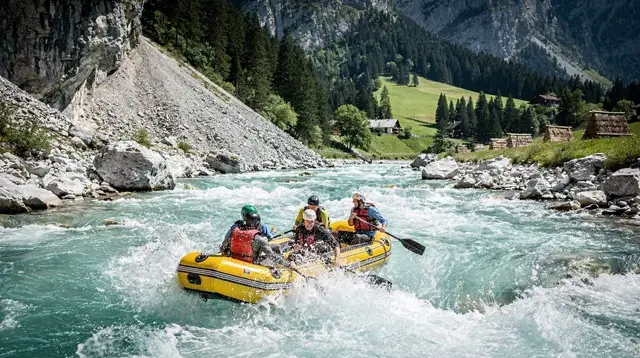
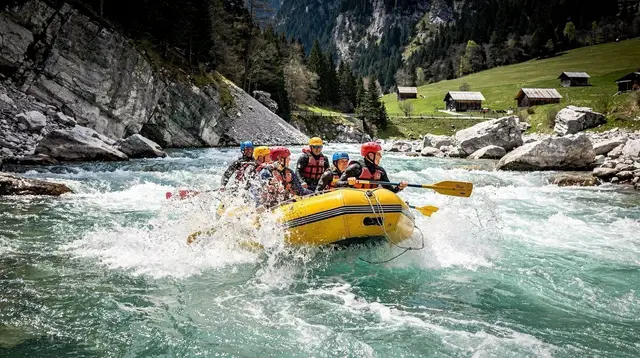
Most visitors hear about the Soča once, in one sentence, and file rafting and canyoning under the same mental heading: “the water sport thing near Bovec.” They aren’t the same thing, and mixing them up leads to booking the wrong trip. Rafting happens on the open Soča river itself — a shared inflatable boat, paddled together, moving downstream on a current everyone in the group can see and feel. Canyoning happens somewhere else entirely: in the narrow, steep-sided tributary gorges that feed into the Soča, reached by a short drive from town, where a small group moves on foot and on rope rather than in a boat.
If you want the full picture of the river trip, the dedicated rafting guide covers put-in points, rapid grades and what a rafting descent involves; this page doesn’t repeat that. And if you’re after the safety brief that applies to any canyoning trip regardless of where you book it — how operators certify guides, what a briefing covers, how groups are sized — that’s handled separately too, in what to expect from canyoning safety. What this page does cover is the part that’s specific to Slovenia: which gorges are used, how the trips are graded, when the season runs, and how a canyoning day in the Julian Alps actually unfolds.
Where it happens: Bovec, and the gorges around it
Bovec is the base for almost every canyoning operator in Slovenia, for the same reason it’s the base for rafting and kayaking: the town sits at the head of the Soča valley, within a short drive of half a dozen side valleys that drain down from the Julian Alps toward the main river. Kobarid and Tolmin, further down the valley, sit near some of the other gorges operators use, but Bovec remains the meeting point for most trips regardless of which specific canyon is booked that day.
The gorges themselves are not the Soča in miniature — they’re a different kind of watercourse: narrower, steeper, shaded by rock walls, and shaped by centuries of water carving smooth chutes, potholes and plunge pools into pale limestone. One route named directly on Slovenian canyoning itineraries is the Sušec gorge, used for entry-level descents; operators also draw on other tributary canyons in the same stretch of the valley, chosen on the day according to group experience and how much water is running. None of these gorges are named “the Soča” on a canyoning booking, and if a listing does mention the Soča by name for a canyoning trip, read carefully — it usually means the meeting point or transport route, not the descent itself.
A smaller number of operators also run canyoning trips based out of Kranjska Gora, on the other side of the Vršič Pass from Bovec, using gorges that drain that side of the range instead. Logistically the two bases don’t overlap much: choose Bovec if you’re building a Soča-valley week around rafting, kayaking and canyoning together, and Kranjska Gora if you’re already staying there for hiking or, in winter, skiing, and want to add one adventure activity without the drive over the pass.
What a canyoning descent actually involves
A typical trip starts with kit: wetsuit, helmet, harness, and a briefing on the group’s specific route before anyone gets near the water. From there, a canyoning descent is a sequence of different ways of moving through the gorge rather than one repeated motion — walking and scrambling over wet rock, sliding down smooth natural chutes the water has polished into the limestone, jumping from ledges into deep plunge pools, and abseiling on a rope past the taller drops and waterfalls where jumping or sliding isn’t an option. A guide sets the pace, checks each pool’s depth before anyone jumps, and rigs the ropes for anything that needs one — this is the main reason canyoning groups run smaller and more closely supervised than a rafting boat.
a half-day canyoning trip out of Bovec is the standard format: pickup or meeting point in town, transfer to the gorge, several hours in the water and on rope, and a return with enough of the day left for something else. It’s built as a complete outing rather than an add-on, so don’t plan much else for the block of time around it.
Skill levels: not one trip for everyone
Slovenian operators grade canyoning trips rather than running a single route for every visitor, and the grading matters more here than it does for rafting. At the accessible end, an easy, level-1 descent of the Sušec gorge is built specifically for people who have never tried canyoning before — shorter jumps, gentler chutes, and a pace suited to a first attempt. More demanding routes exist for canyoners who already have the basics down, with taller jumps, longer abseils and a faster-moving day; these aren’t marketed at first-timers, and operators are generally clear on their listings about which category a given trip falls into.
The practical takeaway: read the grading on a listing before booking rather than assuming “canyoning” means one fixed level of difficulty. A level-1 gorge and a committing one can sit twenty minutes apart in the same valley and feel like entirely different sports.
| Trip style | Typical audience | What to expect |
|---|---|---|
| Easy / level 1 (e.g. Sušec gorge) | First-timers, families with older children, mixed-ability groups | Shorter jumps, gentler natural slides, a briefing that assumes zero prior experience |
| Standard half-day canyoning | Reasonably fit adults comfortable in water | A fuller mix of jumps, slides and abseils, a longer time in the gorge |
| More demanding / committing routes | Canyoners with some prior experience | Taller jumps, longer abseils, less margin for hesitation mid-route |
When to go: season and water
Canyoning around Bovec runs through the warmer months, tracking roughly the same operating window as rafting on the Soča, since both activities depend on manageable water levels and on air temperatures that make getting soaked repeatedly bearable. For the specifics of how that season shifts from spring through late summer on the Soča side of things, the guide to when to visit the Soča valley and the rafting season overview both cover the water-level pattern in more detail than belongs on this page.
One point worth repeating regardless of month: the water in these gorges is cold, fed by snowmelt and shaded by rock walls for most of the day, and it stays cold well into summer. This is exactly why every operator supplies a wetsuit as standard kit rather than treating it as optional gear for cooler days — plan to be cold in the water at some point on the descent no matter how hot it is in Bovec itself when you set off.
Who it’s for, and who it isn’t
Canyoning asks more of participants than rafting does: comfort with jumping into water you can’t fully see the bottom of, willingness to be lowered on a rope past a waterfall, and a baseline level of fitness and calm under a guide’s instructions in a physically committing environment. It suits travellers looking for something more technical and more intensively guided than a group rafting trip, and it rewards people who are comfortable in water generally, not just people who like scenery.
It’s a less natural fit for anyone with a strong fear of heights or confined spaces, for very young children, and for travellers with mobility limitations that would make scrambling over wet rock or abseiling difficult — the guide to accessibility in Slovenia is a better starting point than this page if that’s a planning concern. Minimum ages and any height requirements are set per operator and per gorge, so check the specific listing rather than assuming one age limit applies across every trip; entry-level routes like the Sušec gorge tend to accept younger participants than the more demanding gorges do.
Booking it from Ljubljana, and what to plan around it
Every canyoning operator is based in the Bovec area, roughly two hours from Ljubljana by car through the Julian Alps — not a trip most people do as a day return from the capital on top of the activity itself. It fits most naturally into a Julian Alps stay of two or three nights based in or near Bovec, alongside rafting, kayaking and hiking, rather than as a single-day dash from the city. The Julian Alps adventure itinerary lays out one way to sequence a multi-day stay that includes it.
A few practical notes worth settling before you go. Bring your own car or plan transport carefully: driving without a car in Slovenia is workable for the cities and the coast but far harder for the Julian Alps’ scattered valley bases, so most visitors either rent a car or join a tour that includes transfers.
If you’re driving over the Vršič Pass to reach Bovec from the Kranjska Gora side, remember it’s a seasonal route closed in winter — check current conditions before relying on it. And because good weather windows and group sizes are limited, canyoning belongs on the list of activities worth booking ahead in Slovenia rather than something to arrange the morning of, especially in the busiest weeks of July and August.
Combining canyoning with the rest of the Julian Alps
Bovec earns its reputation as Slovenia’s adventure-sports hub because canyoning is rarely the only activity on offer within a few kilometres. Kayakers use the same stretch of the Soča the rafters do; the guide to kayaking the Soča river covers that side of things. Hikers based in the same valley have the Triglav via ferrata and the trails around Triglav National Park within reach, and paragliders use the same dramatic topography from the air rather than in the water.
If a single physical activity per trip isn’t enough, a canyoning trip billed from the Lake Bled side is worth a look for travellers based there rather than in Bovec — check the listed meeting point and transfer time, since the gorge itself sits some distance from the lake.
For a broader look at what else the things to do in Bovec page and the full canyoning category list, both are useful starting points once you’ve decided canyoning fits your trip. And travellers weighing several adventure options at once against a fixed number of days might find the general Julian Alps planning guide helps sequence canyoning against rafting, hiking and via ferrata rather than trying to fit all four into one short stay.
Canyoning in the Julian Alps: your questions answered
What’s the real difference between canyoning and rafting near Bovec?
Rafting is a shared inflatable boat trip down the open Soča river, paddled as a group under one guide’s steering calls. Canyoning is a much smaller party moving on foot and by rope through a narrow side gorge, with no boat at all: walking, sliding down natural rock chutes, jumping into pools, and abseiling past waterfalls. The two activities do not overlap and are booked separately.
Where in Slovenia does canyoning actually happen?
Almost all commercial canyoning is based around Bovec and, to a lesser extent, Kranjska Gora, in the narrow tributary gorges that drain into the Soča valley rather than in the main river. Operators name specific gorges on their itineraries, such as Sušec, and pick the route to match the group’s experience and the water level on the day.
Do I need previous experience to try canyoning in Slovenia?
No. Entry-level trips, marketed as easy or level 1, are built for people who have never done it before and include a safety briefing and equipment fitting on site. More demanding routes with taller jumps and longer abseils exist for canyoners who already have some experience, and operators grade their trips accordingly rather than running one route for everyone.
What is the minimum age for canyoning near Bovec?
Minimum ages are set by each operator and by the specific gorge, and typically run higher than for rafting because of the jumps and abseils involved. Check the age and minimum-height requirement on the listing for the exact trip before booking, especially if you’re travelling with children or teenagers.
When is the canyoning season in the Julian Alps?
Canyoning around Bovec runs through the warmer months, broadly the same window as rafting on the Soča, since both depend on manageable water levels and air temperature. Water in these gorges stays cold even in summer, which is why every trip includes a wetsuit rather than relying on the season alone.
What should I bring, and what does the operator provide?
Operators supply the wetsuit, helmet, harness and any climbing or abseiling gear needed for the route. Bring swimwear to wear underneath, a towel and dry clothes for afterwards, and shoes you don’t mind getting wet if the operator asks you to keep your own footwear on under neoprene socks.
Is there canyoning near Lake Bled, away from Bovec?
Some operators run canyoning trips billed under Lake Bled even though the actual descent takes place in a gorge some distance from the lake itself, with transport included from a Bled meeting point. If staying at Bled, check the meeting point and transfer time on the listing rather than assuming the gorge is walking distance from the lake.
tours.rafting
Verified deep-linked GetYourGuide tours. Book through these links and we earn a small commission at no cost to you.
GetYourGuide does not provide a product photo for this activity — the image shows the meeting point, photographed by us.