Predjama Castle: The World's Largest Cave Fortress
What makes Predjama Castle unique?
Predjama Castle is built directly into the mouth of a 123-metre limestone cliff near Postojna, which makes it the largest cave castle in the world. Its position let its medieval owners use hidden passages inside the rock behind the walls to withstand long sieges, something no free-standing castle could ever do.
The Castle Built Into a Cliff
Most castles sit on top of hills or beside rivers, built to be seen from a distance as a statement of power. Predjama Castle does something stranger: it disappears into the rock. Wedged into the mouth of a 123-metre limestone cliff in the Slovenian Karst, its front facade is the only part that was ever built to be looked at, because the rest of the structure simply merges into the mountain behind it. That single fact, verified and documented, is what makes Predjama the largest cave castle in the world, and it is worth understanding before you decide whether it earns a place on your Karst itinerary alongside Postojna Cave.
It would be easy to file Predjama away as just another medieval fortress on a list of Slovenian castles and fortresses, somewhere between Ljubljana Castle and Bled Castle in a rotation of towers and courtyards. That undersells it. Ljubljana Castle sits on a hill above the capital and Bled Castle perches on a cliff above a lake, but both are still conventional buildings that happen to have good views. Predjama is a different kind of structure entirely: a fortress that used the cave itself as part of its defenses, with passages running into the mountain that let its occupants do things no free-standing castle ever could.
A Legend Carved Into Limestone
Predjama’s reputation rests as much on story as on stone. Local history remembers the castle’s most famous occupant as a 15th-century knight, often called the robber baron of Predjama, who used the fortress as a base to raid the surrounding countryside and defy the ruling Habsburg authorities of the day. When his enemies laid siege to the castle, expecting to starve him out, he reportedly held on far longer than anyone thought possible, supplied through hidden passages inside the cliff that connected to the cave system behind the walls, invisible to the besiegers camped outside.
Exactly how that standoff ended is one of those stories where legend and documented record start to diverge, and a page like this one is not the place to settle which version is more accurate. What matters for a visitor is that the castle’s whole reason for existing, and the reason it still draws attention centuries later, is that cliff. Take away the rock, and Predjama becomes an unremarkable fortress. Because of the rock, it became something a determined enemy struggled to actually conquer.
Inside the Largest Cave Castle in the World
The castle you walk through today is largely a Renaissance-era rebuilding, constructed onto and into the original medieval core after earlier structures on the site were damaged. Walking room to room, the give-away is the back wall: in several chambers it simply stops being masonry and becomes bare rock, the natural cave ceiling and walls left exposed rather than built over. It is a strange, effective reminder that you are not touring a building that was placed near a cliff, but one that was built as an extension of it.
Inside, the rooms hold a mix of period furniture, weapons, and displays that walk through the castle’s defensive history and its everyday medieval life, spread across several floors connected by stone stairways. None of it is overly polished or roped off into a museum-piece hush; the charm of Predjama is largely architectural rather than curatorial; it is the setting, not the objects inside it, that people remember afterward. Photographs from outside the castle, looking up at the facade set into the cliff, tend to be more striking than anything you will capture from the interior.
Predjama Cave: The System Behind the Walls
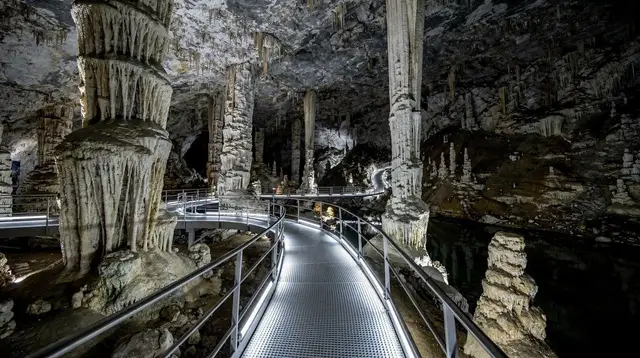
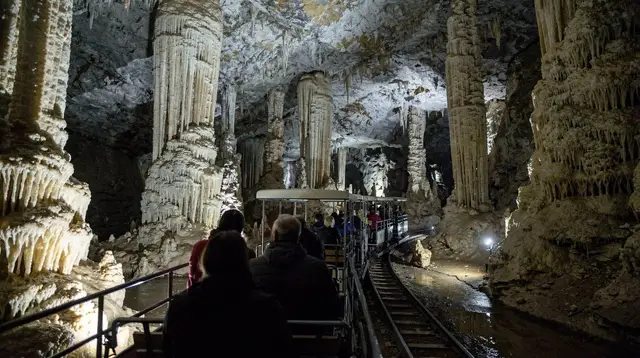
Behind and above the visible castle, the cliff continues into a genuine cave system, part of which the castle’s defenders are believed to have used for supply routes during sieges. This is a separate thing from the show cave experience at nearby Postojna: rather than a large, developed tourist cave with a train, the passages connected to Predjama are more limited in scale and, where accessible to visitors at all, are typically taken in with a guide rather than explored freely.
It is worth being clear-eyed about what this means in practice: most visitors to Predjama see the castle itself, with its exposed rock walls and cliffside setting, rather than penetrating deep into the cave system beyond it. That is not a disappointment so much as a different kind of experience from a full cave tour. If your priority is the underground scale and drama of Slovenia’s show caves, that is squarely the territory of Postojna Cave and the UNESCO-listed Skočjan Caves, both covered in our broader overview of Slovenia’s show caves.
Predjama vs. Other Slovenian Castles
It helps to see where Predjama actually sits relative to the other castles most visitors compare it with, since the temptation is to treat all of Slovenia’s hilltop and cliffside fortresses as roughly interchangeable stops on a checklist.
| Castle | Setting | What makes it distinctive |
|---|---|---|
| Predjama Castle | Built into the mouth of a 123-metre cliff | Largest cave castle in the world; back walls merge into natural rock |
| Ljubljana Castle | Hilltop above the capital | City views, funicular access, centuries of continuous use |
| Bled Castle | Cliff above Lake Bled | Postcard views over the lake and island, not built into the rock itself |
The distinction that matters is structural, not scenic. Bled Castle sits on a cliff; Predjama is built into one. That difference is the entire reason Predjama holds a Guinness-recognized title and Bled does not, and it is worth keeping in mind if you are choosing which castles to prioritize on a short trip through the Slovenian Karst.
Getting to Predjama Castle
Predjama sits about 9 kilometres from Postojna, close enough that the two are almost always packaged together in organized excursions from Ljubljana, and close enough that a rental car makes the detour trivial if you are already driving toward the Karst. If you are relying on public transport, options thin out considerably once you leave the main Postojna–Ljubljana corridor; our guide to getting to Postojna without a car is the more useful starting point for planning that leg, since Predjama itself has essentially no independent public transport connection of its own.
Driving from Ljubljana takes roughly 45 minutes to an hour depending on traffic, largely along the same motorway corridor used for Postojna. Remember that an electronic vignette is required on Slovenian motorways regardless of how short the trip; our vignette guide covers the categories and current prices if you are picking up a rental car for the day. If you would rather not deal with driving and parking at all, an organized tour that includes Predjama removes that logistics question entirely, and is how the majority of visitors actually get there.
a half-day trip from Ljubljana covering both the cave and the castle handles the transport and timing questions in one booking, which matters more here than at most Slovenian sites given how little independent public transport serves Predjama directly.
Best Time to Visit
Predjama Castle is an outdoor-facing site set against a north-facing cliff, so it does not carry the same underground-temperature considerations that apply to Postojna or Skočjan. It is, however, an exposed stone structure, and summer crowds tend to follow the same excursion buses arriving from Postojna, so early or late in the day is generally calmer than midday in July and August. Photographers in particular benefit from softer light on the cliff face earlier or later rather than at high noon.
Because most visits to Predjama are paired with a cave visit at Postojna, the practical planning question is usually less “when is Predjama itself good” and more “when does the combined day work best,” which is exactly the kind of scheduling our Postojna and Predjama day trip guide is built to answer in more depth than makes sense to repeat here.
Tips Before You Go
A few practical notes worth knowing before you set off:
- It’s not an alternative to Postojna Cave, it’s a complement. The two sites cover genuinely different ground, a lived-in cliffside fortress versus a vast developed show cave, and seeing both gives a fuller picture of what the Karst region is about than either alone.
- Wear sensible footwear. Stone stairways and uneven floors inside a centuries-old structure are not forgiving of flip-flops.
- The exterior view is half the experience. Budget time to walk around outside and photograph the castle from below and from the approach road; the cliffside setting reads far more dramatically from outside than from any single interior room.
- Check current hours and ticket formats before you go, since seasonal opening times and combined-ticket options with Postojna Cave change from year to year; our Postojna Cave tickets and tips guide covers those specifics.
a guided day trip from Ljubljana that covers both Postojna Cave and Predjama Castle is the simplest way to see both sites without juggling separate bookings and transport.
Nearby: Lipica and the Karst
If Predjama’s history has you curious about the wider Karst region, the horse-breeding estate of Lipica, founded in the 16th century as the birthplace of the Lipizzaner horse, sits a further drive to the southwest and pairs naturally with a longer day through this part of Slovenia. Our piece on the Lipizzaner tradition at Lipica and our feature on the horses that outlasted empires both go deeper into that history if a single castle and cave day leaves you wanting more of the region’s layered past.
For travelers coming from further afield, particularly on a cruise stop or a longer Slovenian loop, a private tour combining Ljubljana, Bled, and a castle visit can be arranged to include Predjama as part of a broader day rather than a Postojna-only pairing.
a private day tour from Zagreb covering Ljubljana, Lake Bled, and a castle visit is one way to fold Predjama or a comparable castle stop into a wider first look at Slovenia if you are arriving from outside the country.
FAQ about Predjama Castle
Is Predjama Castle really built inside a cave?
Yes. The castle is wedged into the mouth of a 123-metre limestone cliff rather than sitting on top of or beside it. Its back wall merges into the natural rock, and a cave system continues into the mountain behind the visible structure.
How far is Predjama Castle from Postojna Cave?
About 9 kilometres. The two sites are close enough that almost every organized excursion to this part of the Karst combines them, though Predjama can also be visited entirely on its own.
Can you visit Predjama Castle without visiting Postojna Cave?
Yes, a standalone visit to the castle is entirely possible and takes less time than pairing it with the cave. Ticket options and current combined pricing are covered separately in our Postojna Cave tickets guide.
Is there a cave system inside Predjama Castle itself?
Yes. A network of passages continues behind and above the castle into the mountain, part of which historically let defenders move supplies in and out unseen during a siege. Access beyond the castle’s own halls is limited and usually requires a guided or ticketed cave visit rather than free wandering.
How long does a visit to Predjama Castle take?
Plan on roughly an hour to walk through the castle’s floors at a comfortable pace, more if you linger over the exhibits or photograph the cliff from outside. Add travel time from Ljubljana or Postojna on top of that.
Is Predjama Castle suitable for children?
Generally yes. Children tend to find the cliffside setting and the castle’s defensive history more immediately gripping than a conventional palace, though the stone stairs and uneven floors call for supervision with younger kids.
What is the legend of the robber baron of Predjama?
Local history remembers a 15th-century knight who used the castle as a base to raid and defy the ruling Habsburgs, holding out through a prolonged siege thanks to the hidden passages behind the rock. Accounts of exactly how his story ended vary between local legend and documented record, which is part of what keeps the castle’s reputation alive.
Do I need to book tickets for Predjama Castle in advance?
Booking ahead is the safer habit in the Slovenian Karst generally, especially in summer, since nearby Postojna Cave requires a timed slot and many visitors arrive at Predjama straight after. Check the official site for current opening hours and ticket options before you go.
tours.caves-underground
Verified deep-linked GetYourGuide tours. Book through these links and we earn a small commission at no cost to you.
GetYourGuide does not provide a product photo for this activity — the image shows the meeting point, photographed by us.