Show Caves of Slovenia: A Complete Overview of the Karst
How many show caves are there in Slovenia's Karst region?
The Karst plateau is riddled with hundreds of caves, but only a handful are developed for visitors. Postojna Cave and the Škocjan Caves are by far the two most visited, with Predjama Castle built into a cave mouth, the Lipica stud farm sitting on the same limestone plateau, and the intermittent Lake Cerknica rounding out the region's headline karst attractions.
Say “the caves” to someone who has just landed in Ljubljana and they usually mean one specific place. In reality, the limestone plateau southwest of the capital — the Karst, the region that lent its name to karst landscapes everywhere — hides several distinct sites worth knowing apart before you book anything. This overview does not repeat the ticket details already covered in the Postojna Cave guide or the Škocjan Caves guide; instead it maps out how many show caves actually exist, how they differ from each other, and how they sit on the ground relative to one another and to Ljubljana.
Comparing your options at a glance
Five names come up constantly when people plan a Karst trip. Only two are caves you walk or ride through underground in the strict sense; the others are a cave castle, a horse farm, and a lake that periodically vanishes.
| Site | What it is | How you move through it | Distance from Ljubljana |
|---|---|---|---|
| Postojna Cave | Show cave, partly toured by underground train | Train + walking path | ~53 km |
| Škocjan Caves | UNESCO-listed cave system with a suspended canyon path | Walking only, guided | ~65 km |
| Predjama Castle | Fortress built into a cliff cave mouth | Walking, castle rooms + optional cave levels | ~62 km |
| Lipica stud farm | Historic Lipizzaner horse farm, on the surface | Walking, open grounds | ~75 km |
| Lake Cerknica | Intermittent karst lake, appears and disappears seasonally | Walking or cycling around the basin | ~50 km |
That last row is worth pausing on: Lake Cerknica is not a cave at all, but it is one of the clearest surface expressions of the same karst hydrology that carved Postojna and Škocjan underground, which is why it belongs in the same regional picture even though there is nothing to walk into.
Postojna Cave: the biggest, the easiest, the busiest
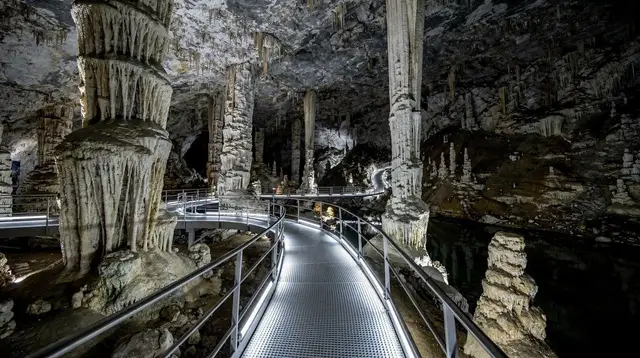
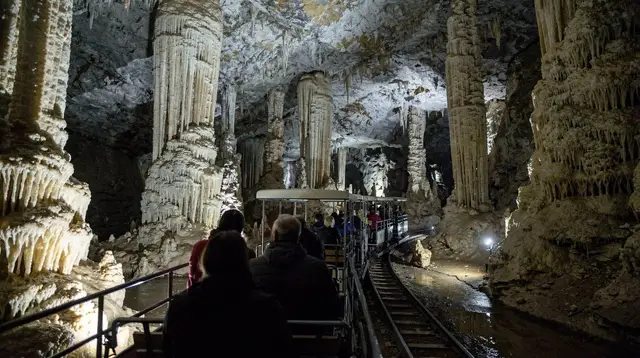
Postojna Cave is the reason most people say “let’s do a cave” while planning a Slovenia trip. It is the most visited show cave in the country, and the reason is largely logistical: a good stretch of the 24-km known system is covered aboard an open underground train, which means visitors of most fitness levels can see chambers that would otherwise require a serious hike. The train covers the approach and retreat; a guided walking section in between takes you past chambers of dripstone formations, including some of the thinnest, most fragile stalactites found anywhere.
This ease of access is also what makes Postojna the busier of Slovenia’s two major caves. The ticketing system requires a specific date and time slot rather than a general day pass, which in practice means booking ahead, particularly for a same-day summer visit. A combined ticket bundling Postojna Cave with nearby Predjama Castle costs less than buying the two separately, and because the sites sit only 9 km apart, almost every organized trip pairs them.
Predjama Castle: a fortress built into a cave mouth
Nine kilometres from Postojna, Predjama Castle answers a slightly different question: what happens when a cave becomes a building material rather than a destination in its own right? The Renaissance-era castle is wedged into the mouth of a 123-metre cliff, making it the largest cave castle on record anywhere. Above ground, you tour furnished rooms, defensive galleries, and a small museum; below, a genuine cave system continues into the rock, explorable as a separate stretch from the castle proper.
Because Postojna Cave and Predjama Castle are so close together, this is the pairing behind most half-day and full-day Karst trips out of Ljubljana — see the Postojna and Predjama day trip guide for how that combination is usually structured.
Škocjan Caves: on foot, UNESCO-listed, and no photographs
The Škocjan Caves sit roughly 40 minutes further southwest and operate on entirely different terms from Postojna. There is no train here — the entire visit is on foot, led by a guide, along a path that includes a dramatic suspended footbridge crossing an underground canyon carved by the Reka river. The scale is the headline feature: this is one of the largest known underground canyons in the world, and the sense of walking through open space rather than a tight tunnel is the main reason visitors who have already done Postojna still make the trip here.
Škocjan was inscribed as a UNESCO World Heritage Site in 1986, the first natural monument in Slovenia to receive that status — decades before Ljubljana’s own Plečnik-designed urban core joined the list in 2021. One rule surprises almost everyone on arrival: photography is not permitted inside the cave. It is worth knowing before you go rather than discovering it at the entrance, since it changes what you plan to bring and how you experience the visit.
a guided half-day trip to the Škocjan Caves from Ljubljana is the simplest way to see this side of the Karst without organizing transport yourself, and it is a fair comparison point against the difference between Postojna and Škocjan if you are still deciding which one — or whether both — deserves a place on your itinerary.
Lipica: on the same plateau, but nothing underground
Lipica is not a cave, and it is worth saying plainly, because the name circulates in the same conversations as Postojna and Škocjan often enough that visitors assume it involves going underground. It does not. Lipica is a working stud farm founded in 1580, a few kilometres from the Italian border, and the birthplace of the Lipizzaner horse breed — the same breed associated with Vienna’s Spanish Riding School. What ties it to this overview is geography rather than geology: it sits on the same limestone Karst plateau, close enough to the Škocjan Caves that day trips regularly combine the two.
a combined day out taking in Lipica’s stud farm alongside the Škocjan Caves makes sense of that proximity in a single itinerary, pairing an underground morning with a very different, open-air afternoon among the horses. If your interest runs more toward the farm’s history and breeding tradition than the caves nearby, the Lipizzaner horse tradition guide goes into that side on its own.
Lake Cerknica: the karst phenomenon with nothing to walk into
Lake Cerknica closes out the list of Karst-region names that come up in the same breath as the caves, and it is the one most likely to disappoint a visitor who arrives expecting water. This is an intermittent lake: when it is full, typically through the wetter months, it becomes the largest lake in Slovenia, spreading across a broad basin.
By summer, it is common for the lake to vanish almost entirely, leaving pastures and dry fields where boats floated months earlier. This cycle is caused by the same porous limestone hydrology that hollowed out Postojna and Škocjan below ground — water simply drains through the karst rather than sitting on an impermeable bed the way it would elsewhere. A page or itinerary promising a lake view here in August is describing the wrong season; check timing before building a visit around it.
Which cave should you actually visit
If you only have time for one, the honest answer depends on what you are drawn to rather than which cave is “better.” Postojna suits travelers who want an easier, faster visit, don’t mind a busier atmosphere, and like the novelty of covering ground by underground train. Škocjan suits travelers who want scale and drama, don’t mind walking the whole way, and are comfortable with a longer drive from Ljubljana. Neither is a lesser choice; they are simply different experiences of the same limestone plateau.
| If you want… | Choose |
|---|---|
| The easiest visit, shortest drive from Ljubljana | Postojna Cave |
| A castle built into a cliff, paired in one trip | Postojna Cave + Predjama Castle |
| The most dramatic single chamber, on foot, UNESCO status | Škocjan Caves |
| An underground visit paired with horses on the surface | Škocjan Caves + Lipica |
| A quick, no-frills overview of the whole region in one go | A full-day guided combination |
For visitors who genuinely cannot choose and have a full day to spare, a day trip combining the Škocjan Caves with the coastal town of Piran is one way to see a very different side of the Karst region on the same outing, since the caves and the coast sit closer together than most visitors expect.
Travelers building a first Slovenia visit from scratch may also find it useful to see where a Karst caves day fits against everything else worth doing, covered in the Slovenia in one day overview — a comparison worth reading if you are also curious how a guided show cave differs from genuine caving expeditions offered elsewhere in the region.
Temperature, footwear, and what “show cave” actually means
A “show cave” is simply a cave developed for public visits: lit, pathed, and led by guides, as opposed to wild caving, which requires equipment, training, and typically a specialist operator. Every site described above except Lipica and Lake Cerknica falls into the show cave category, and all of them share one physical fact that surprises first-time visitors more than anything else: the temperature. Slovenia’s karst caves hold a steady 8 to 12 degrees Celsius year-round, no matter how hot the surface world is.
Arriving at Postojna in August in shorts and a t-shirt, having just driven from a 32-degree Ljubljana afternoon, is the single most common misjudgment visitors make. Bring a light jacket or fleece regardless of season, and wear closed shoes with grip — Škocjan’s paths in particular involve stairs, uneven stone, and damp surfaces. For a fuller rundown by site, see the dedicated guide on what to wear in the karst caves.
Getting there from Ljubljana
None of these sites require a car, though having one gives more flexibility to combine two or three in a single day. Public buses connect Ljubljana to Postojna and on to the coast, but Škocjan, Predjama, and Lipica sit further from regular bus routes and are more comfortably reached by organized transport or a rental car.
If you are weighing whether to self-drive the region or book a guided trip, the one-day Karst caves itinerary lays out a realistic single-day route, and the same logistics apply whether you are basing yourself in Ljubljana or arriving from Trieste or Zagreb, both within reach of the Karst without detouring through the capital first.
Travelers curious about the wider Karst landscape beyond the show caves themselves — the sinkholes, disappearing rivers, and villages built from the same pale limestone — might also enjoy a stop at Štanjel, a hilltop stone village that sits on the plateau without any ticketed attraction at all, simply as a way to see what the surface of karst country looks like once you have already seen what lies beneath it.
FAQ: choosing between Slovenia’s karst caves
How many caves in Slovenia are open to visitors?
Slovenia’s Karst region has thousands of mapped caves, but a small number are developed as show caves with lighting, paths, and guided access. Postojna Cave and the Škocjan Caves are the two major ones; Predjama Castle adds a smaller cave system beneath the fortress, and a few local caves exist but are not part of the main tourist circuit.
What is the difference between Postojna Cave and the Škocjan Caves?
Postojna Cave is toured partly aboard an underground train, is easier underfoot, and is the more visited of the two. The Škocjan Caves are walked entirely on foot along a suspended path above a huge underground canyon carved by the Reka river, are UNESCO-listed, and do not allow photography inside.
Can I visit more than one cave in a single day?
Yes. Postojna Cave and Predjama Castle sit only 9 km apart and are almost always sold as a combined half-day or full-day trip. Škocjan is roughly 40 minutes further southwest, so pairing it with Postojna in one day is possible but makes for a long day; many visitors treat it as a separate excursion.
Do I need to book tickets for the Karst caves in advance?
For Postojna Cave, the official booking system requires choosing a specific date and time slot, so a reservation is effectively mandatory, especially in summer. The Škocjan Caves run guided tours at fixed departure times with limited group sizes, so booking ahead is strongly recommended in July and August.
Is Predjama Castle a cave or a castle?
Both. Predjama Castle is built directly into the mouth of a 123-metre cliff face, making it the largest cave castle in the world. Its lower levels lead into a real cave system that can be explored separately from the castle rooms, which is why it is usually visited alongside Postojna Cave.
What should I wear inside the caves, even in summer?
A light jacket or fleece. Slovenia’s show caves hold a steady temperature of roughly 8 to 12 degrees Celsius year-round, regardless of how hot it is outside. Arriving in a t-shirt on a 30-degree August day is the most common mistake visitors make.
Is Lipica also underground?
No. Lipica is a historic stud farm on the surface of the Karst plateau, founded in 1580 as the birthplace of the Lipizzaner horse. It is often combined with the Škocjan Caves in the same day trip because the two sites sit close together, not because Lipica itself has a cave to tour.
tours.caves-underground
Verified deep-linked GetYourGuide tours. Book through these links and we earn a small commission at no cost to you.
GetYourGuide does not provide a product photo for this activity — the image shows the meeting point, photographed by us.