A Landscape That Explains the Caves
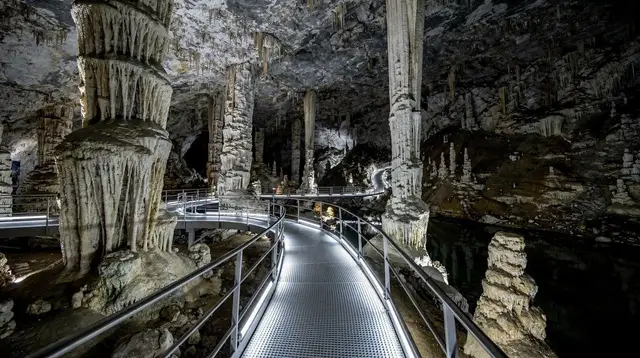
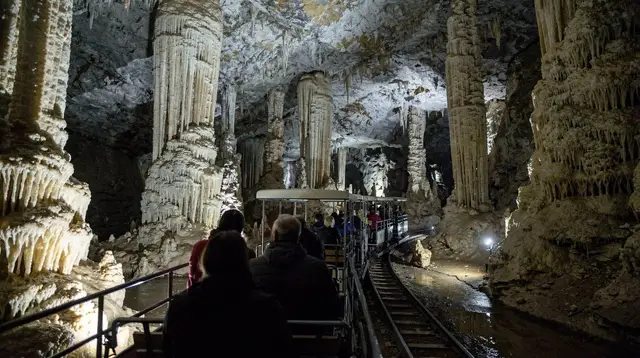
If you’ve already stood in the chill of Postojna Cave or walked the suspended footbridge over the underground canyon at Škocjan, you’ve seen what the Karst plateau looks like from below. Štanjel and the open plateau around it are the same story told from above ground: a rolling shelf of limestone, stripped of most of its surface water, dotted with dry valleys and stone villages that look like they grew out of the rock rather than being built on it.
It’s tempting to file the whole region under “cave country” and move on once the cave ticket is stamped. That would miss most of what’s actually here. The word “karst” itself comes from this exact plateau — Kras in Slovenian — and geologists everywhere now use it to describe any landscape shaped by soluble rock, sinkholes and underground drainage, wherever in the world it occurs. This one page of Slovenia gave its name to a type of terrain found from Kentucky to Guizhou. Štanjel is one of the clearest places to feel that landscape without a ticket, a queue or a guide.
This page won’t re-cover what the show caves themselves are like — that’s what the dedicated pages on Postojna, Predjama Castle and the Škocjan Caves are for, and the guide comparing Postojna and Škocjan if you’re still deciding which one to book. What follows is the plateau around them: the stone, the villages, the vanishing lake, and how to fit all of it around a cave day you’ve already planned.
Štanjel, a Village Built From the Plateau
Štanjel sits on a low limestone hill in the western Karst, a fortified core of grey stone houses, arched passages and narrow stepped lanes climbing toward a small church at the top. There’s no admission gate and no fixed opening hours: it’s a village where people still live, not a museum piece, and that’s a large part of its appeal after a morning spent in a cave with a scheduled entry slot and a guide keeping pace. You walk it at your own speed, and there’s nothing to book in advance.
What makes it worth the detour isn’t a single landmark but the material itself. Every wall, arch, stair and rooftop is cut from the same pale karst limestone that the region’s underground rivers have been dissolving for millennia, so the village reads less like something added to the landscape than something extracted from it. From the highest point of the old core, the view opens out over the plateau itself: a patchwork of small stone-walled fields, scattered dolines (the bowl-shaped sinkholes typical of karst terrain), and, on a clear day, a hint of the Adriatic haze toward Trieste.
Give Štanjel 45 minutes to an hour. It rewards an unhurried walk more than a checklist visit, and it’s compact enough that there’s little risk of running out of things to see before you run out of curiosity.
The Caves Are the Exception, Not the Rule
It’s worth saying plainly: most of the Karst plateau has no caves visible at all. Postojna, Škocjan, Predjama — these are specific points where underground rivers happened to carve chambers large enough, and safe enough, to open to visitors. They’re extraordinary, and they’re also a small fraction of the plateau’s surface area. The rest of the Karst is fields, villages, dry stone walls and the kind of quiet, weathered farmland that doesn’t advertise the enormous hollow spaces running beneath it.
That’s the useful mental model for a day here: the plateau is the whole story, and the caves are the parts of it you can walk into. If your trip so far has been Postojna’s underground train or Škocjan’s canyon bridge, Štanjel and the villages around it are how you see the rest of that same rock without going underground again. Predjama Castle, built directly into the mouth of a cliff cave near Postojna, is arguably the clearest single image of how completely this region’s architecture and geology overlap — worth a stop on the same day if you haven’t already been.
a guided day trip from Ljubljana that covers Postojna Cave is the most common way visitors reach this stretch of the plateau in the first place, and Štanjel or a Karst village stop slots naturally either before or after it if you’re driving yourself rather than joining a fixed-route tour.
When the Plateau Empties: Lake Cerknica
The clearest proof that the Karst isn’t only about caves is Lake Cerknica, roughly half an hour from Štanjel. It’s an intermittent lake: when the water table rises, typically from autumn through spring, it can become the largest lake in Slovenia, spreading out over what is otherwise farmland and pasture. Come summer, it usually dries out almost completely, leaving grazing meadows where a boat might have floated a few months earlier.
This is a genuinely easy mistake to make when planning a Karst day around a July or August cave visit: expecting a lake and finding a field. The lake’s rhythm isn’t a curiosity on the side of the region — it’s the same underground plumbing that carved Postojna and Škocjan, just working in reverse, letting water rise to the surface through the same porous rock instead of only carving through it below. If open water at Cerknica matters to your itinerary, the Lake Cerknica day trip guide has the seasonal detail worth checking before you commit a whole afternoon to it.
Sinkholes, Dry Valleys and Why Nothing Stays on the Surface
A short drive or even a walk around Štanjel makes the plateau’s basic mechanic visible: water doesn’t stay on top of karst limestone for long. Rain and small streams disappear into sinkholes and fissures almost as soon as they form, re-emerging kilometers away, sometimes underground, sometimes as a spring at the base of the plateau. The result is a landscape with very few visible rivers or lakes despite a normal Central European rainfall, and instead a scatter of dolines — round or oval depressions, some just a few meters across, some large enough to hold a small field — across nearly every stretch of open ground.
It’s worth pairing a Karst village stop with the guide to Slovenia’s show caves overview if the mechanics of the region interest you: it lays out how the different cave systems in this single small country — Postojna, Škocjan, and smaller ones — relate to each other, and to the same underground drainage that shapes what you see at ground level around Štanjel and Cerknica.
If you do plan to go underground again, remember the plateau’s caves sit at a steady 8-12°C year-round regardless of how warm it is outside — the guide on what to wear for karst cave temperatures is worth a glance before a Postojna or Škocjan booking, since it’s the single most common packing mistake visitors make on a Karst day.
Wine, Ham and the Edge of the Plateau
The western edge of the Karst plateau, toward the Italian border, shifts gradually from bare limestone to something greener and more cultivated: the vineyards of the Vipava valley and, further northwest, Goriška Brda. The soil here still carries the plateau’s mineral character, which is part of why the wines from this corner of Slovenia have a distinct, often savory edge compared to those from the country’s other wine regions — the overview of Slovenia’s wine regions aside, the Karst and Vipava belt is one of the more compact wine-touring stretches in the country, easily reached on the same day as Štanjel.
The plateau also produces one of Slovenia’s best-known cured meats: Kraški pršut, a dry-cured ham made specifically in this region, where the bora wind blowing down from the plateau is credited with giving it its character. Several small houses near Štanjel age and sell it, and a guided visit is a straightforward way to taste it properly rather than guessing at a deli counter. a guided visit to a traditional Karst prosciutto house covers exactly this, with a tasting included, and it’s a natural stop on the same loop as Štanjel since the production houses are scattered across the same plateau villages.
For a single outing that ties the wine and the village together without self-driving between separate bookings, a full day tour combining the Karst plateau and Goriška Brda with lunch and tastings covers both the landscape and the food side of this corner of Slovenia in one trip from Ljubljana.
Getting to Štanjel and Planning Your Day
Štanjel is roughly an hour’s drive from Ljubljana on the A1 motorway toward Italy, then a short stretch of secondary road. Driving is by far the most practical option: public transport into the smaller Karst villages is thin, and the appeal of this part of the trip — stopping wherever a stone wall or a view catches your eye — depends on having your own schedule. If you’re renting, check the car rental guide for Slovenia and don’t skip the motorway vignette guide: Slovenia’s toll system is fully electronic now, and driving even a short motorway stretch without the e-vignette linked to your plate risks a fine.
Coming from the Italian side rather than from Ljubljana — Trieste is close to this stretch of the plateau — the guide to reaching Ljubljana from Trieste covers the border crossing and routing if you’re arriving from that direction instead.
A realistic one-day plan looks like this: a cave visit in the morning (Postojna or Škocjan, whichever you’ve booked), Štanjel around midday for lunch and a walk, then either Lipica’s stud farm, Lake Cerknica, or a Vipava/Goriška Brda wine stop in the afternoon, depending on the season and what’s open. The Karst caves in one day itinerary is built around exactly this kind of route and is worth checking against your own timing before you set out.
The Karst Plateau at a Glance
| Site | What it shows | Distance from Štanjel | Ticket needed |
|---|---|---|---|
| Postojna Cave | Underground river cave, show-cave train | About 30 minutes | Yes, book ahead |
| Predjama Castle | Castle built into a cliff cave | About 25 minutes | Yes, often combined with Postojna |
| Škocjan Caves | UNESCO-listed underground canyon | About 25-35 minutes | Yes, book ahead |
| Lipica | Historic Lipizzaner horse stud farm | About 20 minutes | Yes |
| Lake Cerknica | Intermittent karst lake, present roughly autumn-spring | About 25-30 minutes | No |
| Štanjel | Fortified stone village on the plateau | — | No |
Use this less as a checklist and more as a reminder that the plateau rewards mixing an underground stop with a surface one — a cave and a village, or a cave and a lake, rather than three caves back to back.
FAQ: Štanjel and the Karst Plateau, Practically Speaking
Is Štanjel worth a special trip, or only a stop between other sites?
Most visitors treat it as a stop, and that’s the right instinct: Štanjel sits close to the same road that already connects Ljubljana to Postojna, Predjama and the Italian border. Give it 45 minutes to an hour to walk the lanes and take in the view, then continue toward a cave or a winery rather than building a whole day around the village alone.
How does Štanjel relate to Postojna Cave and the Škocjan Caves?
All three sit on the same limestone plateau, but they show different faces of it. Postojna and Škocjan reveal what the karst looks like underground, carved by rivers over hundreds of thousands of years. Štanjel shows what people built on top of it: a fortified hilltop village made of the same stone, with no ticket gate and no set opening hours.
Do I need a car to reach Štanjel?
In practice, yes. Štanjel has no train station and public bus connections from Ljubljana are sparse and slow. Nearly every visitor arrives self-driving or on an organized tour that already includes the Karst plateau, often paired with Postojna Cave or a wine-tasting stop in Vipava or Goriška Brda.
Is there an entrance fee to visit Štanjel village?
No. Štanjel is a lived-in village, not a ticketed attraction, so walking its stone lanes and the old core costs nothing. Some individual sights inside it, such as a small gallery or garden, may charge a modest fee on their own, but there’s no gate fee for the village itself.
When can I actually see water at Lake Cerknica?
Cerknica is an intermittent karst lake: it typically fills from autumn through spring, when it can become the largest lake in Slovenia, and it usually dries out over summer into meadows and pasture. If you’re visiting in July or August expecting a lake, you’ll find grass instead — plan a Cerknica stop for the cooler months if seeing open water matters to you.
What makes the Karst plateau’s landscape different from the rest of Slovenia?
The Karst is built on porous limestone, so surface water disappears underground almost everywhere: rivers vanish into sinkholes, dry valleys called dolines pock the fields, and a lake like Cerknica can be there one season and gone the next. It’s this same porous rock, weathered from both above and below, that also produced the cave systems at Postojna and Škocjan.
Can I combine Štanjel with a cave visit and wine tasting in one day?
Yes, and it’s the most efficient way to see the plateau. A typical route from Ljubljana runs Postojna Cave or Predjama Castle in the morning, Štanjel around midday, and Vipava valley or Goriška Brda for a late-afternoon tasting, since all of them sit within roughly 30-45 minutes of each other on the same plateau.