Visiting Skocjan Caves: Tickets, Rules and the Walk Through the Canyon
What do I need to know before visiting Skocjan Caves?
Skocjan Caves is a UNESCO World Heritage cave system explored entirely on foot, not by train, along a route that crosses a suspended footbridge over a vast underground canyon carved by the Reka river. Adult tickets run from about 16 EUR in low season to 24 EUR in July and August, and photography of any kind is strictly forbidden once you are inside.
Why This Cave Has No Train
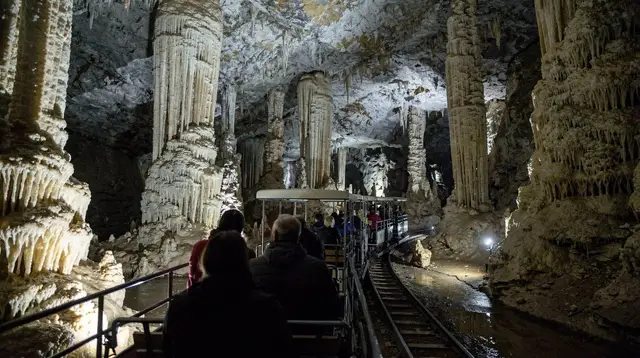
Most visitors to the Slovenian Karst arrive expecting a version of what they have seen at Postojna: a little electric train rattling underground while the walls slide past. Skocjan Caves is a different experience by design, and understanding that difference before you buy a ticket changes how you plan the whole visit. There is no train here. Every visitor covers the entire route on foot, and that single fact is the reason Skocjan was inscribed on the UNESCO World Heritage List in 1986, the first natural site in Slovenia to receive that recognition.
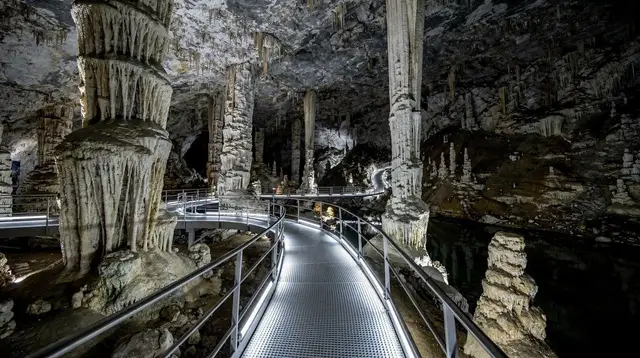
The cave was not honoured for being decorated with stalactites, though it has plenty of those in its upper chambers. It was honoured for a single underground space so large that guidebooks struggle to describe it without sounding like exaggeration: a canyon carved by the Reka river, deep enough and wide enough that a suspended footbridge is the only way across, strung high above the water with nothing below it but open air and stone.
This is what makes the Karst plateau distinctive in the first place: a landscape of limestone riddled with sinkholes, dry valleys and rivers that vanish underground only to reappear kilometres away, a pattern so characteristic of this particular stretch of Slovenia that geologists borrowed the region’s own name, “karst,” to describe the phenomenon wherever it occurs elsewhere in the world. The Reka doing exactly that — disappearing into the ground near the surface dolines and resurfacing far downstream — is the process that carved Škocjan’s chambers over an immense span of geological time, and it continues today, essentially unchanged by the handful of decades tourists have spent walking through the result.
If you have already read about the Postojna versus Skocjan choice or are mapping out a full day trip that combines the two, this page does not repeat that ground. What follows is narrower and more practical: current prices, the booking rules that actually matter, what the walk demands of your body, and the one mistake that trips up more visitors here than at any other cave in the country.
Tickets and Prices
Skocjan Caves is managed as a regional park, Park Skocjanske jame, and its official ticket office publishes a seasonal price scale rather than a single flat fee. The gap between low and high season is real enough to plan around if your travel dates are flexible.
| Season | Months | Adult ticket |
|---|---|---|
| Low season | January, February, March, November, December | around 16 EUR |
| High season | July, August | around 24 EUR |
| Shoulder season | April, May, June, September, October | between the two, check current dates |
These figures come from park-skocjanske-jame.si and are the ones to verify before you travel, since the park adjusts them from year to year. Unlike Postojna Cave, which sells a headline combined ticket with Predjama Castle, Skocjan’s pricing is simpler: one adult rate that moves with the calendar, with reduced rates typically available for children, students and families. Buying online in advance does not usually cost more than buying at the counter, and it does remove the uncertainty of turning up to find the next available slot is hours away.
Entry is organised as guided groups departing at fixed times through the day, not as a continuous stream of visitors wandering in whenever they like. That structure protects the cave environment, but it also means summer afternoons can sell out a specific departure. Reserving a time slot online before you arrive is the safer route, especially if Skocjan is the centrepiece of a tightly scheduled day rather than a stop you can shuffle to another hour.
a full-day trip pairing Skocjan Caves with the Venetian old town of Piran is one way to let someone else handle the timing and the drive, particularly useful if you are travelling without a car and do not want to build a schedule around a single bus connection to Divaca.
What the Walk Actually Involves
Škocjan’s route begins on the surface, among two enormous collapsed dolines, Velika dolina and Mala dolina, where the Reka river disappears underground in dramatic fashion before you have even reached the cave entrance proper. These surface trails are worth the extra time on either side of the ticketed walk: paths wind along the rim of the dolines with views down into a green, cliff-walled chasm that already hints at the scale of what is below.
Once inside, the guided route descends through a sequence of chambers that grow progressively larger, culminating in Martel’s Chamber, one of the biggest known underground chambers on the planet, tall enough and wide enough to swallow the sound of your own group’s footsteps. The path then reaches the suspended footbridge, the moment most people remember longest: a walkway with a metal grate underfoot and cable railings on either side, strung across open space above the Reka far below, with no train, no glass wall, and no barrier between you and the drop except the bridge itself. Photographs of this crossing look impressive online precisely because the real thing feels exposed in a way that carriages and platforms do not.
Past the bridge, the route continues along maintained paths and staircases before eventually surfacing through a different exit than the one you entered, meaning the walk is genuinely point to point rather than a loop back to where you started; the park runs a shuttle or a marked path back to the visitor centre for people who parked at the entrance. Guides who lead each group set the pace, stop at points of interest, and enforce the rules, cave etiquette in Slovenia’s show caves is not a suggestion.
Budget on the order of two hours underground, more once you add the surface trails and the walk back to your car or bus stop. Several hundred steps, damp stone, and sections without handrails on both sides make this a moderately demanding walk rather than a gentle amble, and it is worth being honest with yourself and with anyone travelling with you about fitness before booking.
Škocjan Versus a Real Caving Trip
It is worth being clear about what kind of experience this is, because “cave” covers a wide range of activities in Slovenia. Škocjan is a show cave: a fixed, guide-led route on maintained paths, staircases and the suspended footbridge, open to any reasonably fit visitor and requiring none of the ropes, helmets or crawling associated with genuine caving.
If the scale of Martel’s Chamber and the footbridge over the Reka leaves you wanting more, the guide to show caves versus real caving in Slovenia explains how the two differ and where to look if a helmet-and-headlamp trip into an undeveloped cave is closer to what you are after. For a wider view of how Škocjan sits alongside the country’s other developed caves, the overview of Slovenia’s show caves covers the smaller sites that rarely make a first-time itinerary but reward a second visit to the Karst.
That said, don’t mistake “show cave” for “easy.” The absence of ropes and harnesses does not mean the walk is effortless: the steps, the damp stone and the exposure on the bridge are real, and Škocjan asks more of a visitor’s legs and nerve than Postojna’s train ride does. It sits in something of a middle ground — accessible to anyone reasonably fit, but noticeably more physical than the phrase “tourist attraction” tends to suggest.
The Rule That Catches People Out: No Photography
Here is the piece of practical information that matters more at Skocjan than at almost any other cave in Slovenia: photography is banned inside, completely, without exception, at every point past the ticket gate. Not flash photography specifically, not tripods specifically — cameras, phones used as cameras, and phones used as flashlights are all prohibited once the guided walk begins. This is different from Postojna Cave, where visitors do photograph the train ride and the illuminated chambers, and different again from many other show caves around Slovenia, where rules vary from cave to cave.
The reason is straightforward: Skocjan is a working ecosystem as much as a tourist attraction, home to bat colonies and cave-adapted species sensitive to artificial light, and the park treats the ban as a conservation measure rather than a photogenic quirk. Guides do enforce it, sometimes firmly, and the instinct to sneak a quick shot of the footbridge is exactly the instinct to resist. If a photograph of that crossing matters to you, look for it in the park’s own official materials or accept that this is one Slovenian sight you experience rather than collect. Coming to terms with that before you arrive, rather than being told off mid-tour, makes for a far better visit.
Cave Temperature: Dress for Winter Underground, Even in August
Like every cave described in this guide’s parent region, Skocjan holds a steady temperature of roughly 8 to 12 degrees Celsius year-round, regardless of what the thermometer reads outside on the Karst plateau. Visitors arriving in a July heatwave in shorts and sandals are the ones who end up shivering halfway through the walk, an easy and entirely avoidable mistake covered in more detail in the guide to what to wear inside Slovenia’s karst caves. Bring a jacket or fleece regardless of season, and wear closed shoes with real grip: the paths are damp stone and metal grating, and this is not a cave you want to navigate in flip-flops.
Škocjan for Families and Visitors With Limited Mobility
Families weighing whether to add Škocjan to a Slovenia itinerary should know that the walk, while not difficult for a healthy adult, is a genuine hike by the standards of a “cave visit”: several hundred steps, uneven natural rock, and roughly two hours on your feet before you resurface.
Children old enough to manage that kind of walk tend to come away as the most enthusiastic members of the group — a suspended bridge over an underground river is the sort of thing that sticks in a child’s memory longer than almost anything else in Slovenia. For help judging whether this fits alongside gentler stops on a family trip, the guide to Slovenia’s best activities for families sets Škocjan against easier options elsewhere in the country.
The picture is less encouraging for visitors who use a wheelchair or struggle with stairs and uneven ground: the route is not adapted for limited mobility, and the footbridge in particular has no alternative crossing that avoids the steps and the drop below. Anyone planning a Slovenia trip around accessibility needs should read the accessibility in Slovenia guide before building Škocjan into the itinerary, since the constraints here are structural rather than a matter of asking staff for help.
Best Time of Year to Visit
Because ticket prices and crowd levels both track the calendar closely, the best time to visit Škocjan is largely a question of which trade-off suits your trip. July and August bring the highest prices, the largest guided groups, and the best odds of warm, dry weather on the surface trails around the dolines. The shoulder months of April, May, September and October sit in between on price and tend to bring smaller groups, while January through March and November and December are the cheapest and quietest months, though a Karst winter can mean cold, damp, sometimes foggy conditions above ground even as the cave itself holds its usual temperature regardless of season.
The guides to Slovenia in summer, Slovenia in autumn and the month-by-month Slovenia weather guide go into more detail on what each season actually feels like on the ground — detail that matters far more for the surface walk around the dolines than for the cave interior itself.
Getting There and What Else Sits Nearby
Skocjan Caves sits near the village of Divaca in the Karst plateau, roughly in the same corner of Slovenia as several other sights that reward combining into a single day: the Lipica stud farm, home of the Lipizzaner horse breed since 1580, and the walled hilltop village of Stanjel.
If your route brings you from the direction of Postojna, Predjama Castle built into its cliff face is close enough to fold into the same itinerary without much extra driving, and the disappearing waters of Lake Cerknica sit a reasonable distance to the north for anyone building a longer Karst-focused day. None of these need detailed treatment here — the day trip planning guide and the broader things to do around Skocjan Caves page cover logistics and sequencing.
Travellers without a car have real options too: guided trips depart from Ljubljana and handle the connection to Divaca directly, which is worth considering given how infrequent public transport to the cave itself can be. If horses interest you as much as geology, a combined day covering both the Lipica stud farm and the Skocjan Caves avoids the logistics of arranging two separate trips to the same corner of the Karst.
For a shorter window, a half-day trip from Ljubljana focused purely on the caves suits visitors who want the canyon and the footbridge without giving up a full day of their trip to get there and back.
More broadly, Skocjan belongs to the same caves and underground category as Postojna, Predjama and the smaller show caves scattered across the Karst plateau, and anyone building a wider itinerary around this landscape will find that category page useful for comparing options beyond the two headline names.
Anyone deciding how to fold Škocjan into a longer trip has two broad approaches: renting a car and driving the Karst circuit independently, or booking organised transport that handles the driving and the timing for you. The comparison in car versus organised tour in Slovenia lays out that trade-off in more detail, and travellers stringing together several Karst and coastal stops in one trip may find the multi-day tours from Ljubljana guide useful for seeing how Škocjan fits into a longer route rather than a single afternoon squeezed between two cities.
Škocjan at a Glance
| Detail | What to know |
|---|---|
| UNESCO status | Inscribed 1986, Slovenia’s first natural World Heritage site |
| Underground transport | None — the entire route is walked on foot |
| Signature feature | Suspended footbridge over the Reka river canyon |
| Photography | Strictly forbidden throughout the guided route |
| Cave temperature | Roughly 8 to 12 degrees Celsius year-round |
| Typical visit length | On the order of two hours underground, more with surface trails |
| Nearest landmarks | Lipica stud farm, Stanjel, Predjama Castle |
Skocjan rewards visitors who arrive prepared rather than expecting a scaled-up version of Postojna. Leave the camera in your bag once you pass the entrance, bring a layer for the cold, wear shoes that can handle wet stone and stairs, and book your time slot before a summer afternoon fills up around you. What is left, once those practicalities are handled, is a walk across one of the largest known underground spaces on the planet, on a bridge with nothing beneath it but a river that carved the whole thing out of solid rock.
tours.caves-underground
Verified deep-linked GetYourGuide tours. Book through these links and we earn a small commission at no cost to you.
GetYourGuide does not provide a product photo for this activity — the image shows the meeting point, photographed by us.