Getting from Trieste to Ljubljana
What is the best way to get from Trieste to Ljubljana?
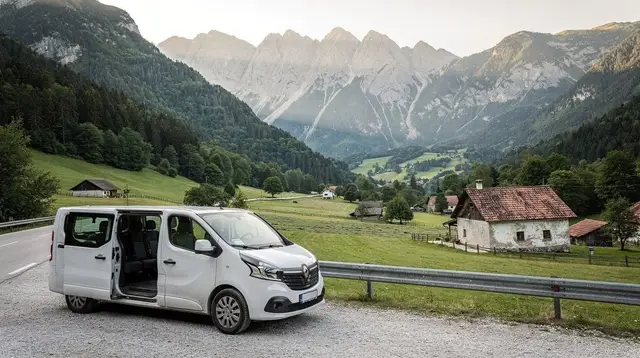
Driving is the fastest and most flexible option, roughly 100 km and about 1 hour 15 minutes to 1 hour 45 minutes depending on border traffic. There is no fixed passport checkpoint on this Schengen-to-Schengen border, but Slovenia's motorway vignette is fully electronic and required the moment you join the highway, so it needs to be sorted before or right at the border.
Why Trieste is a common way in
Trieste sits right at the northern tip of the Adriatic, a short hop from the Slovenian border, and that makes it one of the quieter but genuinely useful gateways into the country. Plenty of travelers land at Trieste Airport on a cheap Italian fare, spend a day or two on the Italian side, and then cross into Slovenia almost as an afterthought — only to realize the crossing itself has a few things worth knowing before they leave the hotel.
This guide sticks to that one job: getting from Trieste to Ljubljana. For what to do once you are actually driving inside Slovenia, the vignette guide and the car rental guide cover that ground in full; this page is about the route in between.
The straight-line distance is short. By road, Trieste to Ljubljana is roughly 100 km, and on a clear run that translates to somewhere between 1 hour 15 minutes and 1 hour 45 minutes door to door, depending on how busy the crossing is and how much traffic you hit approaching the Slovenian capital. It is one of the shorter international transfers anywhere in Europe, and that short distance is exactly why so many people treat it casually — and why the one real trap on this route, the vignette, catches people who assumed a 100 km hop would not need much planning.
The direct route by car
The standard way to drive from Trieste to Ljubljana runs on Italian motorways to the border, then straight onto Slovenia’s own A1 motorway corridor toward the capital. It is a fast, mostly featureless drive by European motorway standards — hills, tunnels, and the Karst plateau rolling by on either side — and it is the route almost every rental car, taxi, and organized tour uses because it is simply the quickest way through.
The border itself, at this crossing, is not a stop-and-show-your-passport affair. Italy and Slovenia have both been Schengen members for years, and there is no fixed checkpoint here the way there might be elsewhere. Traffic generally moves straight through. That said, keep a passport or ID card within reach — Schengen membership removes routine checks, it does not remove the legal requirement to carry identification, and it is one less thing to dig for if anything ever does slow the crossing down.
The vignette pitfall — read this before you cross
Here is the part that trips up more visitors than the border ever does. The instant you join the Slovenian motorway network — which effectively starts right where you cross from Italy — your car needs a valid e-vinjeta, Slovenia’s motorway toll pass. Slovenia dropped the old sticker-on-the-windscreen system entirely; the vignette today exists only as an electronic record tied to your license plate. There is no paper sticker to pick up from a booth as you cross the border, and no physical vignette to display. If you are used to Austria or Switzerland, where a sticker is something you buy and stick on the glass, expect to unlearn that habit here.
In practice this means sorting your vignette before you reach the border, either online in advance or at a service station on the Italian side that sells them, so it is active the moment your plate crosses into Slovenian territory. Driving even a short stretch of Slovenian motorway without one is enforced and fined. The full categories, current prices, and where to buy one are covered in the Slovenia vignette guide — this page is only the reminder that, coming from Trieste, you hit that requirement almost immediately, with far less buffer than travelers arriving from, say, Vienna or Munich.
If you are picking up a rental car in Trieste for a Slovenia trip, also check with the rental company about cross-border terms and insurance before you leave the lot; the mechanics of renting itself are covered separately in the car rental guide.
Stopping along the way: the Karst plateau
The direct route from Trieste happens to run straight through Slovenia’s Karst region, which means the classic mistake — driving Trieste to Ljubljana in one unbroken stretch — skips some of the country’s best-known sights for no good reason. If you have any flexibility at all, this corridor rewards a stop.
Škocjan Caves, a UNESCO World Heritage site since 1986, sit just off this route and offer an underground canyon carved by the Reka river that is genuinely dramatic — no train inside, just a walkway over a real gorge (a dedicated Škocjan day trip guide has the details).
Further along, Postojna Cave is the more famous, more visited option, reached in part by an underground train, and it pairs naturally with nearby Predjama Castle, built into the mouth of a cliff — the Postojna and Predjama day trip guide lays out how to combine the two. A little further off the main road, Lipica is the stud farm where the Lipizzaner horse breed originated in 1580, an easy detour for anyone interested in the tradition behind it (see the Lipizzaner horses guide).
None of this requires abandoning the Trieste-to-Ljubljana plan; it just means treating the drive as roughly two hours plus whatever stops you choose, rather than a straight sprint.
The coastal alternative via Koper
Instead of the inland motorway, some travelers take the coastal road that hugs the Adriatic through Koper, Slovenia’s main port town, before curving inland toward Ljubljana. It is slower than the direct motorway — expect meaningfully more time on the road — but it trades speed for a look at Slovenia’s short, 46 km stretch of coastline, and it sets up an easy add-on to Izola or Piran if those are already on your list. It is a reasonable choice if the coast itself is part of the trip, not just the fastest way to tick off the transfer.
Doing it without a car
Not everyone flying into Trieste wants to rent a car, and the route works reasonably well without one.
Intercity coach. A bus connection is the most dependable public transport option on this corridor, running from Trieste’s bus station across the border to Ljubljana. Schedules and journey times vary by operator and season, so check current timetables close to your travel date rather than assuming a fixed frequency — the Slovenia intercity bus guide covers how the country’s coach network works once you are inside it.
Train. Rail options between Trieste and Ljubljana are more limited than the coach, and a single direct through-service is not always running, so most travelers who want to go car-free lean on the bus instead. If train travel elsewhere in Slovenia is part of your plan, the Slovenia train guide explains what the domestic network actually looks like once you have arrived.
Organized day trip or private transfer. For a lot of visitors based in Trieste for a night or two, the simplest fix is letting someone else handle the crossing entirely. A guided day trip picks up in Trieste, deals with the drive, the vignette, and the border, and delivers a full day in Ljubljana without any of the planning above. The short daily trip to Ljubljana from Trieste is built exactly for this, and if Lake Bled is higher on your list than the capital itself, the Lake Bled excursion combined with Ljubljana covers both in a single day out of Trieste.
Travelers who would rather not share a coach and want the day shaped around their own pace can look at the private tour to Lake Bled and Ljubljana from Trieste, with a private vehicle and guide instead of a set group itinerary. For a fuller day that still runs as a group tour, the full-day bus tour to Ljubljana and Lake Bled from Trieste covers more ground in one outing, useful for anyone based in Trieste for only a short stay who wants both the capital and the lake without an overnight in Slovenia.
Trieste airport vs. Ljubljana airport
Anyone booking flights rather than already being in Trieste has a real choice to make, and it is worth comparing the two before locking in a ticket. Trieste Airport (Ronchi dei Legionari) sits on the Italian side, a reasonable option if fares are notably cheaper or if Trieste and the Italian coast are already part of the itinerary — but it adds this Trieste-to-Ljubljana leg on top of whatever transfer gets you from the airport into Trieste itself. Landing directly at Ljubljana’s own airport, by contrast, cuts out this entire crossing and drops you within about 25 km of the capital; the Ljubljana airport guide covers that route in detail.
If your trip also touches Venice, the Venice-to-Ljubljana guide runs the same comparison from that side of the border, and travelers arriving from the south instead should see the Zagreb-to-Ljubljana guide, where the border situation is genuinely different from this one — checks have been reintroduced on that crossing, unlike the Italy–Slovenia border covered here.
Planning the rest of the trip
Once the transfer itself is sorted, the bigger planning questions — how many days to spend, whether a car is worth it beyond this one crossing, what a Ljubljana Card actually saves — sit in their own guides rather than this one. A good next stop is how many days in Slovenia is realistic for a first visit, since that number shapes whether Trieste ends up as a quick one-day hop into the capital or the starting point of a longer loop through the Karst, the Alps, and the coast.
For a ready-made structure rather than building one from scratch, the Ljubljana day trip from Trieste itinerary lays out a single full day, and the things to do from Trieste page rounds up the wider set of excursions departing from that side of the border, including the Postojna Cave option below for those who would rather see the Karst on a guided day than drive it themselves.
Postojna Cave day trip from Ljubljana is worth keeping in mind even for Trieste-based travelers who end up basing themselves in the capital for a night or two, since it runs the Karst leg of this same corridor from the Ljubljana side.
Getting from Trieste to Ljubljana: frequently asked questions
How far is Ljubljana from Trieste?
Around 100 km (62 miles) by the direct motorway route, which usually takes 1 hour 15 minutes to 1 hour 45 minutes by car depending on the border crossing and traffic around Ljubljana itself.
Is there a direct train from Trieste to Ljubljana?
Rail links between the two cities are limited and not always running as a single direct service, so most travelers without a car rely on intercity coaches instead. Check current timetables before counting on a train.
Do I need a vignette immediately after crossing the border from Italy?
Yes. Slovenia’s motorway vignette, the e-vinjeta, is fully electronic and tied to your license plate, with no sticker to buy at a roadside kiosk. It must be active before you join the Slovenian motorway network, which starts right at the border.
Are there border checks between Italy and Slovenia?
Both countries have been long-standing Schengen members and there is no fixed checkpoint on this crossing, so traffic normally flows through without stopping. Carry a passport or ID card anyway, since it is required to hold one when traveling within Schengen.
Can I visit Lake Bled or Postojna Cave on the way from Trieste?
Yes, both work well as a stop. Postojna Cave and the Karst plateau sit directly between Trieste and Ljubljana, while Lake Bled is a manageable detour to the north before continuing to the capital.
What is the fastest way to get from Trieste to Ljubljana without a car?
An intercity coach is the standard public transport option, and a day tour or private transfer departing from Trieste covers the same route with a guide and no logistics to arrange yourself.
Should I fly into Trieste or Ljubljana airport?
Trieste Airport works well if your trip starts on the Italian coast or you are combining Trieste with Slovenia, while Ljubljana’s own airport puts you closer to the capital and the rest of the country. Compare both against the rest of your itinerary before booking.
Is the coastal route via Koper worth taking instead of the direct motorway?
It adds time but trades the motorway for a look at the Slovenian coast, including Koper and the approach to Piran and Portorož, before turning inland toward Ljubljana.
Transfers and transport passes on GetYourGuide
Verified deep-linked GetYourGuide tours. Book through these links and we earn a small commission at no cost to you.
GetYourGuide does not provide a product photo for this activity — the image shows the meeting point, photographed by us.