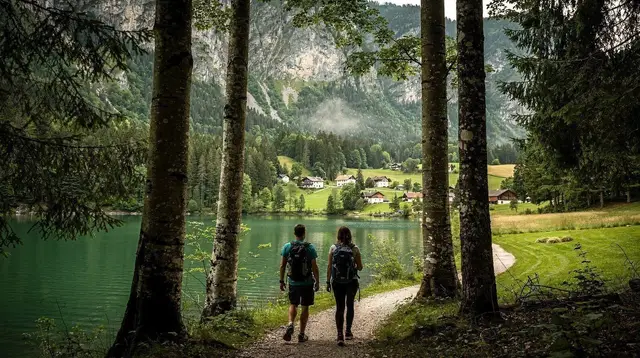
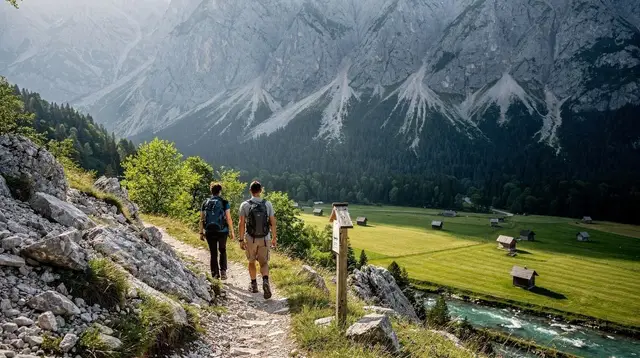
Hiking Trails at Vršič Pass
What hikes can I do from Vršič Pass?
From the summit car park you can walk short viewpoint trails to the Russian chapel and the Poštarski Dom hut in under an hour, or take on the steeper ridge routes up Mala Mojstrovka and Velika Mojstrovka in half a day. All of it depends on the road being open, which in practice means summer only, roughly June to October.
Where the road runs out of switchbacks
At 1,611 meters, Vršič Pass is the highest road pass in Slovenia and the hinge of the Julian Alps: the point where the valley road climbing out of Kranjska Gora tips over the ridge and drops toward Bovec and the emerald Soča Valley on the other side. Most people who drive it treat the summit as a photo stop between the fifty numbered hairpin bends. That undersells it. The car park at the top sits at the foot of two genuine mountains, a short walk from a wartime chapel, and within reach of ridge trails that feel a world away from the traffic below.
This guide is only about what you can walk from the pass itself once you are up there on foot. It does not cover the drive over the switchbacks, the rental logistics, or the debate between basing yourself on the Kranjska Gora side versus the Soča side — those live on their own pages, at Renting a Car in Slovenia and Kranjska Gora vs Bovec. What follows is the walking itself: which trails start where, how long they take, how hard they are, and the one seasonal trap that catches people who plan a Vršič hike without checking the calendar first.
The trap: this is a summer-only mountain
The single fact to internalize before anything else: Vršič Pass is closed to cars and to hikers alike for roughly half the year. Snow closes the road from around November through May, with the exact dates set by how the winter behaves rather than by a fixed calendar. There is no plowing-through in a rental car, no shortcut on foot around the barriers, and no trail up top that makes sense once the ridge is under snow and the avalanche risk is real.
If your itinerary has you crossing the Julian Alps in winter, the hikes on this page simply are not available — read Slovenia in Summer for the season that actually works, and see Why the Vršič Pass Closes and Reopens With the Seasons for how unpredictable the opening date really is from one year to the next. Plan for June through October, and build in a backup day if you are visiting at the edges of that window, since a late spring or an early snap can shift things by weeks.
Inside that window, conditions still swing hard within a single day. The summit is more than a kilometer higher than Ljubljana, and it shows: clear morning sun over the ridge can turn into cold horizontal rain by early afternoon, especially in July and August when Alpine storms build quickly. None of the walks below are long, but all of them are exposed to weather that changes faster than the trail itself.
Getting oriented at the summit
The car park at the top of the pass sits beside the Poštarski Dom pri Vršiču, a working mountain hut that serves basic food and drinks and marks the trailhead for almost everything described here. It is a useful landmark rather than a hike in itself — arrive, get your bearings, and pick a route depending on how much time and daylight you have left. The parking area is small for how popular the pass is in July and August; arriving before mid-morning, or later in the evening for the light, avoids the worst of the circling.
Two mountains frame the summit on either side of the road: Mala Mojstrovka (roughly 2,332 m) to the east and Velika Mojstrovka (roughly 2,366 m) to the west, both accessible on marked trails starting within a few minutes of the car park. Below them, gentler paths lead to the pass’s wartime memorial and toward the valley on the Soča side.
The four walks, from easiest to hardest
Ruska kapelica — the Russian chapel
The easiest thing to do at Vršič is also the most affecting. A short path, well under a kilometer and no more than fifteen to twenty minutes each way, leads from near the car park down to a small wooden chapel built into the hillside: the Ruska kapelica, or Russian chapel. Russian prisoners of war built it during the First World War in memory of comrades killed by an avalanche while constructing the military road that still carries traffic over the pass today. It is a quiet, level walk that anyone can manage, and it puts the pass in context before you tackle anything steeper — this road exists because of a war, not because of tourism.
Poštarski Dom loop and viewpoint walks
A network of short paths fans out from around the hut, climbing just far enough to give a proper view back down both sides of the pass without committing to a real mountain ascent. Count on thirty minutes to just over an hour round trip depending on which viewpoint you pick, with modest elevation gain and no technical difficulty. This is the option for families, for anyone short on time between a drive from Kranjska Gora and a drive down into the Soča Valley, or for hikers who want a preview before deciding whether to go higher.
Mala Mojstrovka
The more approachable of the two summits, Mala Mojstrovka is a genuine mountain hike rather than a stroll: a marked trail gains real elevation over rocky, sometimes loose terrain, with a short scramble near the top. Plan on three to four hours round trip at a comfortable pace, sturdy footwear, and a head for a bit of exposure on the final approach. The reward is a summit view that takes in the pass itself, the ridge toward Triglav, and on a clear day the green thread of the Soča far below.
Velika Mojstrovka
The taller and harder of the pair, Velika Mojstrovka adds more distance, more elevation gain, and stretches where hands come into play alongside feet. Reckon on four to six hours round trip, and treat this one as a full-day commitment rather than an add-on to a driving day — leave early, watch the weather all the way up, and turn back without hesitation if cloud rolls in before the summit ridge. This is mountain hiking, not pass sightseeing, and it deserves the same respect as the approach trails toward Triglav itself.
| Trail | Round trip | Difficulty | Best for |
|---|---|---|---|
| Ruska kapelica (Russian chapel) | Under 30 min | Easy, flat | Anyone, including families |
| Poštarski Dom viewpoints | 30–70 min | Easy to moderate | A quick taste of the ridge |
| Mala Mojstrovka | 3–4 hours | Moderate to hard, some scrambling | Fit hikers with a half day |
| Velika Mojstrovka | 4–6 hours | Hard, exposed sections | Experienced hikers, full day |
Combining the pass with the rest of the day
Because Vršič sits exactly on the seam between the Kranjska Gora side and the Soča Valley side, most visitors treat it as a stop on a longer day rather than a destination in itself. A common pattern: start from Kranjska Gora, drive the switchbacks up, walk to the chapel or take on Mala Mojstrovka if time allows, then continue down the western side toward Kobarid or Tolmin for the afternoon. If rafting or kayaking on the Soča is on your list, that side of the day is covered separately at Rafting the Soča River, and a full route linking the pass with the valley below is laid out at Julian Alps Adventure.
Whichever direction you are driving, remember that the electronic vignette required on Slovenian motorways does not cover this stretch, but it does cover the roads you will use to reach Kranjska Gora or the Soča Valley in the first place — see The Slovenia Vignette if you have not sorted that out yet.
If you would rather not drive it yourself
Vršič itself has no year-round public bus and no guided hiking tour that starts exactly at the summit, which is part of why most visitors reach it by rental car. If a self-drive mountain pass is not what you are after, but you still want a genuine alpine hiking day organized for you out of Ljubljana, a handful of guided trips cover comparable ground in the Kamnik-Savinja Alps.
A guided day hike through Velika Planina’s shepherd huts and the Logar Valley gives you marked alpine trails and a driver without touching the wheel yourself, and a full day of alpine hiking through the Logarska Valley and around Jezersko covers similarly dramatic terrain a short way from the capital.
For something shorter and closer to town, a half-day guided hike up Šmarna Gora with a local host, finishing with homemade štruklji is a gentler introduction to Slovenian hiking culture if the ridge routes above sound like more mountain than you want on this trip.
None of these follow the exact trails described above — Vršič’s own paths are self-guided, on foot, once you have driven or been driven to the summit. They are simply the closest guided alternative if getting yourself over fifty hairpin bends is not part of the plan.
Practical notes before you go
Water and food options at the summit are limited to what the Poštarski Dom sells, so carry more than you think you will drink, especially on the longer Mojstrovka routes where there is no refill point once you leave the car park. Trail markings follow the standard Slovenian red-and-white waymarking system, but cloud can obscure them fast on the exposed upper sections, so a downloaded map or a paper one is worth the weight. Mobile signal is inconsistent right at the ridge. And because the whole area sits inside the approach zone to Triglav National Park, the same rule applies here as everywhere else in Slovenia’s mountains: no permit, no fee, just preparation.
Vršič Pass hiking FAQ
When can I hike from Vršič Pass?
Only when the road over the pass is open, which is a summer window that typically runs from June to October depending on snowmelt and clearance. Outside that window the pass is closed to both cars and hikers, and there is no fixed reopening date each year.
Do I need a permit to hike from Vršič Pass?
No. Slovenia does not require a permit for hiking anywhere in its mountains, including the trails around Vršič and the approach toward Triglav. Bring good boots, water and a map instead of paperwork.
How difficult are the trails near the pass?
They range from an easy fifteen-minute walk to the Russian chapel to a genuinely steep half-day scramble up Mala Mojstrovka or Velika Mojstrovka with some exposed sections. Read the trail notes above before choosing, and turn back if the weather turns.
Can I hike at Vršič Pass in winter?
No. The pass is closed to all traffic once snow makes it impassable, usually from around November to May, and the trails above it become an avalanche-prone, snow-covered mountain environment rather than a summer walking route.
Is there parking at the top of the pass?
Yes, a car park sits at the summit near the Poštarski Dom hut, but it is small and fills early on clear summer weekends. Arriving before mid-morning is the simplest way to avoid circling for a space.
What is the Russian chapel at Vršič Pass?
The Ruska kapelica is a small wooden chapel built by Russian prisoners of war during the First World War, in memory of comrades killed by an avalanche while building the military road over the pass. It sits just below the summit and is one of the easiest short walks from the car park.
Do I need a car to reach Vršič Pass?
A car is the practical way to get there, and most visitors combine it with a longer drive between Kranjska Gora and the Soča Valley. There is no year-round public bus over the pass itself, so travelers without a car generally join an organized trip elsewhere in the Julian Alps instead.
What should I pack for a summer hike from the pass?
Even in August, the summit sits above 1,600 meters and the weather can shift from sun to cold rain within an hour. Pack a warm layer, a waterproof shell, sturdy shoes, more water than you think you need, and sun protection for the exposed ridge sections.
tours.hiking-mountains
Verified deep-linked GetYourGuide tours. Book through these links and we earn a small commission at no cost to you.
GetYourGuide does not provide a product photo for this activity — the image shows the meeting point, photographed by us.