A Car-Free Weekend in Ljubljana, Bled and Postojna
Why this weekend needs no rental car
Slovenia is small enough, and Ljubljana is central enough, that a first-time visitor without a driving licence — or one who simply prefers not to drive on the right in an unfamiliar country — loses almost nothing by leaving the car at home for a weekend. The capital’s old town is closed to private traffic, so a rental car would sit unused for most of the trip anyway. Lake Bled and Postojna Cave are both sold as organized day trips that pick up in central Ljubljana and drop you back in the evening — no parking to find, no e-vinjeta to buy, no unfamiliar roundabouts.
This plan deliberately stays out of the Julian Alps and off the coast. Kranjska Gora, the Vrsic Pass and the Soca Valley are real without a car, but connections are thin and a day trip there and back eats most of a day in transit — that itinerary lives in Julian Alps Adventure. If you do have a car, or four days instead of three, Ljubljana in Four Days opens up more of the country. This page is built for exactly three days, on foot and by coach, covering the capital, Bled, and the caves.
Before you go
Buy timed tickets in advance for Postojna Cave if you plan to go independently by public bus rather than on an organized tour — the official booking system requires a specific date and time slot, so walk-up entry is not guaranteed on a busy weekend. If you’re taking the organized coach trip described in Day 3, the tour operator handles the cave ticket for you. Either way, pack a light jacket even in August: the caves sit at 8–12°C year-round, and this is the single most common thing first-time visitors get wrong. For the wider question of whether skipping a rental car works for a full week rather than a weekend, see Slovenia Without a Car.
Day 1 — Ljubljana on foot
You don’t need a bus, a taxi or a bike-share app for day one. Everything worth seeing in central Ljubljana sits inside a pedestrian core you can cross in twenty minutes, so today is entirely on foot, apart from one short ride up a hill.
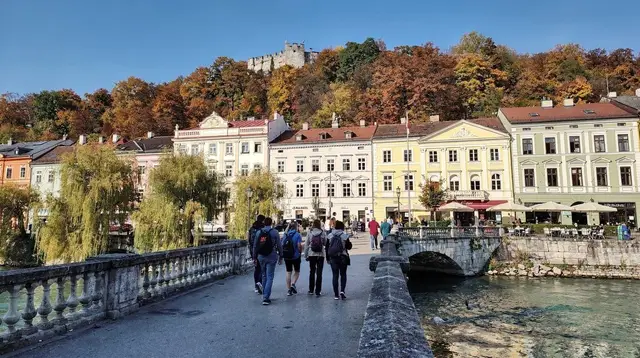
Morning: the old town and the Triple Bridge. Start at Preseren Square and cross into the old town over Joze Plecnik’s Triple Bridge, three linked footbridges over the Ljubljanica where a single span used to be. Plecnik’s imprint is everywhere in this stretch of the city — the riverside quays, the market colonnade, the lamp posts and balustrades — and the whole ensemble was inscribed as a UNESCO World Heritage Site on 31 July 2021.
A short self-guided loop covers it well; if you’d rather have a local point things out, a walking tour of the historic center works through the same streets with commentary on Plecnik, the Habsburg-era facades and the 1895 earthquake that reshaped the city. Read more on Plecnik’s Ljubljana or follow a dedicated route in the old town walking guide.
a guided walk through Ljubljana’s old town is worth booking if you want the Plecnik story told properly rather than pieced together from plaques.
Midday: the castle, on foot or by funiculaire. Ljubljana Castle sits on the hill above the old town and is reachable two ways with no car involved: a free walk of about fifteen minutes up marked paths, or the funicular from Krekov trg, which runs an adult round trip for 6 EUR (or 19 EUR combined with castle entry). Either way you arrive at the same viewpoint over the terracotta roofs, the Ljubljanica, and the Kamnik Alps on a clear day.
Afternoon: the central market and the riverside. Come back down to Plecnik’s central market colonnade along the river — a covered arcade of food stalls and produce that’s at its liveliest on Friday and Saturday mornings, though it runs all week. From there, walk the riverside quays down toward Cobblers’ Bridge, another Plecnik design, and cross into Metelkova, Ljubljana’s converted-barracks arts quarter, for a change of pace and a coffee.
Getting around without walking everything. If your feet need a break, the Kavalir is a small electric shuttle that covers the pedestrian center — and it’s genuinely free, not a paid shuttle: up to five passengers, no fixed stops (you simply hail one or call for pickup), running from 6am to 22:00. Two of the four vehicles are enclosed and heated for winter. It’s one of the few free services in the city worth knowing about before you arrive. For everything else about moving around without a car — bus cards, the Kavalir, walking distances — see Getting Around Ljubljana.
Evening. Dinner in the old town, then a stroll back over the Triple Bridge once the buildings are lit — this is when Plecnik’s lighting design, understated by day, does the most work.
Should you buy the Ljubljana Card? If you’re planning at least the castle plus a couple of museums and a river cruise, the math works in the card’s favor — it bundles unlimited city buses, the funicular and castle entry, a guided city tour, a Ljubljanica cruise, a bike rental and more than twenty museums into one price (41 EUR for 24 hours, 49 EUR for 48 hours, 54 EUR for 72 hours). Run your own numbers against Is the Ljubljana Card Worth It? before buying, and if you’d rather pay per attraction, see Ljubljana Card vs Individual Tickets.
the Ljubljana Card, covering the castle, buses and a river cruise in one pass.
Day 2 — Lake Bled by organized day trip
This is the day a rental car would normally earn its keep — and the day you can skip renting one entirely. Lake Bled is about 55 km from Ljubljana, and a seat on an organized coach tour gets you there and back with someone else doing the driving, the parking and the timing.
Getting there. A day tour departs Ljubljana by coach in the morning, typically with pickup from a central point or your hotel, and drops you at the lake for several hours of free time before the return leg. This removes the two real headaches of visiting Bled independently: parking in a town with genuinely limited space, and figuring out the public bus timetable from Ljubljana’s bus station. If you’d rather compare that option properly against public transport, see How to Get to Bled Without a Car; for the broader question of car versus organized tours across the whole trip, Car vs Organized Tour in Slovenia lays out the trade-offs.
a day tour to Lake Bled departing from Ljubljana is the most straightforward way to fit the lake into a car-free weekend without losing half a day to timetables.
At the lake. Once you arrive, the lake itself asks for nothing more than your legs and, if you want it, a boat. The classic move is a pletna ride to Bled Island — the traditional flat-bottomed boat, rowed standing by a boatman, running around 20 EUR per adult round trip with roughly a half-hour wait at the dock. Boatmen are typically paid in cash.
Once on the island, entry to the Church of the Assumption is separate, around 12 EUR per adult, and includes the bell tower and a small museum. Both figures are working estimates from consistent sources rather than a published official tariff — no single operator lists a fixed pletna price, which is itself part of Bled’s charm and its frustration; more on that in the price nobody publishes.
If you’d rather skip the boat, walking the lake’s shoreline path takes about two hours at an easy pace and gives you the postcard view from several angles without paying for anything. Bled Castle, perched on a cliff above the north shore, charges 19 EUR for an adult ticket if you want the terrace view from above rather than just from the water — see Bled Castle for what’s inside.
One thing this itinerary deliberately leaves out: there is no entry fee or toll for simply arriving in Bled by car or coach. What does exist is paid parking in the town center (the main P0 lot runs 2 EUR/hour or 15 EUR for a full day) — worth knowing even though it isn’t your problem on a coach tour.
Evening. The coach returns you to Ljubljana in time for dinner. If Bled leaves you wanting a quieter, less-visited lake with the same mountain backdrop, Bled vs Bohinj explains why Bohinj is the trip for another visit — it isn’t part of this weekend, since it adds a longer transfer that doesn’t fit a car-free two-night stay well.
Day 3 — Postojna Cave and Predjama Castle
Your last day goes underground, then into a cliff face, both reachable the same way you reached Bled: an organized coach that handles the driving and, in this case, usually the cave ticket too.
Getting there. Postojna is about 53 km from Ljubljana, and a day trip departing the capital typically bundles the cave visit with a stop at Predjama Castle, 9 km away — the two sights are sold together in almost every tour because they pair naturally into one day. If you’d rather do this leg independently by train or bus, How to Get to Postojna Without a Car walks through the timetables; for booking your own cave slot rather than going through a tour, see Postojna Cave Tickets and Tips.
a day trip from Ljubljana that covers Postojna Cave, or, if you’d rather have both sights locked into one ticket without arranging transfers yourself, a combined Postojna Cave and Predjama Castle tour is the more efficient booking.
Postojna Cave. The cave is toured partly aboard a small underground train and partly on foot along walkways through vast chambers, with the full visit running roughly an hour and a half. An adult ticket for the cave alone is 34.90 EUR; combined with Predjama Castle it’s 49.90 EUR rather than 58.90 EUR bought separately, so if you’re doing both — and almost everyone does — buy the combined ticket. Postojna’s official booking system requires choosing an exact date and time, so treat reservation as effectively mandatory rather than optional, especially on a weekend.
Predjama Castle. Nine kilometers on, Predjama Castle is built directly into the mouth of a 123-metre cliff — the largest cave castle in the world, and a genuinely strange sight even in photos. Nearly every Postojna tour includes it as the second half of the day, which is why it’s worth booking the combined ticket rather than the cave alone.
If you have any flexibility left. The Karst region also holds Skocjan Caves, a UNESCO World Heritage Site since 1986 and a different experience entirely — no train, a suspended footbridge over an underground river canyon instead, and a strict no-photography rule inside. It’s further from Ljubljana than Postojna and doesn’t fit neatly into this particular weekend, but if a future trip has an extra day, Postojna vs Skocjan Caves explains which one earns the detour.
Evening. The coach returns to Ljubljana by early evening, leaving time for a last walk along the river before you head home or on to your next stop.
Budget for the weekend
Prices below are per adult, in euros, and reflect the pace of this specific itinerary — a solo or two-person trip staying central and using organized transport rather than public buses.
| Item | Estimated cost |
|---|---|
| Ljubljana Card (24h, optional) | 41 EUR |
| Castle funicular only (if skipping the card) | 6 EUR |
| Bled day trip by coach | varies by operator |
| Pletna boat to Bled Island | ~20 EUR |
| Church of the Assumption entry | ~12 EUR |
| Postojna Cave + Predjama combined ticket | 49.90 EUR |
| Three nights, budget-to-midrange hotel | varies widely |
For a fuller breakdown across a longer stay, see Slovenia Daily Budget and the site’s own budget calculator.
Car-free weekend in Ljubljana: frequently asked questions
Do I really not need a car for this itinerary?
No. Ljubljana’s center is closed to private traffic, and both Lake Bled and Postojna Cave are reachable by organized coach day trips departing from Ljubljana, with hotel or central pickup. A car would spend most of the weekend parked.
Is the Kavalir shuttle in Ljubljana free?
Yes. The Kavalir is a small electric vehicle that circulates through the pedestrian center from 6am to 22:00, carries up to five passengers, and has no fixed stops — you hail it or call it. There is no fare.
Can I use cash on Ljubljana’s city buses?
No. Cash payment on board was discontinued in 2010. You need an Urbana card (2 EUR for the card itself, loaded with credit), a contactless bank card, or the LPP mobile app. Fares run around 1.30 EUR per ride; check lpp.si for the current rate.
Is it better to book an organized tour to Bled or go by public bus?
An organized tour costs more but removes parking, timetable and pletna-timing guesswork in one booking, and fits a two-night weekend more comfortably. A public bus is cheaper and fully workable with more time; Car vs Organized Tour in Slovenia compares both properly.
Do I need to book the Postojna Cave ticket separately if I take a tour?
No. Tours that include Postojna Cave typically handle the timed-entry booking as part of the package. If you’re going independently, you must book a specific date and time yourself in advance.
Is three days enough to see Ljubljana, Bled and Postojna?
Yes, at the pace in this itinerary — one full day in the capital, one day trip to Bled, one day trip to Postojna and Predjama. It leaves out the Julian Alps and the coast, both of which need their own dedicated days; see Ljubljana in Four Days if you can add one.
Why doesn’t this itinerary include the Julian Alps or the coast?
Both are genuinely reachable without a car, but connections thin out quickly outside Ljubljana, Bled and the Karst, and a round trip to Kranjska Gora or Piran consumes most of a day in transit alone. They fit better as their own trip — see Julian Alps Adventure.
What should I pack for the cave visit in summer?
A light jacket or fleece, even in August. Postojna Cave sits at a steady 8–12°C year-round regardless of the season outside.
tours.3 days
Verified deep-linked GetYourGuide tours. Book through these links and we earn a small commission at no cost to you.
GetYourGuide does not provide a product photo for this activity — the image shows the meeting point, photographed by us.