The Kavalir and Ljubljana's Car-Free Old Town
The first time a Kavalir pulled up next to me, I hadn’t asked for it. I was standing near the Triple Bridge with a phone in one hand and a paper map in the other, clearly lost, when a small electric buggy slowed down, and the driver leaned out and asked, in English, if I needed a lift.
I said no out of reflex — the kind of no you give a stranger’s offer in most cities — and then I watched him do the same thing for an elderly woman with two shopping bags thirty seconds later, and for a father carrying a toddler on his hip thirty seconds after that. That’s when I understood the Kavalir isn’t a tourist gimmick bolted onto Ljubljana. It’s a piece of everyday infrastructure that happens to be free, and happens to be lovely, and most visitors never think to use it.
What the Kavalir actually is
The Kavalir is a small electric vehicle, open-sided or enclosed depending on the season, that circulates through Ljubljana’s pedestrian center. It carries up to five passengers, it has no fixed stops and no printed timetable, and it costs nothing. You hail one the way you’d flag a passing cyclist, or you call ahead for a pickup at a set point. The fleet is four vehicles, and two of them are closed in and heated, which matters more than you’d think once November arrives.
It runs daily from 6am to 10pm, which covers early risers heading to the market and the after-dinner crowd walking back from Metelkova. There’s no app to download, no card to buy, no queue to join. You either see one and wave, or you don’t, and you keep walking — which, this being a compact old town, is rarely a hardship.
Why the center has no cars in the first place
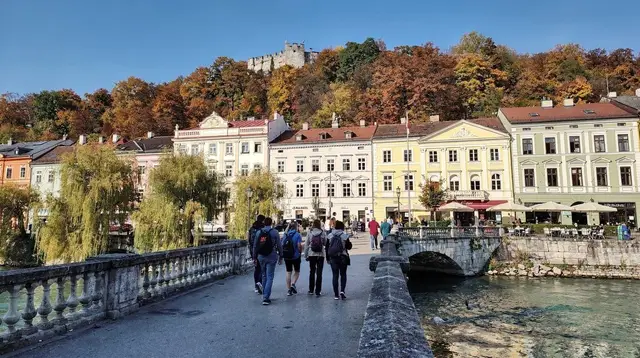
None of this would matter if Ljubljana’s center still let cars through, because the Kavalir exists precisely because cars don’t. The historic core — the stretch between the Triple Bridge and Prešeren Square, the quays along the Ljubljanica, the streets around the central market — is closed to general traffic. Residents with permits and delivery vehicles still move through at set hours, but there’s no cutting across town in a rental car, no circling for parking, none of the low hum of engines that fills most European city centers.
That closure isn’t recent improvisation. It follows the logic laid down a century ago by Jože Plečnik, the architect whose vision for the riverbanks, bridges, and public spaces here was recognized as a UNESCO World Heritage site in 2021, precisely because it treats the city as something built around people walking, not vehicles passing through. Reading about his UNESCO-listed urban design is interesting; walking it car-free is what actually makes the argument land. You notice how the quays are scaled for someone strolling with a coffee, not someone glancing up from a windshield.
I’d read about the pedestrianization before I arrived, filed it mentally under “nice policy,” and then spent my first hour in the old town genuinely surprised by how quiet it was. Not empty — cafés were full, buskers were playing near the market colonnade, kids were chasing pigeons across the square — just quiet in the specific way a place is quiet when nothing is idling at a light. It’s the kind of ordinary that’s easy to miss if you don’t stop and notice you’re missing something: traffic noise.
Who actually rides it
I assumed, wrongly, that the Kavalir was aimed at tourists. It isn’t, or not primarily. In the twenty minutes I stood near the market watching the vehicles pass, I saw an elderly man flagged down with a bag of onions, a woman with a stroller who clearly knew the driver by name, and a delivery of framed paintings being ferried between two galleries. Visitors use it too, especially people managing a rolling suitcase between a riverside apartment and the bus station, but it reads first as a service the city built for its own residents and only secondarily as something charming for the rest of us.
That’s worth knowing if you have any mobility concerns. The step up is low, the ride is short and unhurried, and drivers are used to slowing for people who need an extra moment. It isn’t a substitute for purpose-built accessible transport, and if your needs are significant it’s worth checking our accessibility in Slovenia guide before you rely on it, but for a lot of travelers who simply can’t manage cobblestones and bridges comfortably, it quietly solves a problem that no ticketed system would.
A short list of things nobody tells you
A few details that only became clear after a few days of actually using the thing, rather than reading about it:
| What you might assume | What’s actually true |
|---|---|
| You need to book or reserve a seat | You just hail one on the street, or call for a pickup |
| It follows a bus-style route | It has no fixed stops, it goes where passengers need |
| It only runs in good weather | Two of the four vehicles are enclosed and heated |
| It’s a paid tourist shuttle | It’s entirely free, run as a city service |
| It replaces the bus network | It’s separate from Ljubljana’s urban transport, which still requires an Urbana card |
That last point trips people up. The Kavalir has nothing to do with the city bus system, and it won’t get you out to Tivoli Park or across to the newer neighborhoods — for that, and for what a realistic day of local transport actually costs, it’s worth reading through what a day in Ljubljana really costs separately. The Kavalir’s whole purpose is narrower and, I’d argue, more charming: covering the last stretch inside a zone where nothing with an engine is otherwise allowed.
What it feels like, day to day
What stayed with me wasn’t any single ride — most of them were three or four minutes, from one side of the old town to the other — but the cumulative effect of a center where the loudest thing most mornings is the market vendors calling out and the Ljubljanica running under the Triple Bridge.
I walked past Ljubljana Castle on the hill above town most evenings, took a slow river cruise one afternoon, and never once had to step around a parked car or wait for one to pass. If you want a guided version of that same walk, with someone pointing out the Plečnik details you’d otherwise miss, a guided walk through Ljubljana’s car-free center covers the same ground with better context than I managed on my own.
The idea also travels. A little way outside the capital, in Šmartno, an entire fortified hilltop village is walkable in the same spirit, car-free by geography rather than policy, and a walking tour of Šmartno with a local guide makes a nice half-day if you want to see how a much smaller Slovenian town handles the same idea.
In Kranj, the old town sits above a network of tunnels that once sheltered residents during air raids, and a guided walk through the tunnels beneath Kranj’s old town is a strange, worthwhile detour if you’re curious how these preserved centers were built to be lived in, not just driven through.
None of this makes Ljubljana unique in wanting a quieter center — plenty of European cities pedestrianize a square or two. What’s different is the follow-through: a free, on-demand vehicle for anyone who can’t or shouldn’t be walking the whole distance, running from early morning to late evening, funded as public service rather than sold as a novelty.
It’s a small thing, and I’d guess most visitors spend three days here and never ride one. But once you know to look for it — a boxy little cart, easing along the riverside path, someone leaning out to ask if you need a lift — it’s hard not to see it as the clearest evidence of what the car-free decision actually bought this city: room for people to move at walking pace, and a backup for the days that pace isn’t enough.
If you’re planning how to spend those days before or after, our one-day Ljubljana itinerary and car-free weekend itinerary both assume exactly this kind of center — one built for arriving on foot, and occasionally catching a free ride the rest of the way.
tours.Local voices
Verified deep-linked GetYourGuide tours. Book through these links and we earn a small commission at no cost to you.
GetYourGuide does not provide a product photo for this activity — the image shows the meeting point, photographed by us.