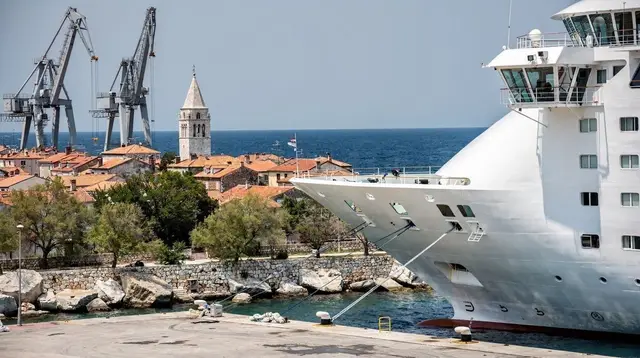
The coast’s working harbor, not its showpiece
Every guide to Slovenia’s 46 km of Adriatic coastline eventually lines up the same three names: Piran, Izola, and Koper. Piran gets the postcards — Tartini Square, the Venetian bell tower, the town walls with views clear across to Italy and Croatia. Koper gets the cruise ships and the container port. Izola, sitting quietly between the two, gets neither, and that is exactly why it belongs on your itinerary rather than off it.
Izola is a fishing port. Not a fishing port that used to matter and now sells the memory of it to tourists — a town that still smells faintly of the sea at the harbor edge, where boats tie up along working quays and the fish market opens early. For most of the twentieth century Izola’s economy ran on tuna canning, and its Delamaris factory was one of the best-known fish-processing plants in the former Yugoslavia. That industrial, maritime backbone is still legible in the town today: narrow streets that were built for dockworkers rather than for grand civic display, a harbor that is used rather than decorative, and a scale that never asked to compete with Piran’s.
This page will not try to sell you Izola’s old town as a substitute for Piran’s — it isn’t one, and pretending otherwise sets up a disappointing comparison. What Izola offers instead is a genuine, unpolished stop on the same short stretch of coast: somewhere to eat fresh seafood without a queue, watch fishing boats unload, cycle a former railway line along the water, and feel like you’ve found the part of the Slovenian coast that isn’t performing for visitors.
Where Izola sits, and why the coast works as one trip
Slovenia’s entire coastline is short enough that this whole region reads as a single loop rather than three separate destinations. Izola sits almost exactly midway between Piran and Koper, each only about 15-20 minutes away by road. Portorož, Piran’s beach-resort neighbor, adds a fourth stop just beyond Piran, and together the four towns fit inside a stretch of coast you can drive end to end in under an hour without traffic.
That geography is the whole logic of visiting Izola: almost nobody comes here as a single-destination day trip from Ljubljana. Instead, Izola is the stop travelers add in the middle of a longer coastal day — the harbor town you pass through, park in for an hour, or eat lunch in, on the way from Koper’s cruise terminal to Piran’s old town, or the reverse. If you are weighing which of the coastal towns deserves your limited time, the comparison guide on Piran versus Portorož is a useful companion, since Izola’s role only makes sense once you understand what its two more famous neighbors are already covering.
Getting to Izola from Ljubljana
By car, Izola is roughly 115 km from Ljubljana, and the drive takes about an hour and fifteen minutes to an hour and a half depending on traffic around Koper. The route runs on Slovenia’s motorway network for most of the distance, which means the electronic vignette applies — sort this out before you leave, since driving without one is fined. If you are renting a car for the coast specifically, the guide to renting a car in Slovenia covers what to expect at pickup, and Slovenia’s vignette rules are explained in full in the dedicated vignette guide.
Public transport to Izola on its own is thinner than to Piran or Koper. There is no train station in Izola itself — the coastal rail line serves Koper, not the smaller towns beyond it — so most car-free travelers take an intercity bus toward Koper or Piran and pick up a local coastal bus for the final short leg. If you are building a car-free coastal day, start with the intercity bus guide for the Ljubljana-to-coast leg, and expect to check current timetables locally rather than assume a fixed connection, since coastal bus frequency drops outside the summer season.
The simplest way to see Izola without driving yourself is to book it as part of a coastal tour that already includes Piran and Portorož, which removes the local-transfer question entirely. A tour built specifically around this stretch of coast will typically stop in Izola for photos and a short walk rather than a full visit, which suits how most travelers actually want to experience the town anyway.
a coastal day tour from Koper that stops in Izola, Piran and Portorož in one loopWhat actually fills a visit to Izola
Because Izola doesn’t have a single headline monument, the town rewards wandering rather than checklist sightseeing. A few anchors are worth aiming for:
The harbor itself. This is Izola’s real attraction, and it’s free. Fishing boats — working vessels, not tour boats dressed up for photographs — tie up along the quay, and the adjoining fish market sells the morning’s catch directly. Arrive earlier in the day if you want to see the harbor in full working mode rather than as an evening backdrop.
Punta pier. At the southern tip of the small peninsula that Izola’s old town sits on, the Punta pier extends out toward the sea and is the town’s best-known photo spot — an open stretch of stone and water rather than a monument, but a good place to get your bearings on the whole bay, with Koper’s port cranes visible in one direction and Piran’s peninsula in the other.
The old core. Izola’s historic center is compact and walkable in well under an hour: narrow lanes, a parish church, small squares that never scaled up into anything resembling Piran’s Tartini Square. Treat it as texture and a place to eat rather than as a monument-hunting stop — that comparison with Piran is exactly the trap worth avoiding, and the Piran old town guide is where that grander architecture actually lives.
The Parenzana trail. One of Izola’s more distinctive features has nothing to do with the sea directly: the town sits on the route of the former Parenzana narrow-gauge railway, which once ran between Trieste and Poreč (in modern Croatia) and has since been converted into a long cycling and walking path along the coast. Renting a bike in Izola and riding a stretch of the Parenzana toward either Koper or the Strunjan coastline is one of the better low-key half-days on this part of the coast.
Izola’s beaches and the sea
Like most of this coastline, Izola’s shoreline is rocky and platform-based rather than sandy — a Mediterranean pattern common across the northern Adriatic, not a flaw specific to this town. The best-known bathing spot near the center is Simonov zaliv (Simon’s Bay), a short walk or drive south of the harbor, with concrete sunbathing terraces and clear, swimmable water.
The harbor and the open bay beyond it are also where most of Izola’s water-based activity tours launch from, since the town’s working port doubles as a genuinely good base for paddleboarding, sailing and faster boat rides along the coast. A sunset paddle is a particularly good way to see the harbor and the old town silhouette from the water rather than the shore.
a sunset stand-up paddleboarding session launched from Izola’s harborFor a faster, more adrenaline-driven option along the same stretch of water, there are couch-style and towed rides that run directly off the town’s beaches — a different pace entirely from the paddleboard version, and better suited to groups or families with older kids.
an inflatable couch ride towed along the coast at speedIf you’d rather stay upright under sail than towed behind a motor, Izola is also a reasonable base for a short sailing trip along the coast, taking in the view of Piran’s peninsula and the open Gulf of Trieste from the water.
a sailing trip along the Slovenian coast departing near IzolaEating in Izola
This is arguably Izola’s strongest card. The town’s identity as a fishing port translates directly into some of the freshest, least tourist-inflated seafood on this stretch of coast — a genuine advantage over Piran’s more heavily visited restaurant strip, where prices and turnover both reflect the crowds. Look for small, family-run konobas (informal Istrian taverns) along the harbor and in the old town lanes, serving grilled fish priced by weight, black risotto, and the region’s own olive oil, which Slovenian Istria produces in real quantity despite the country’s small size.
The fish market by the harbor is worth a look even if you’re not cooking for yourself — it’s a useful gauge of what’s actually in season locally, and a reminder that Izola’s relationship with the sea is still economic, not just scenic.
Izola compared with its coastal neighbors
| Izola | Piran | Koper | |
|---|---|---|---|
| Character | Working fishing port | Venetian old town, tourist showpiece | Port of commerce and cruise arrivals |
| Signature sight | Harbor, Punta pier | Tartini Square, town walls | Cruise terminal, historic core |
| Crowd level | Low to moderate | High in summer | Moderate, spikes on cruise days |
| Best for | A quieter, local-feeling stop | Photography, architecture, sunset views | Arrival point, transport hub |
| Typical visit length | 1-3 hours | Half a day | A few hours |
None of these towns is a substitute for the others — this table is a way to plan a shared day between them, not a ranking. If you’re deciding how to allocate a single coastal day from Ljubljana, the Piran day trip itinerary is a good starting frame, with an Izola stop added on either end depending on your route.
Best time to visit Izola
Izola follows the same seasonal pattern as the rest of Slovenia’s coast. Summer (June to August) brings the warmest sea and the busiest beaches, though Izola’s crowds stay noticeably lighter than Piran’s even in August, simply because fewer visitors seek it out deliberately. Shoulder season — May, June, September — is the sweet spot: warm enough to swim, without the peak-season parking and restaurant queues.
Spring and early autumn also suit the Parenzana cycling route better than the height of summer heat. Winter is quiet and mild by Slovenian standards thanks to the coast’s Mediterranean influence, though many seasonal boat tours and beach-based activities pause outside the warmer months. The Slovenia in summer guide covers the coast-wide seasonal picture in more detail, including how coastal heat compares with inland Ljubljana.
Planning a stop in Izola
| Question | Answer |
|---|---|
| How much time do I need? | 1-3 hours for the harbor and old town; a half or full day if you add the beach, a boat trip, or the Parenzana trail |
| Do I need to book anything in advance? | No — Izola has no timed-entry sites; only water activities and organized tours benefit from advance booking |
| Is it walkable? | Yes, the old town and harbor are compact; a bike helps for the Parenzana trail |
| Can I do it without a car? | Yes, but plan the connection via Koper or Piran rather than expecting a direct link from Ljubljana |
| What’s the one thing not to miss? | The harbor itself, ideally in the morning when the boats are working |
For the wider question of what a day on this stretch of coast costs beyond Izola alone, the Slovenia daily budget guide breaks down typical spending across meals, transport and activities.
If your route into Izola comes via a cruise call at Koper rather than a drive from the capital, the dedicated Koper cruise port guide explains how much time a typical port call leaves for side trips like this one, and how Izola fits into a self-organized shore day alongside Piran.
Travelers looking for one more option that pairs Izola with a longer inland detour can also combine a coastal morning with an afternoon underground, since Postojna and Predjama sit within striking distance of the coast on the way back toward Ljubljana.
a heritage boat cruise along the coast departing from Izola
Frequently asked questions about visiting Izola
Is Izola worth visiting instead of Piran?
Not instead of — alongside. Piran keeps the postcard old town, with Tartini Square and its Venetian walls; Izola trades that for a real, working harbor and a slower pace. Most travelers see both on the same coastal day, since they sit only a short drive or bus ride apart.
How do I get from Ljubljana to Izola without a car?
Direct public transport to Izola specifically is limited, so most car-free visitors take a bus or train toward Koper or Piran and connect locally, or book a coastal day tour from Ljubljana that includes an Izola stop. Check current timetables before you rely on a same-day connection.
Can I combine Izola, Piran and Koper in a single day?
Yes — this is the most common way to see Izola. The three towns sit close together along roughly 20 km of coastline, so a single day trip from Ljubljana can realistically cover all three, especially with a car or an organized coastal tour.
Does Izola have a beach?
Yes. Izola’s shoreline is mostly rocky and concrete-platform swimming rather than sand, with Simonov zaliv (Simon’s Bay) as the best-known bathing area near town, plus paddleboarding and sailing options launched straight from the harbor.
Is Izola’s old town like Piran’s?
No, and this is the point of visiting both. Izola has its own compact old core with narrow lanes, but it was shaped as a fishing and canning town, not as the grand Venetian showcase that Piran became around Tartini Square. Come to Izola for harbor life, not for monumental architecture.
What is Izola famous for?
Izola built its modern identity on fishing and fish canning — its Delamaris cannery was one of the best-known in the former Yugoslavia — and today it is known for its working harbor, its fish market, and the Punta pier at the tip of the peninsula.
Is Izola a good stop for a Koper cruise port day?
Yes, if your ship call allows a couple of extra hours. Izola sits between Koper and Piran, so many cruise passengers on a self-organized shore day add it as a short stop between the two rather than visiting it as a separate destination.