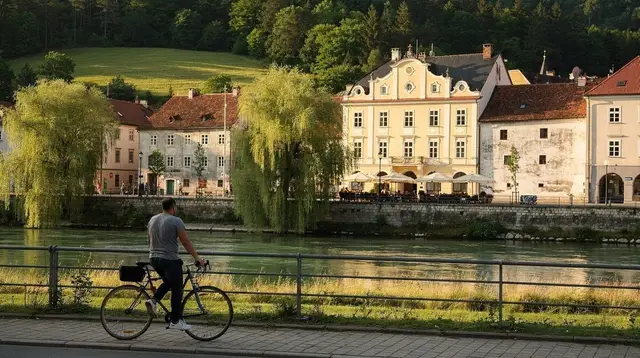
Cycling in Ljubljana: The Bike-First Way to See the City
Do you need to rent a bike separately to cycle in Ljubljana?
Not if you already have a Ljubljana Card: a bike rental is included in the 24, 48 and 72-hour passes, on top of unlimited buses, the funicular, castle entry and a river cruise. Without the card, the city's public share bikes and several private rental shops fill the gap, and the flat, largely car-free center makes either option easy.
Why Ljubljana rewards riders more than walkers
Most European capitals make you choose between fighting traffic on a bike or accepting a slow crawl on foot. Ljubljana sidesteps the choice. The historic core between the Triple Bridge and Ljubljana Castle is closed to private cars, the main sights sit within a fifteen-minute pedal of each other, and the riverside promenades that architect Jože Plečnik laid out along the Ljubljanica double as some of the most pleasant cycling in the city. If you’d rather cover ground on two wheels than on foot, or you’re tired of waiting for a bus for a three-stop hop, cycling is a genuinely good way to spend two or three days here — not a novelty add-on.
This guide is deliberately narrow. It doesn’t retrace the city buses or the free electric Kavalir shuttle — both are covered in the guide to getting around Ljubljana — because cycling deserves its own explanation, and the single most common mistake visitors make is renting a bike on day one without checking what they might already have paid for.
The mistake to avoid: don’t rent a bike before checking your Ljubljana Card
If you’re carrying a Ljubljana Card, stop before you book or pay for a rental. The card already includes a bicycle rental as one of its standard inclusions, alongside unlimited city buses, the funicular up to the castle, castle admission itself, a guided city walk, a Ljubljanica river cruise, and entry to more than twenty museums and galleries. Paying twice for the same day of cycling is the single easiest way to overspend in this city, and it happens because most visitors read the pass as a transit-and-museum product and never notice the bike line in the fine print.
The pass comes in three durations, all covering the same list of inclusions, bike rental included:
| Duration | Adult | Child (6–14) |
|---|---|---|
| 24 hours | 41 EUR | 26 EUR |
| 48 hours | 49 EUR | 31 EUR |
| 72 hours | 54 EUR | 35 EUR |
Compare that against a standalone bike rental plus separate castle admission, a museum ticket and a cruise, and the arithmetic usually favors the card outright — you’re not paying extra for the bike at all, you’re getting it as a rounding error on a pass you’d want anyway. The exception is a visitor who has no interest in the museums, the cruise or the castle and only wants a bike for an afternoon; in that narrow case, a plain rental shop is simpler and there’s no reason to buy the wider pass just to unlock two wheels.
Getting a bike without the card
Skip the card and you still have two straightforward routes to a bike in Ljubljana.
Public bike-share stations. Ljubljana runs an automated, docking-station bike-share network with pickup and drop-off points scattered through downtown and the surrounding districts — the same idea as Paris’s Vélib’ or London’s Santander bikes, sized for a much smaller city. You register through an app or at a station kiosk, and pricing is structured in tiers with short trips priced cheaply or free and longer holds costing more; check the current rates in the app before you commit to a full day, since bike-share pricing structures change more often than museum tickets do.
Private rental shops. A handful of bike shops around the old town and near Tivoli Park rent city bikes, e-bikes and occasionally road or gravel bikes by the hour, half-day or full day, usually with a helmet available on request and sometimes a lock and basic map thrown in. This is the more flexible option if you want a specific bike type, want to keep it overnight, or want gear that a docking station won’t offer.
Either way, you’ll want a card, phone, or ID for the deposit or registration step — sort that out before you plan a tight schedule around picking up a bike first thing in the morning.
Where cycling actually earns its keep in the city
The obvious loop, and the one worth doing on your first ride, follows the Ljubljanica through the old town: start near the Triple Bridge, ride the flat riverside quays that Plečnik built as the city’s ceremonial promenade, pass the covered market stalls, and continue toward Tivoli Park, whose broad tree-lined avenues are some of the easiest and most scenic pedaling in Ljubljana. None of this requires any real fitness — it’s a slow, flat, photogenic ride that would take three times as long on foot and feels cramped by bus.
The one hill in the city is the castle knoll, and cycling up it is not really a thing anyone does — the funicular, a short uphill walk, or a little tourist train are the normal ways up. Lock or drop off your bike at the base and treat the castle as a walking detour from your ride, not a cycling objective.
Beyond the historic core, the network of marked bike lanes thins out the farther you get from downtown, so treat the center and the immediate riverside districts as the reliable cycling zone, and ride more like you would in ordinary city traffic once you’re out past Tivoli. Slovenia drives on the right, and the usual city-cycling caution — using lanes where they exist, being visible and predictable at junctions, checking for turning traffic where a lane simply ends — applies here as it would in any mid-sized European city.
A two- or three-day rhythm built around the bike
If you’re staying in Ljubljana for two or three days and want cycling to be more than a single afternoon loop, a workable rhythm looks like this:
Day one — Pick up your bike (from your Ljubljana Card, a share station, or a shop), then ride the Ljubljanica corridor: Triple Bridge, the Plečnik quays, the central market, and out to Tivoli Park. This is the easiest orientation ride in the city and pairs naturally with the museums and the river cruise the card already includes. See the Ljubljana in two days or Ljubljana in three days itineraries for how to slot the rest of the day around it.
Day two — Use the bike for point-to-point errands rather than a set loop: ride to a museum, to lunch, back toward the old town for an evening walk once you’ve parked the bike for the night. This is where cycling actually saves time over walking or waiting for buses, because Ljubljana’s sights are close enough that a five-minute ride replaces a fifteen-minute walk or a bus with a wait built in.
Day three, optional — If you want cycling with more distance and less city traffic, this is the point to switch from a city bike to a guided tour rather than pushing your rental bike out of town on unfamiliar roads. A guided mountain-bike route through the hills around the capital, or a guided e-bike tour that takes care of navigation and any steeper stretches, both make more sense than improvising a long ride solo on a rental bike with no support.
a half-day mountain-bike route through the hills that ring Ljubljana is built for exactly that step up, and if you’d rather stay on pavement with pedal assistance, a guided e-bike city tour with a coffee stop and no parking hassle covers more ground than a solo city-bike loop without asking for extra fitness.
When to look past the city for your riding
Ljubljana’s cycling is about convenience and short, flat distances — it is not where you’ll find dramatic scenery. Riders chasing that instead look toward the Soča Valley, whose turquoise river corridor and quiet back roads are built for longer, guided rides rather than a solo day out from the capital. a guided cycling route through the Soča Valley with snacks and support along the way is the realistic way to combine that scenery with a day trip from Ljubljana, since covering the distance and the terrain independently on a city rental bike isn’t practical.
If cycling is one activity among several on a longer Slovenia trip, it’s worth pairing with the country’s other headline day trips rather than trying to bike between them — Bled sits roughly 55 km from the capital, well past a comfortable independent ride, and is better reached by a day tour to Lake Bled from Ljubljana or a similar transfer, saving your legs for the riding that’s actually worth doing on two wheels. The same logic applies to a broader loop through a guided day covering the best of the Julian Alps from Ljubljana, which reaches terrain no rental city bike is built for.
Practical notes before you set off
A few things are worth settling before you head out for the day, rather than discovering them mid-ride.
- Weather and layers. Ljubljana’s climate swings with the seasons — check the seasonal guides before you plan a full day of riding, since summer heat and winter cold both change how comfortable a long ride will be. A light rain layer is worth carrying most of the year; the city gets rain year-round rather than a single dry season.
- Locking up. If your rental or share bike comes with a lock, use it every time you step away, even for ten minutes at a museum door or a coffee stop — treat it the way you’d treat any bike left on a city street anywhere in Europe.
- Helmets. Adults are not required by law to wear a helmet while cycling in Slovenia, though it’s sensible on shared roads outside the pedestrian core; it is compulsory for children under 14. Ask your rental shop or check the share-bike terms if you want one included.
- Where cycling stops making sense. Once you’re heading to sights that involve a highway drive — Postojna, the Karst caves, or the coast — a bike is the wrong tool entirely; that’s what the day trips from Ljubljana and the Postojna Cave day trip are for. a day trip from Ljubljana to Postojna Cave is a straightforward way to cover that distance without trying to combine it with a bike.
- First-time visitors. If this is your first visit and you’re still deciding how much of the city to see on foot versus by bike, the first-time-in-Ljubljana guide and the where-to-stay guide are worth reading alongside this one — where you sleep changes how much of the cycling network is worth using.
Cycling in Ljubljana: frequently asked questions
Is the Ljubljana Card the cheapest way to get a bike for a day?
If you were already planning to use two or three of the attractions it bundles — the castle, a museum, the river cruise, the buses — the included bike rental is essentially free on top of that. Buying a standalone rental only makes sense if you don’t want the rest of the pass.
Can I cycle inside Ljubljana’s old town?
Yes, and it is one of the pleasant surprises of the city. The historic core is closed to private cars, and bicycles share the pedestrianized streets and riverside quays at a walking pace, which is far less common in old European centers than you’d expect.
Is Ljubljana flat enough for casual riders?
The center and the river corridor are flat, and Tivoli Park adds only gentle grades. The one hill in town is the castle knoll, and almost nobody cycles up it — you walk, ride the funicular, or take a tourist train instead.
Do I need my own helmet or gear?
Public share bikes and most rental shops do not include helmets by default; ask if you want one. Adults are not legally required to wear a helmet while cycling in Slovenia, though it is recommended, and it is compulsory for children under 14.
Can cycling replace the bus or the Kavalir for getting around Ljubljana?
For the compact center, yes — most sights sit within a 15 to 20-minute ride of each other. For a full rundown of the city’s buses, the free Kavalir shuttle and other transit options, see the dedicated guide to getting around Ljubljana.
Are there bike lanes outside the historic center?
Ljubljana has an expanding network of marked bike lanes and shared paths, especially along the Ljubljanica and around Tivoli Park, though coverage thins out once you leave the central districts. Ride defensively at intersections where lanes end abruptly.
Can I cycle from Ljubljana to Bled or the Julian Alps?
Not comfortably as an independent day ride — Bled is around 55 km away, mostly on roads shared with car traffic. Riders who want serious distance and scenery head instead to the Soča Valley or join a guided road or gravel route, rather than pedaling out of the capital itself.
Is cycling safe in Ljubljana’s traffic?
Within the car-free core, cycling is about as safe as walking. Outside it, Ljubljana drives on the right like the rest of continental Europe, and ordinary city-traffic caution applies — signal, use lanes where marked, and be extra alert at junctions without dedicated bike infrastructure.
tours.cycling-ebike
Verified deep-linked GetYourGuide tours. Book through these links and we earn a small commission at no cost to you.
GetYourGuide does not provide a product photo for this activity — the image shows the meeting point, photographed by us.