Slovenia's Wine Regions: A First Overview, West to East
What are Slovenia's main wine regions?
Slovenia has three official wine regions split across the country: Primorska in the west (Vipava Valley and Goriška Brda, bordering Italy's Collio and Friuli), Posavje in the southeast, and Podravje in the northeast around Maribor and Ptuj. Most first-time visitors focus on either the west, easily combined with a Ljubljana-Piran-Trieste route, or the east, paired with Maribor and Ptuj.
Most travellers arrive in Slovenia expecting Alpine lakes and limestone caves, not vineyards. Then someone mentions that the country has been making wine for two thousand years, that its western hills border Italy’s Collio, and that a single vine in the eastern city of Maribor has been producing grapes since before the country existed in any of its modern forms. The surprise is fair, but it also creates a trap: visitors who do discover Slovenian wine often assume it lives in one place, pick a single cellar door near Ljubljana, and never realise they only saw a fraction of the picture.
Slovenia’s wine country is not one region. It is two very different landscapes on opposite sides of the country, with a smaller third tucked into the southeast, and the choice between them shapes an entire day or two of any itinerary. This page does not pour you into the detail of any single valley — that comes later, in the dedicated guides for the Vipava Valley, Goriška Brda and Maribor’s old vine. What it does is give you the map: where the wine actually is, how the regions differ, and which one to build into your route depending on where the rest of your trip is heading.
Why Slovenia Splits Into Two Very Different Wine Countries
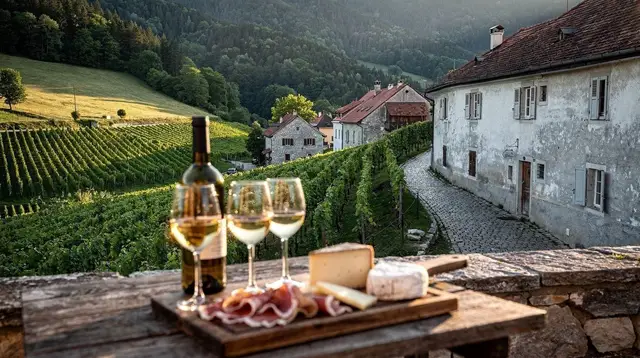
Slovenia’s wine map is officially divided into three regions, and the geography explains almost everything about how they taste and how you visit them. Primorska, in the southwest, is the Mediterranean-facing side: it includes the Vipava Valley and Goriška Brda, both within an hour or two of the Adriatic coast and the Italian border, both producing wines that would not feel out of place on a Friuli wine list, because geologically they are the same ridge of hills continuing across an international line.
Podravje, in the northeast, is the continental opposite: rolling hills around Maribor and Ptuj, a cooler climate, and a wine identity built on aromatic whites rather than the fuller, more textured styles common in the west. Posavje, in the southeast toward the Croatian border, is the smallest and least visited of the three, and does not have a dedicated guide on this site.
For a visitor building an itinerary from Ljubljana, this splits into a simple decision: west or east. The west sits naturally alongside a route toward Piran, Portorož or Trieste, and is close enough to visit on a long day trip from the capital. The east pairs more naturally with a stop in Maribor and Ptuj, sits further from Ljubljana, and works best as an overnight rather than a rushed day. Trying to do both west and east on the same short trip usually means seeing neither properly — pick one, and let the rest of your itinerary decide which.
Before picking a side, it helps to know how much time you actually have. A quick west-versus-east wine detour fits differently into a three-day trip than a ten-day loop — the general framework in how many days you need in Slovenia is worth a look before committing a day to either wine region, and if you are weighing a rental car against a guided tour for the whole trip, car versus organized tour in Slovenia covers that decision in more detail.
The West: Vipava Valley and Goriška Brda
Driving southwest from Ljubljana, the road climbs through forest before dropping into the Vipava Valley, a wide, wind-scoured valley running almost to the Italian border. The wind — a cold northeasterly called the burja — is not incidental; it keeps the vines dry and disease-free and is part of why the valley has become a hotspot for Slovenia’s natural and low-intervention wine producers.
Vipava is known for indigenous white varieties rarely seen outside Slovenia, alongside more familiar names, and for a wine scene that has grown quickly in the last decade without losing its family-farm character. A full regional breakdown, including specific villages and producers, is in the dedicated /destinations/vipava-valley/ guide and its companion /guides/vipava-valley-wine-guide/.
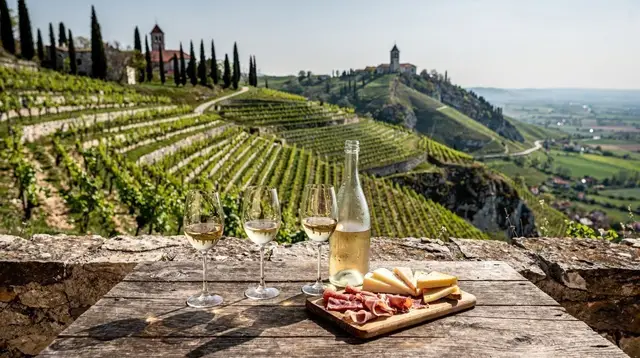
Further west and slightly south, Goriška Brda is a different kind of landscape entirely: a dense cluster of vine-covered hills folding right up to the Italian frontier, often described as a miniature Tuscany. It is more compact than Vipava, easier to explore in an afternoon of hopping between cellar doors, and has the highest concentration of well-known boutique producers in the country — several of them farming plots that straddle the border with Italy’s Collio region, selling wine under two different national labels from grapes grown metres apart. See /destinations/goriska-brda/ and /guides/goriska-brda-wine-guide/ for the detail.
Because both western regions sit close to the border, they also work well tacked onto an arrival or departure through Italy rather than only as a Ljubljana day trip. Visitors flying into or driving from Trieste or Venice can fold a cellar-door stop into that leg of the journey instead of adding it separately — see getting to Ljubljana from Trieste and getting to Ljubljana from Venice for how that connection actually works.
Both western regions are close enough to the coast and to Trieste that they slot naturally into a route from Ljubljana toward /destinations/piran/, /destinations/koper/ or /destinations/from-trieste/, and the return leg through /destinations/idrija-stanjel-karst/ style detours — practically, that means the karst plateau covered in /destinations/stanjel-karst/ — works well if wine is one stop among several rather than the whole day’s plan.
The East: Maribor and Ptuj
Slovenia’s second city, Maribor, sits on the Drava River in the country’s continental northeast, a different climate and a different wine culture from anything in Primorska. Its single most famous attraction for any visitor, wine drinker or not, is a single vine trained along the wall of a house on the Lent quay: verified as the oldest producing grapevine in the world, still harvested every year in a small local ceremony. The surrounding Štajerska hills grow aromatic white varieties in a cooler climate than the coast, producing lighter, higher-acid wines than their western counterparts. The full picture, old vine included, is in /destinations/maribor/ and /guides/maribor-old-vine-wine-tasting/.
A short distance away, Ptuj — Slovenia’s oldest town, predating even Ljubljana — sits in the same wine belt and doubles as one of the country’s most distinctive cultural stops, home to the Kurent carnival tradition recognised on UNESCO’s intangible heritage list. A wine-focused day around Ptuj and Maribor pairs naturally with the itinerary-planning guide for /destinations/ptuj/ and the heritage background in /guides/ptuj-kurent-carnival-heritage/. Further south, /destinations/celje/ makes a reasonable stopping point on the drive between the two halves of the country, though it is not itself a wine destination.
For visitors continuing past Maribor rather than looping back to Ljubljana, the wine stop can also be the last leg before crossing into a neighbouring country — see Ljubljana versus Zagreb if Croatia is next on the route. Those staying within Slovenia and building a longer trip around the two halves of the country may prefer to read multi-day tours from Ljubljana before deciding whether to drive the wine route independently or join an organized multi-day option.
Comparing the Regions at a Glance
| Region | Location | Distance from Ljubljana | Character | Pairs well with |
|---|---|---|---|---|
| Vipava Valley | Southwest, near Italy | About 1 hour | Windswept valley, indigenous whites, natural wine scene | Piran, Karst caves, Trieste |
| Goriška Brda | Far west, on the Italian border | About 1.5 hours | Dense vine-covered hills, boutique producers | Vipava, coast, Venice |
| Maribor | Northeast | About 1.5–2 hours | River city, oldest vine in the world, continental whites | Ptuj, onward to Zagreb or Hungary |
| Ptuj | Northeast, near Maribor | About 1.5–2 hours | Oldest town in Slovenia, wine plus heritage | Maribor, Celje |
| Posavje | Southeast, toward Croatia | Variable | Smallest region, least set up for casual visitors | Not covered in detail on this site |
Treat the distances as ballpark: they assume normal traffic and no stops, and none of the wine regions has a train line running through its cellar doors, so a car or an organized tour does most of the actual work either way.
That same lack of rail access is true of Slovenia’s countryside generally, not just its wine regions — the trade-offs are covered more broadly in renting a car in Slovenia and, for visitors trying to avoid driving altogether, Slovenia without a car.
How to Choose Which Region Fits Your Trip
If your trip is built around Ljubljana, the coast and the Karst caves, the west is the natural fit — Vipava Valley or Goriška Brda cost you little detour from a route you were probably already driving, toward /destinations/postojna/ or /destinations/piran/. If your route instead runs toward Zagreb, Hungary, or you simply want to see Slovenia’s less-visited second city, the Maribor and Ptuj pairing in the east makes more sense, and rewards an overnight rather than a rushed pass-through.
If you only have one day free anywhere in the country for wine and nothing else, Goriška Brda edges out the alternatives for most visitors, simply because its hills are compact enough to see several producers without long drives between them — the same logic that makes it easy to combine with a coastal day rather than requiring its own dedicated trip. Families or groups without a car should look instead at organized tastings that include transport, several of which run directly from Ljubljana.
Budget is worth factoring in too: tastings, transport and the occasional bottle to take home add up differently depending on whether you drive yourself or join a tour, and the general cost expectations in Slovenia’s daily budget guide apply here as much as anywhere else in the country, including what to tip at a cellar door or wine bar.
Tasting Wine Without Leaving Ljubljana
Not every trip has room for a half-day detour into the hills, and the capital itself has a real wine scene worth knowing about before writing off the idea entirely. Ljubljana’s wine bars pour bottles from Vipava, Goriška Brda, Maribor and Ptuj side by side, letting a visitor compare regions in an evening rather than a road trip — a useful low-effort compromise, and one way to decide which region deserves the real visit on a longer future trip.
You can, for instance, taste through a curated flight at a guided Slovenian wine tasting at a Ljubljana wine bar without booking a single kilometre of driving. If Ljubljana’s wine bars turn into a first taste of a longer interest, Ljubljana’s old town walking guide points to where several of these bars cluster within easy walking distance of each other, without needing a special trip to any one address.
For a still-easy but slightly more structured introduction, a sparkling wine tasting paired with food removes the guesswork of which bottle goes with which dish, and works well as a first evening before deciding where to go deeper — see a Slovenian sparkling wine tasting with food pairing for that option. Either approach fits neatly into the practical planning covered in /guides/where-to-stay-in-ljubljana/ and /guides/first-time-in-ljubljana/, and pairs naturally with a broader look at /guides/what-to-eat-in-ljubljana/.
Getting Out to the Wine Regions Themselves
Travellers heading east specifically for the wine and heritage combination in Ptuj and Maribor can join a wine-hopping day through Slovenia’s oldest town, Ptuj, which threads several small producers together without the planning overhead of arranging each stop independently. It is a practical shortcut for visitors who want the region’s wine culture without renting a car for a single day.
Visitors approaching from further afield, including those routing through Trieste or arriving via the coast, sometimes prefer to fold a wine stop into a broader look at the capital and country first; a full-day Slovenia overview tour is one way to get oriented before committing a separate day specifically to wine. None of this replaces a rental car for visitors who want to move slowly between individual cellar doors in Vipava or Goriška Brda — see /guides/renting-a-car-in-slovenia/ and /guides/slovenia-without-a-car/ for the trade-offs — but it removes the barrier for anyone short on time or without a licence.
Travellers wanting to see more of the country in the same trip, rather than treating wine as a single detour, might also look at what a multi-day Julian Alps route or the Karst caves in one day itinerary adds either side of a wine stop.
What Grows Where, and What to Eat With It
The west’s proximity to Italy shows up on the plate as much as in the glass: expect prosciutto-style cured meats, fresh seafood if you continue to the coast, and a wine list dominated by crisp, mineral whites suited to exactly that food. The Vipava Valley in particular has become known for skin-contact and orange wines made from indigenous grapes, a style worth trying at least once even if it is unfamiliar — it is a genuinely distinctive part of the region’s current identity rather than a gimmick.
The east eats differently. Around Maribor and Ptuj, expect heartier, more central-European influences — the kind of continental cooking that pairs naturally with the region’s aromatic whites, though it also produces reds. Further south and west, /destinations/idrija-stanjel-karst/-adjacent Idrija is known for its own culinary specialty, the potato-filled žlikrofi dumpling, covered in /guides/idrija-zlikrofi-and-lace-guide/ — not a wine destination itself, but a reasonable stop if you are threading a route between the coast and the interior.
Best Time to Visit Slovenia’s Wine Regions
Harvest season, roughly mid-September through October, is the single best window for wine tourism specifically: producers are at their busiest and most talkative, grape-picking is often visible from the road, and the year’s first young wine sometimes appears on tasting menus. It is also, unsurprisingly, the busiest booking window for the well-known cellars in both Goriška Brda and around Maribor, so reserving ahead matters more in autumn than at any other time of year. The broader seasonal picture for the whole country, including how it interacts with an autumn wine trip, is covered in /guides/slovenia-in-autumn/.
Late spring is the quieter alternative — vineyards are green rather than gold, tastings are easier to arrange without advance notice, and temperatures in both the coastal west and continental east are comfortable for a day of moving between cellar doors. Summer works too, though the western regions can get warm, and winter tastings exist but are a niche pursuit rather than the norm; most producers scale back visitor hours once harvest is finished.
Building Wine Into a Longer Slovenia Itinerary
None of this needs to be its own trip. A wine stop in the west slots naturally into a longer loop that also covers Ljubljana, the Karst caves and the coast — the kind of route mapped out in general terms in /guides/how-many-days-in-slovenia/ and /itineraries/slovenian-wine-trail/. A wine stop in the east works better paired with the cultural weight of Ptuj and a night in Maribor, extending a Ljubljana-based trip by a day or two rather than replacing it.
For a full week that treats wine as one stop among several rather than the centrepiece, a one-week Slovenia itinerary or a five-day Ljubljana-based trip both leave room for a wine day without building the whole route around it.
Whichever half of the country you choose, treat this page as the map, not the guidebook: the real detail on grape varieties, specific producers, opening patterns and what to actually order lives in the dedicated guides for /guides/vipava-valley-wine-guide/, /guides/goriska-brda-wine-guide/ and /guides/maribor-old-vine-wine-tasting/. Read the overview here to decide where you are going, then read the region-specific guide once you know.
Frequently Asked Questions About Slovenia’s Wine Regions
Does Slovenia actually make good wine?
Yes. Slovenia has been making wine for over two thousand years, and its western regions sit on the same geological ridge as Italy’s Collio and Friuli — some of the same producers even farm plots on both sides of the border. It is a small industry by volume, which is exactly why it stays interesting: most bottles never leave the country.
Which is better for a day trip from Ljubljana: the west or the east?
The west is closer and easier: Vipava Valley is about an hour from Ljubljana, and Goriška Brda a little further, both combinable with Piran or Trieste in one long day. Maribor and Ptuj, in the east, sit roughly ninety minutes to two hours away and work better as an overnight or as part of a route toward Zagreb or Hungary.
Can I visit Slovenia’s wine regions without a car?
It is possible but harder than in the west’s flat cellar-door towns. Organized wine-tasting day tours from Ljubljana cover the accessible highlights without driving, while independently exploring the scattered hill farms of Goriška Brda or the Vipava Valley is far easier with a rental car.
What is the difference between Vipava Valley and Goriška Brda?
Vipava Valley is a wider, windier valley known for indigenous white varieties and a growing natural-wine scene; Goriška Brda is a compact range of vine-covered hills right on the Italian border, often compared to Tuscany in miniature, with a denser concentration of boutique producers.
What makes Maribor’s wine scene different from the west?
Maribor sits in Slovenia’s continental east, on the Drava River, and is best known for the oldest producing vine in the world, over 400 years old, still trained on a house wall along the Lent quay. The surrounding Štajerska hills produce aromatic whites in a cooler, more continental climate than Primorska.
Do I need to book wine tastings in advance?
Small family cellars in both regions often welcome walk-ins outside peak harvest weekends, but the well-known producers and any tasting paired with a meal fill up, especially in September and October. Booking a day or two ahead, or joining an organized tasting tour, removes the guesswork.
When is the best time to visit for wine tourism specifically?
Harvest, from mid-September through October, is the most atmospheric season in both regions, with grape-picking activity and the year’s first young wine. Late spring is a quieter, greener alternative if you would rather avoid harvest-weekend crowds.
tours.wine-tasting
Verified deep-linked GetYourGuide tours. Book through these links and we earn a small commission at no cost to you.
GetYourGuide does not provide a product photo for this activity — the image shows the meeting point, photographed by us.