The World's Oldest Vine and Slovenia's Eastern Wine Country
What makes Maribor's old vine and eastern Slovenia's wine country worth the detour?
The Old Vine on Maribor's Lent quay is a verified world record: it is over 400 years old and still produces grapes every year, making it the oldest vine on the planet still in production. It anchors the wider Styria wine region around Maribor and Ptuj, a hillside wine country of its own, distinct from the Vipava Valley and Goriška Brda in western Slovenia.
A vine older than the country growing it
Most travelers who make it to Maribor go to see one specific plant: a vine trained across the facade of a house on the Lent quay, above the Drava river, that has been producing grapes for more than four hundred years. That is not a rounded-up estimate or a marketing figure. It is a documented, verified record — the oldest vine in the world that is still alive and still fruiting every autumn, not a museum piece kept for looks. Every year the harvest is pressed into a small batch of wine, bottled in tiny quantities, and given rather than sold in any volume that would matter commercially.
It is easy to walk past it as a curiosity: a gnarled trunk on a wall, a plaque, a photo, done in five minutes. That undersells what it actually is. This single vine is the anchor of a much larger, largely overlooked wine country in Slovenia’s east — the Styria region around Maribor and Ptuj — which most visitors never see because it sits far outside the well-worn triangle of Ljubljana, Bled, and Postojna. If your itinerary already includes the west — the Vipava Valley or Goriška Brda — this guide covers the other half of Slovenian wine country, the half most guidebooks skip.
Why the east is a genuinely different Slovenia
Slovenia’s wine country splits, broadly, into two halves that rarely appear in the same afternoon. The west — Vipava Valley and Goriška Brda, both close to the Italian border — gets most of the attention in English-language coverage, partly because it is closer to Ljubljana and partly because its wines travel better internationally. Our guide to Vipava Valley and guide to Goriška Brda cover that side in full, and our overview of Slovenia’s wine regions lays out how all of them fit together.
The east is a different proposition. Maribor sits roughly 130 km northeast of Ljubljana, about ninety minutes by car on the A1 motorway, or a comparable time by direct train — see our guide to renting a car in Slovenia if you are weighing a self-drive route. Many drivers pass through or near Celje on the way, a worthwhile short stop in its own right if you have the time to break the drive. The hills here are gentler and greener than the sharper, more Mediterranean-influenced terrain of the west, and the wines lean toward aromatic and skin-contact whites rather than the reds more associated with the coast and the Karst.
The practical consequence: this is not a detour you tack onto a Ljubljana-Bled-Postojna week without adjusting the plan. It is its own leg of a trip, best treated as a deliberate eastern extension rather than an afterthought squeezed into a single overloaded day.
Maribor: the old vine, the quay, and a city worth a night
Maribor is Slovenia’s second city, and it does not try to compete with Ljubljana’s polish — that is part of its appeal. The Lent quay, where the Old Vine grows, runs along the Drava river below the old town, and is the natural starting point: the vine itself, the small Old Vine House beside it, and the row of cafes and wine bars along the water. From there the old town climbs gently toward the castle hill, with a compact core that rewards an unhurried afternoon rather than a checklist sprint. Our things to do in Maribor page rounds up the rest of the city beyond the vine, if you have more than a few hours.
What matters for a wine-focused visit is that Maribor is not just a photo stop for the vine — it is the practical base for tasting the surrounding Styria hills. The Slovenske Gorice wine road climbs into rolling vineyard country north and east of the city, dotted with small family cellars, many of which sell directly from the property and pour a tasting alongside. This is not a region set up for casual walk-in tourism the way parts of the west are; cellars here are smaller, more scattered, and often visited by appointment. That is precisely why a guided route through them earns its cost here more than almost anywhere else in Slovenia: a local driver-guide knows which gates are actually open on a given afternoon.
A guided day tour through the Styria hills with a wine tasting built in solves that problem directly, threading together a handful of cellars and a countryside route you would otherwise spend an afternoon just finding. For a narrower, more focused tasting experience closer to the city, an orange wine tasting session guided by a sommelier is worth booking specifically for the skin-contact whites Styria is increasingly known for — a style that surprises visitors who arrive expecting only crisp, conventional whites.
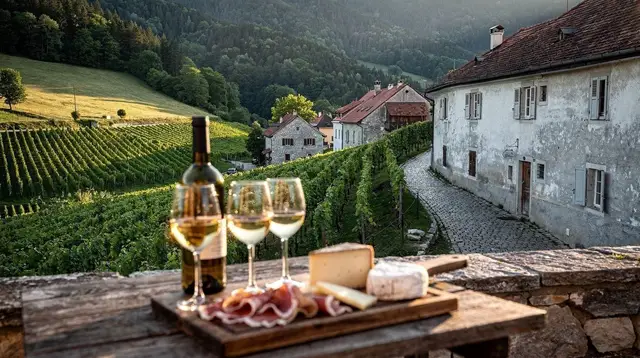
What separates a Styria cellar visit from a polished tasting room elsewhere is scale: many of these are working farms first and tasting rooms second, run by the same family that tends the vines on the slope behind the house. Expect a handful of wines poured at a kitchen table or a cool cellar room rather than a curated flight with tasting notes printed on card stock, and expect the conversation, if the host speaks English, to drift toward the vineyard and the vintage rather than a rehearsed script. It is a different kind of hospitality than the more commercial wine tourism found closer to Ljubljana, and part of what makes the detour worth the extra driving time.
Ptuj: older than the wine, and worth the extra half-day
Sixteen kilometers south of Maribor sits Ptuj, which claims a different record from its neighbor: it is the oldest town in Slovenia, with continuous settlement going back to Roman times. It is easy to treat Ptuj purely as a heritage stop — its castle, its Roman-era street plan, and above all its Kurent carnival, with sheepskin-and-horn costumes recognized on UNESCO’s list of intangible cultural heritage, covered in full in our Kurent carnival guide. But Ptuj has its own wine tradition too, with cellars along the hills above the Drava that predate most of what tourists associate with Slovenian wine entirely, some tracing their underground galleries back centuries.
Pairing Maribor and Ptuj in one loop makes geographic sense — they are a short drive apart — but it is worth being honest about the time it takes. The round trip from Ljubljana to Maribor and back is already four to five hours of driving before you have tasted a single glass or walked a single street. Add Ptuj to the same day and you are managing a schedule, not a visit. Most travelers who want to do this region properly build in an overnight in Maribor or Ptuj rather than treating it as a single marathon day trip from the capital; our itinerary for the Slovenian wine trail lays out one way to sequence it.
How Styria compares to the west
If you are deciding whether to add the east to a trip that already covers Vipava Valley or Goriška Brda, or choosing between the two if you can only do one, the differences are real enough to matter:
| Styria (Maribor / Ptuj) | Vipava Valley | Goriška Brda | |
|---|---|---|---|
| Distance from Ljubljana | ~130 km northeast | ~65 km west | ~110 km west |
| Landscape | Rolling green hills, river valley | Wind-swept valley floor, Alpine backdrop | Terraced hills, Italian border |
| Signature wines | Aromatic and orange-style whites | Whites and reds, strong Vipava wind influence | Whites, some blends, close ties to Friuli across the border |
| Signature feature | The Old Vine, world’s oldest producing vine | Bora wind, farmhouse cellars | Terraced vineyards, cross-border wine road |
| Visiting style | Appointment-based cellars, guided routes work well | Mix of open cellars and appointment visits | Well-signposted wine road, easier for self-drive |
None of the three is objectively better — they are genuinely different countryside, different grapes, and different logistics. The east rewards travelers who want to see a Slovenia that most tourists skip entirely; the west rewards travelers optimizing for proximity to Ljubljana and easier self-guided access.
Guided tour or drive yourself
Because Styria’s cellars skew toward small, family-run operations rather than polished visitor centers, a guided tour changes the experience more here than it does in more tourist-oriented wine regions.
Beyond the two Maribor-area tours already mentioned, it is worth knowing what else exists in the broader wine-and-tasting category if your route flexes: our wine tasting session near Radovljica is a west-of-Ljubljana alternative worth knowing about if your final route does not stretch as far east as Maribor, and it says something about how differently the two regions are set up for visitors — Radovljica’s tasting sits inside easy day-trip range of the capital, while Styria genuinely asks for a dedicated leg of the trip.
If you are driving yourself through the Styria hills, treat it the way you would any rural wine road: confirm opening hours or appointments before you set out, budget more time than the map suggests for narrow, winding lanes, and designate a driver for the day, since tastings here are not token pours. Our category page for wine tasting experiences across the country is a useful reference if you want to compare options side by side before committing.
A few practical notes worth knowing before you set out: small family cellars in the Styria hills do not always take cards, so carrying cash is the safer default, and English is spoken less consistently here than in Ljubljana’s more tourist-facing wine bars, another reason a guided tour with an English-speaking driver-guide smooths the visit rather than merely adding convenience. None of this makes the region difficult to visit — it simply rewards a bit more planning than a spontaneous stop into a Ljubljana wine bar would.
Getting there without a car
Driving is the simplest way to link Maribor, Ptuj, and the Styria hills in one loop, but it is not the only way. Direct trains connect Ljubljana and Maribor along a comfortable route that avoids the A1 motorway traffic entirely, and buses cover the same corridor at a lower cost if timing matters more than legroom. Our guide to Slovenia’s trains and guide to intercity buses both cover the Ljubljana-Maribor corridor in more detail, and our broader guide to seeing Slovenia without a car is worth reading before ruling out public transport for this leg.
The catch is the last mile: once you are in Maribor, reaching the scattered cellars of the Slovenske Gorice wine road without a car of your own is genuinely difficult, which is exactly the gap the guided Styria tour above is built to close. If you are still weighing whether to rent a car for the whole trip or lean on organized tours instead, our car versus organized tour comparison walks through the trade-off in general terms.
If you do drive, remember that Slovenia’s motorways, including the A1 stretch between Ljubljana and Maribor, require a prepaid vignette rather than a toll booth — our guide to Slovenia’s vignette system explains how to buy one before you set out, since fines for driving without one are handed out on the spot.
When to go
Styria follows the same broad seasonal pattern as the rest of Slovenia’s wine country: harvest runs through September and into October, and this window — covered in more depth in our guide to Slovenia in autumn — is when the hills are at their most active, with pressing underway and cellars often more willing to pour something freshly finished. Summer works for the Old Vine itself and for city time in Maribor, but the working vineyards are quieter to look at outside harvest. Winter is workable for the Old Vine and Ptuj’s old town, though many small cellars scale back visiting hours, so confirming ahead matters more than at other times of year.
Closing the loop back in Ljubljana
However you sequence Maribor and Ptuj into the rest of a Slovenia trip, most routes eventually loop back through Ljubljana. If wine has been the theme of the trip’s eastern leg, it is worth knowing the capital has its own drinking-and-tasting scene waiting on return — a canoe and craft beer tasting tour on the Ljubljanica is a genuinely different way to spend an afternoon back in the city, pairing the river that defines Ljubljana’s center with a tasting format that has nothing to do with grapes.
Before you head east at all, it is worth confirming the basics of the trip around it: how many days the rest of your route actually needs, what a realistic daily budget looks like, and what belongs on a Slovenian table beyond wine, covered in our guide to what to eat in Ljubljana.
For those two planning questions specifically, our guide to how many days Slovenia actually needs and our breakdown of a realistic daily budget both help size the trip correctly before you decide how much of it to spend in the east versus the west.
The Old Vine on Lent quay will still be there regardless of when you visit — it has outlasted empires, wars, and four centuries of Maribor’s own history. Treating it as a five-minute photo stop rather than the entry point to an entire, still under-visited wine region is the one mistake worth avoiding.
tours.wine-tasting
Verified deep-linked GetYourGuide tours. Book through these links and we earn a small commission at no cost to you.
GetYourGuide does not provide a product photo for this activity — the image shows the meeting point, photographed by us.