The Vignette Nobody Explains Before You Cross the Border
The mistake I nearly made at a petrol station near Trieste
I had done the sensible thing, or so I thought. Flight into Trieste, rental car confirmed, route to Ljubljana mapped out for the next morning. What I had not done was read anything at all about how you actually pay to use a Slovenian motorway. I assumed, the way you assume things you have never had to think about, that it would work like most of Western Europe: pull up to a barrier, take a ticket, pay on the way out, or worst case, stick something on the windshield at a kiosk.
None of that is how it works in Slovenia anymore, and if you are reading this before your own first drive across that border, you have just saved yourself the ten minutes of quiet panic I went through in a parking lot outside a petrol station, phone in hand, cars queuing behind me.
What the e-vinjeta actually is
Slovenia charges for motorway use through a pass called the vignette, or vinjeta. Until a few years ago, that meant an actual sticker you bought and attached to your windshield, visible to anyone checking. That version is gone. What exists now is the e-vinjeta, a fully electronic system: you register your license plate against a paid pass, and cameras or checks along the network confirm you are covered. There is nothing to display, nothing to peel, nothing to forget on the dashboard of a previous rental car.
This matters because a lot of the advice floating around online, and a lot of habits built from driving in other countries, point you toward looking for a sticker. If you are searching for where to buy one at a border kiosk expecting to walk away with something physical, you will not find it, because it no longer exists in that form.
What it costs, and which category you need
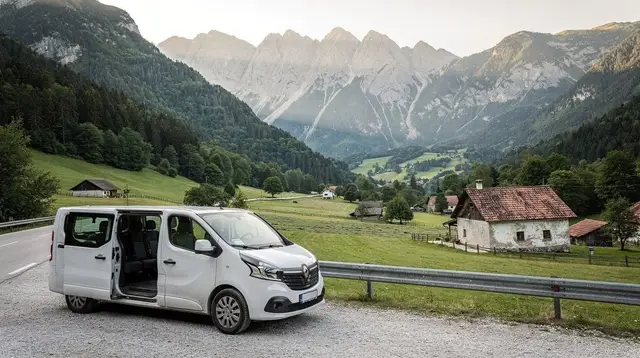
The price depends on your vehicle. For a standard passenger car — anything under 1.30 meters in height at the first axle, which covers the overwhelming majority of rental cars — a week costs 16 EUR and a month costs 32 EUR. If you have rented something taller, a campervan or a large SUV, up to 3.5 tonnes, you fall into the higher category: 32 EUR for a week, 64.10 EUR for a month.
For most visitors flying in for a week or ten days centered on Ljubljana, Bled, and a loop through the Karst, the weekly pass at 16 EUR is the obvious choice. It is genuinely one of the smaller line items of the whole trip, which is part of why it is so easy to forget entirely — nobody budgets time to think about a 16 EUR purchase, and that is exactly the kind of small thing that gets skipped.
Where and when to actually buy it
You can buy the e-vinjeta online in advance, through the official portal, or in person at petrol stations, including ones close to the Italian, Austrian, and Croatian borders. Both work. What I would do differently next time is buy it the evening before, from my hotel, rather than standing at a pump trying to register a plate number correctly on a small screen while a queue forms.
If you are arriving from Trieste or Venice, the border crossing itself is unremarkable — you may not even fully register that you have crossed it. That is precisely the trap: there is no barrier forcing you to stop and think about tolls, unlike systems where you take a ticket at an entry gantry. Slovenia’s motorways start feeling normal almost immediately, and normal is when you forget to check the one thing you were supposed to sort out first.
Coming from Zagreb is a slightly different story, because Croatia’s border with Slovenia still runs occasional checks — reintroduced in 2023 and repeatedly extended, currently through the end of 2026. It is not the old hard border by any means, but it means you may actually be stopped and asked questions, which is one more reason to already have your vignette sorted rather than improvising an answer.
The airport exception, and other things people get wrong
If your only drive is from Ljubljana Airport into the city center, you do not need a vignette at all — that stretch of road is not part of the tolled motorway network. The moment your plans expand to a day trip toward the coast, the Soča Valley, or Maribor, you are back to needing it, so it is simpler to just buy the weekly pass once you know you will be doing any real driving.
Rental cars are the other gray area. Some companies quietly include a vignette in the price; plenty do not. I would never assume either way — ask directly when you pick up the keys, and if the person at the counter shrugs, budget for your own. It is cheap enough that overpaying by one week is not a real loss, while driving uncovered and getting fined absolutely is.
One more thing worth saying plainly, because I have seen it asked in exactly these words in forums: no, you cannot find a sticker version as a backup or a cheaper option. It was discontinued. If someone offers you a physical vignette sticker for Slovenia, be suspicious rather than relieved.
Once the vignette is sorted, actually enjoy the driving
The reason this is worth getting right before you leave the airport rental desk is that Slovenia genuinely rewards having a car — this is a country where almost everything is a day trip, from the Alps to the Karst caves to the coast. Once the paperwork side is handled, I would rather spend the mental energy on where to actually stop. A slow morning wandering through Šmartno with a local guide walking you through the walled hilltop village is a completely different pace from the caves and castles most itineraries chase, and it is the kind of stop you only make because you are driving, not being shuttled between bus parking lots.
The countryside east of the capital rewards the same patience. A traditional countryside wine and food tasting near the Vipava Valley or Goriška Brda turns a driving day into something closer to an afternoon with people who actually farm the hills you are passing through. And if you are basing yourself in Ljubljana for a few nights before or after the road trip, the Ljubljana Card covers the city side of things — buses, the castle funicular, and a handful of museums — so the car can simply stay parked while you explore on foot.
None of that changes the first, unglamorous task: buy the e-vinjeta before your wheels touch a Slovenian motorway, choose the right category for your vehicle, and stop looking for a sticker that has not existed for years. It takes less time than deciding where to have dinner, and it means the rest of the trip runs exactly as smoothly as the postcards suggest.
For the full breakdown of categories, prices, and how the system checks your plate, see our complete Slovenia vignette guide, and if you have not finalized your rental yet, our guide to renting a car in Slovenia covers what to check before you sign anything.
If you would rather skip driving altogether, Slovenia without a car lays out the train and bus alternative, including the intercity bus network and the train guide. And once you are actually in Bled, parking — not tolls — becomes the thing to plan around, which is a separate story told in why Bled is a victim of its own postcard.
Vignette FAQ: what first-time drivers in Slovenia ask me
What exactly is the e-vinjeta?
It is Slovenia’s motorway toll pass, valid on the country’s highway network. Since it went fully electronic, the system checks your license plate against a database rather than checking a sticker on your windshield.
How much does it cost?
For a standard car under 1.30 meters at the first axle (category 2A), a week costs 16 EUR and a month costs 32 EUR. Taller vehicles up to 3.5 tonnes, like campervans and large SUVs (category 2B), pay 32 EUR for a week and 64.10 EUR for a month.
Where do I actually buy it?
Online at evinjeta.dars.si, or in person at petrol stations near the border and around the country. Buying it a day before you drive, rather than at the border itself, saves you from doing it half-asleep after a flight.
Do I need it just to drive from the airport into Ljubljana?
No. The road from Ljubljana Airport into the city center is not a tolled motorway, so you can skip the vignette for that specific trip. You need it the moment you plan to use Slovenia’s actual highway network, including day trips toward Bled, Postojna, or the coast.
What happens if I forget?
You risk a fine if checked, and ignorance of the electronic system is not an accepted excuse. Since there is nothing to display, there is also nothing to show as proof except the registration itself, so buy it before you need it, not while already on the road.
Does my rental car already come with one?
Sometimes, and sometimes not — it depends entirely on the rental company and the specific booking, so never assume. Ask directly at pickup, and if the answer is unclear, buy your own for peace of mind; it only takes a couple of minutes online.
Do I need a separate vignette for Austria, Italy, or Croatia?
Yes. Each country runs its own toll or vignette system, and Slovenia’s e-vinjeta only covers Slovenian motorways. If your route also crosses Austria, budget for its separate vignette before you leave.
Can I still find a sticker version as a backup?
No, and this is worth repeating: the sticker vignette was discontinued and Slovenia’s system is now electronic only. Do not spend time searching for one at a kiosk — it no longer exists in any form.
Transfers and transport passes on GetYourGuide
Verified deep-linked GetYourGuide tours. Book through these links and we earn a small commission at no cost to you.
GetYourGuide does not provide a product photo for this activity — the image shows the meeting point, photographed by us.