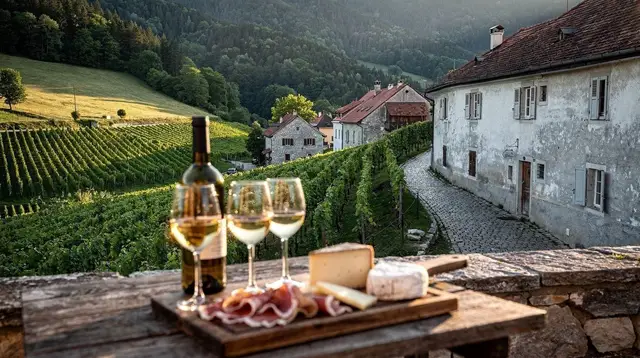
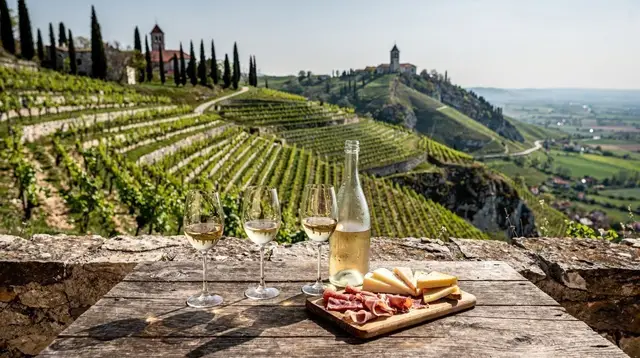
Vipava Valley Wine Guide
When is the best time to visit the Vipava Valley for wine?
September and October, during the grape harvest, are by far the best months: cellars are open, villages hold harvest events, and the valley is at its most atmospheric. Summer is pleasant for scenery but the wine calendar is quiet.
Most visitors to Slovenia never make it to the Vipava Valley, and that is exactly its appeal. Tucked into the country’s far west, between the Karst plateau and the foothills of the Julian Alps, this is a working wine region rather than a tourist stage set: family cellars with no signage on the road, villages that empty out at lunchtime, and vineyards that catch a particular Mediterranean-meets-Alpine light you won’t see anywhere else in the country. If you’re building a wine-focused week in western Slovenia, the valley belongs on the map alongside its better-known neighbour to the northwest, but it deserves its own day rather than a rushed detour.
Why the Vipava Valley Is Different From the Rest of Slovenia’s Wine Country
Slovenia has several distinct wine regions, and it is easy to blur them together on a first visit. The Vipava Valley sits apart from Goriška Brda, the hillier, more polished region just to its north that has attracted more international attention and more wine tourism infrastructure — that region has its own guide, and this page won’t retread it.
Vipava is also unrelated to Maribor’s old-vine tradition in the east, a different climate and a different story entirely, tied to the Drava river rather than the Adriatic hinterland. For a fuller picture of how Slovenia’s wine regions relate to one another, the wine regions overview is the right starting point before you commit an itinerary to paper.
What sets Vipava apart geographically is its position: a wide, flat-bottomed valley running roughly east-west, walled in by the limestone edge of the Karst plateau to the south and the first Alpine foothills to the north. That combination produces a genuine microclimate — warm, sun-heavy days pulled up from the nearby Adriatic, and cool nights that roll down from the mountains. Winemakers here will tell you this diurnal swing is what gives Vipava wines their particular balance of ripeness and acidity, and it’s also why several grape varieties survive here that have all but disappeared elsewhere in Europe.
The Grapes That Only Grow Here
The reason wine people talk about the Vipava Valley in reverent, slightly conspiratorial tones is a handful of indigenous white grapes that are, practically speaking, endemic to this valley and a few neighbouring pockets. Zelen is the best known: a green-tinted, mineral, moderately aromatic white that pairs naturally with the valley’s own trout and freshwater fish dishes. Pinela is softer and rounder, often blended rather than bottled alone, and historically the valley’s everyday table wine. You’ll also find Klarnica in smaller quantities, alongside more familiar names — Malvasia (Malvazija), Rebula (the same grape known as Ribolla Gialla just across the Italian border), Sauvignon, and Chardonnay.
On the red side, the valley’s warmth supports Merlot and Cabernet Sauvignon convincingly, plus the local Barbera-adjacent variety Refošk in the valley’s Karst-facing edges. What you won’t find much of, compared with the rest of the country, is a single flagship grape the way Riesling anchors parts of eastern Slovenia — Vipava’s identity is built on this diversity, and on cellars that often pour four or five different wines from four or five different grapes rather than one signature bottle.
If food pairing interests you as much as the wine itself, note that this is also the western edge of the country associated with hearty, Alpine-Mediterranean home cooking — smoked meats, mountain cheese, and fresh trout from the valley’s rivers. It sits at some distance from Idrija’s lace and zlikrofi tradition further north, but travellers combining a car route through the west often link the two in a single day.
Harvest Season: The Real Reason to Time Your Visit for Autumn
Here is the piece of planning advice that matters more than any other on this page: visit in September or October, not July or August. This is the single most common mistake travellers make with the Vipava Valley, and it comes from a reasonable but wrong assumption — that summer, being warm and sunny, must be the region’s high season.
It isn’t. Summer in the Vipava Valley is genuinely pleasant for scenery and cycling, but the wine calendar is essentially dormant. Grapes are still on the vine, cellars are between vintages, and the harvest energy that gives the valley its character simply hasn’t started yet.
The grape harvest (trgatev in Slovenian) runs through September and into October depending on the variety and the year, and this is when the valley comes alive: pickers in the vineyards at dawn to beat the heat, presses running in small courtyards, and villages hosting harvest festivals with live music, open cellar doors, and communal meals built around the new wine. Family producers who keep irregular hours the rest of the year are far more likely to be open, and far more willing to talk you through a tasting, when there is fresh must fermenting a few metres away.
This also happens to be one of the best windows for visiting Slovenia as a whole. If your trip has any flexibility, cross-reference this with the broader autumn planning guide — cooler temperatures, thinner crowds at Lake Bled, and harvest season across every wine region line up in the same six or seven weeks. Spring is the reasonable second choice: cellars still pour, the valley is green and quiet, and you’ll have wineries largely to yourself, just without the harvest atmosphere. Winter tastings happen too, mostly indoors, and are the least visually rewarding time to come.
Wineries and Tastings You Can Actually Book
The practical challenge with the Vipava Valley is that many of its best cellars are small, family-run operations without websites, fixed hours, or English-speaking staff on a given afternoon. Turning up unannounced can mean a closed gate. Two approaches solve this reliably.
The first is a structured regional tasting built around one well-organized producer. A guided tasting at Lepa Vida in the Vipava Valley puts you at one address with a set flight of local wines and someone on hand to explain what you’re drinking and why the valley’s climate produces it — a sensible anchor if you’d rather have one unhurried, well-hosted stop than chase down several gates.
The second is to let someone else handle the routing entirely. A full wine-focused day trip to the Vipava Valley departing from Ljubljana strings together multiple cellars and villages in a single organized outing, with transport, introductions, and pours already arranged — useful if you don’t have a rental car, or would simply rather taste than drive between stops.
If your route runs along the coast rather than starting from the capital, it’s worth knowing that wine tasting isn’t confined to the valley itself. A guided tour of Piran that includes a wine tasting is a reasonable way to fold a coastal-Slovenian wine experience into a beach-town day if the Vipava Valley itself doesn’t fit your schedule, though it draws on different producers and a different landscape than the ones described above.
Whichever route you choose, treat the harvest-season crowd as a double-edged fact: it’s when the valley is most alive, but it’s also when small cellars are busiest with actual winemaking, and the least able to accommodate a walk-in group. Booking ahead in September and October isn’t a nicety here — it’s close to essential.
The Valley’s Villages: Where to Actually Go
Vipava town gives the valley its name and is the natural first stop: a small, unhurried town built around a spring-fed stream, with a compact old core and several tasting rooms within easy walking distance of each other. Ajdovščina, the valley’s largest town, is more workaday but sits inside the walls of a former Roman fort (Castra) and makes a sensible base if you want a hotel with normal check-in hours rather than a farmstay.
Beyond the two main towns, the valley is really a scatter of hamlets — Vrhpolje, Podnanos, Vipavski Križ among them — where the actual wineries sit, often signposted only in Slovenian and often at the end of a gravel lane. This is the terrain where a self-drive itinerary genuinely benefits from either local knowledge or a guide who already knows which gates open on a given day.
At the valley’s eastern edge, where the flat vineyard floor starts climbing into limestone, you brush up against the Karst plateau around Štanjel — a fortified hill village with its own distinct stone architecture, and a sensible half-day add-on if you’re driving rather than joining a wine-only tour. It sits in a different destination category on this site because its appeal is architectural and karst-geological rather than viticultural, but geographically the two areas are neighbours.
Getting There and Getting Around
The Vipava Valley’s location is one of its practical advantages: it sits directly on the main highway corridor linking Ljubljana to Italy, which means it slots naturally into a route rather than requiring a detour. From Ljubljana, the drive is roughly an hour on the motorway. From Trieste on the Italian side, it’s closer to thirty to forty minutes, which makes the valley a realistic half-day or full-day excursion for travellers based across the border — a wine region essentially without a passport check in either direction, since both countries sit inside the Schengen area.
If you’re driving, remember that Slovenia’s motorways run on an electronic vignette system rather than toll booths — read the vignette guide before you cross onto the highway, since driving without one is a real fine, not a formality. If you haven’t arranged a car yet, the car rental guide covers what to expect from Slovenian rental agencies, and the car versus organized tour comparison is worth reading specifically for a wine-region day, where a car buys flexibility but a guide buys open doors.
Public transport reaches Ajdovščina and Vipava town by bus and, in Ajdovščina’s case, occasional rail connections, but it will not get you to the individual cellars scattered through the valley’s villages. Anyone without a car should default to an organized tasting or day trip rather than trying to piece together a self-guided route by bus.
Combining Vipava With the Rest of Western Slovenia
Because of where it sits, the Vipava Valley works well as one stop on a wider loop through the country’s western edge rather than as an isolated day. A common pattern: start in Ljubljana, spend a day in the valley, continue toward the coast through Koper, and either loop back inland or push north toward the Soča Valley for a contrast of scenery — turquoise river instead of vineyard rows.
If adventure activities are part of your plan for that stretch, a full-day tour covering the Soča Valley’s landmark viewpoints pairs naturally with a wine-focused day further south, since both are reachable from the same general corridor without backtracking through the capital.
For structuring the wider trip, the Slovenian wine trail itinerary lays out how Vipava, Goriška Brda, and the eastern wine country can fit into a single multi-day route, and the general how many days in Slovenia guide will help you decide whether a wine-focused western loop deserves two days or four inside your overall trip.
Practical Notes Before You Go
Slovenia uses the euro, so there’s no currency conversion to think about between the valley and the rest of the country, and cellar-door tastings are typically settled in cash or card without any complication. Tipping isn’t obligatory but rounding up for a generous host is normal and appreciated. None of Slovenia’s temporary border-control measures — the checks reinstated at the Croatian and Hungarian frontiers — apply anywhere near this region, since the Vipava Valley sits on the opposite, Italian side of the country.
One more seasonal note worth repeating because it catches people off guard: the burja, a strong and often bitterly cold wind that drops off the Karst plateau into the valley, can blow hard for days at a stretch, mostly in the colder months. It shapes everything from the low stone walls around local farmhouses to the timing of certain outdoor harvest events, and while it is unlikely to derail a wine-tasting day, it is worth a jacket if you’re visiting in the shoulder season and planning to spend time outdoors between cellars.
Vipava Valley Wine Tasting: Common Questions
Is the Vipava Valley the same as Goriška Brda?
No. They are two separate wine regions in western Slovenia, next to each other but with different landscapes, grape mixes, and villages. This guide covers the Vipava Valley only.
How far is the Vipava Valley from Ljubljana?
Roughly an hour by car on the highway toward Italy, and a similar distance from Trieste on the other side of the border. It works comfortably as a full-day trip or as one night on a longer western Slovenia route.
What grapes make the Vipava Valley distinctive?
Indigenous white varieties such as Zelen and Pinela, found almost nowhere else, alongside Malvasia, Rebula, and Sauvignon. The valley’s warm days and cool nights also favour reds like Merlot and Cabernet Sauvignon.
Do I need to book wine tastings in advance?
For small family cellars, yes: many pour by appointment only and have no regular opening hours. A guided day trip that includes prearranged stops removes that uncertainty.
Can I visit the Vipava Valley without a car?
It is far easier with one, since the wineries are spread across villages with limited public transport. Travellers without a car typically join an organized wine tour from Ljubljana or Trieste instead of self-driving.
Is the Vipava Valley worth visiting outside harvest season?
Yes, but for different reasons: spring and early summer show the valley green and quiet, and cellars still pour. Just don’t expect the harvest atmosphere, which is genuinely tied to September and October.
What is the burja and does it affect a visit?
The burja is a strong, cold, gusty wind that funnels down from the Karst plateau into the valley, sometimes for days at a time. It shapes the local architecture and viticulture, and can affect outdoor plans, but rarely disrupts a wine-tasting itinerary.
tours.wine-tasting
Verified deep-linked GetYourGuide tours. Book through these links and we earn a small commission at no cost to you.
GetYourGuide does not provide a product photo for this activity — the image shows the meeting point, photographed by us.