Goriška Brda Wine Country
What is Goriška Brda and how is it different from the Vipava Valley?
Goriška Brda is a hilly wine region in western Slovenia, right on the Italian border near Nova Gorica, known for the Rebula grape and its walled hilltop villages. It is a separate wine region from the Vipava Valley, which lies further south along a different river valley — the two are often mentioned together but should not be treated as the same place.
A Region of Hills, Not a Single Village
Goriška Brda means, roughly, “the Gorica hills” — the band of low, vine-covered ridges that rises just east of Nova Gorica and runs right up against the Italian border. On the Italian side, the same soil and the same slopes continue under a different name, Collio, and the two halves were one wine district before a 20th-century border split them. Stand on a terrace in Goriška Brda on a clear day and you are often looking straight at Italy, sometimes at a winery whose cousin cellar is a fifteen-minute drive away across the frontier.
This is not a single town to park in and walk around. It is dozens of small hilltop hamlets, family wineries down narrow lanes, and terraced vineyards that catch the last of the Adriatic’s warmth before the land rises toward the Julian Alps. It rewards slow movement — a morning at one cellar, lunch on a terrace, an afternoon at another — more than a single stop on a checklist.
Not the Vipava Valley: Two Different Wine Regions
The most common mix-up in western Slovenia’s wine country is treating Goriška Brda and the Vipava Valley as interchangeable, or as two names for the same trip. They are not. They are separate wine regions, roughly an hour apart by car, with different landscapes and a different feel on the ground — Goriška Brda is a tight cluster of hills against the Italian border, while the Vipava Valley is a longer, open river valley further south and east, with its own villages and its own producers, covered separately in the Vipava Valley wine guide.
| Goriška Brda | Vipava Valley | |
|---|---|---|
| Landscape | Compact hills, walled hilltop villages | Open river valley |
| Nearest city | Nova Gorica | Ajdovščina / Vipava town |
| Signature grape | Rebula (Ribolla Gialla) | Also grows Rebula, plus local varieties like Zelen and Pinela |
| Distance from Ljubljana | About 90 km | Closer to Postojna and the Karst |
| Feel | Terraced, cherry orchards mixed with vines | Wider fields, wind-shaped landscape |
Both share a similar climate and a similar autumn, which is why their harvests fall in roughly the same weeks each year — but a wine trip that lumps them together as one stop tends to shortchange both. This page stays with Goriška Brda; for the fuller picture across the country’s wine country, the Slovenia wine regions overview lays out how the two connect to the vineyards further east around Maribor and Ptuj, covered in the separate Maribor old vine tasting guide.
The Hilltop Villages
Šmartno is the postcard image of Goriška Brda: a small walled village on a hilltop, its stone lanes barely wide enough for two people to pass, ringed by vineyards on every side. It was fortified against Ottoman raids centuries ago, and the walls still stand. A short walk around the perimeter gives a 360-degree view over the surrounding hills — on a clear day, toward Italy in one direction and the foothills of the Julian Alps in the other.
Dobrovo is the practical hub of the region, home to Dobrovo Castle, a Renaissance-era manor that now doubles as a wine cellar and tasting room for a large local cooperative — a useful stop for anyone who wants to taste a broad range of the region’s wines under one roof before choosing which small producer to visit next.
Vipolže, close by, centers on another restored manor house set among vineyards, now used for tastings and events. Between these three points — Šmartno, Dobrovo, Vipolže — most visitors can cover the essential character of the region in a single day, with time left for one or two family cellars along the way.
Cherry orchards are woven in among the vines throughout Goriška Brda, and the region is well known for a spring cherry blossom season that draws its own visitors, well before the grapes are anywhere near ready.
The Wines: Rebula and Its Neighbors
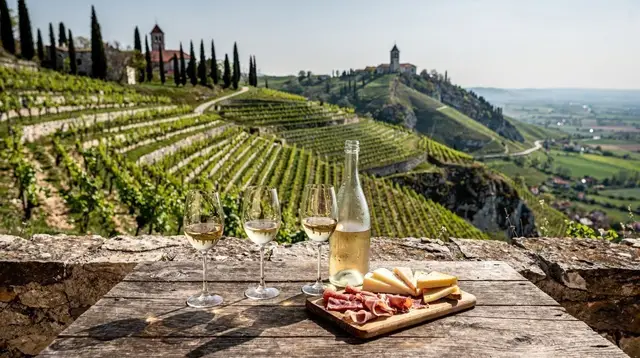
The grape most associated with Goriška Brda is Rebula, known just across the border as Ribolla Gialla. In its everyday form it is a crisp, citrus-toned white, easy to pair with the region’s cured meats and cheeses. Some producers also make an “orange wine” style — Rebula left in contact with its skins for extended aging, giving a deeper amber color and a fuller, more tannic character. Trying both styles side by side, often at the same cellar, is one of the clearer ways to understand what makes this grape distinctive.
Beyond Rebula, the hills also grow Chardonnay, Sauvignon, and Pinot Grigio among the whites, and Merlot and Cabernet Sauvignon among the reds — grapes that trace directly back to the region’s history under Austro-Hungarian and then Italian influence before it became part of Slovenia. Many of the cellars are small, family-run operations passed down through generations, and a tasting often means sitting at a kitchen table with the winemaker rather than a formal tasting room.
When to Visit: Harvest and Beyond
Grape harvest in Goriška Brda typically runs from mid-September into October, with the exact dates set each year by the weather rather than a fixed calendar. This window closely tracks the harvest timing in the Vipava Valley, since the two regions share a similar climate — but each has its own pace and its own local harvest festivals, so a producer’s schedule in one region tells you nothing certain about the other.
Outside harvest, spring brings the cherry blossom season already mentioned, and summer evenings on a vineyard terrace, with the light lasting until well past nine, are a strong argument for visiting even without a single grape on the vine. For a broader sense of how autumn compares to the rest of the year across the country, the Slovenia in autumn guide sets the wider seasonal picture.
Tasting: What to Expect
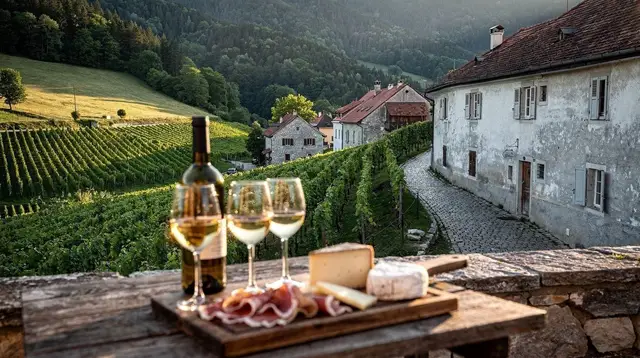
Most wineries in Goriška Brda are small enough that a visit means calling or emailing ahead rather than walking in. A typical tasting runs through three to six wines, often paired with a plate of local prosciutto, cheese, and bread, and takes the better part of an hour once the winemaker starts talking about the vineyard outside the window.
For visitors who would rather not chase down appointments themselves, an organized wine walk covers several cellars in sequence with the logistics already arranged. A guided wine walk through the hills of Goriška Brda moves on foot between vineyards and cellars, which suits anyone who wants to taste without also driving afterward. A tasting paired with local snacks in Goriška Brda leans further into the food side, matching each pour with the region’s cured meats, cheese, and bread rather than moving between multiple cellars.
Getting There
Goriška Brda has no train station and no meaningful public bus network linking its scattered villages, which makes a rental car the practical choice for most visitors — the renting a car in Slovenia guide and the Slovenia vignette guide cover what to arrange before setting out, since the electronic vignette applies to Slovenia’s motorway network on the drive out from Ljubljana even though the hills themselves are reached on smaller roads. For anyone without a car, the Slovenia without a car guide is worth reading before committing to a self-drive day here.
From Ljubljana, it is around 90 km and close to an hour and a half on regional roads. From Nova Gorica, the region’s hills start within minutes of the city center. From Trieste, just over the Italian border, the drive is under an hour, which makes Goriška Brda a realistic half-day add-on for anyone approaching Slovenia from Italy — see the getting to Ljubljana from Trieste guide for the border crossing itself, and the from Trieste destination page for what else that gateway city covers.
Combining Goriška Brda With the Karst
Because Goriška Brda sits at the western edge of the country, it pairs naturally with a stay in the Karst rather than a day trip bolted onto Ljubljana. The walled hilltop town of Štanjel, the underground canyon at Škočjan Caves, and the show cave and castle at Postojna are all within reach of a single loop that ends, or begins, with an afternoon among the vines. The Škočjan Caves guide and Postojna Cave tickets and tips cover booking those stops in advance, which matters more than the winery visits since both caves require timed entry.
Visitors arriving by sea rather than by road often come through Koper; the Koper cruise port guide explains how far a wine detour like this one sits from a single shore-excursion day, and for those extending west along the coast afterward, Piran and a guided Piran tour that folds in a wine tasting from Trieste combine the Venetian old town with a glass of something local before heading back across the border.
Food to Pair With the Wines
Goriška Brda sits close enough to the Adriatic and to Italy that its table follows a similar logic to the coast and the Karst: cured pršut (the Slovenian answer to prosciutto, cured on the Karst plateau nearby), sheep’s and cow’s milk cheeses, olive oil pressed just a short drive away toward the coast, and bread eaten with all of it rather than as a side. Cherries from the region’s own orchards show up on dessert plates in season. None of this needs a formal restaurant — most of it appears alongside the tasting itself, at the same table where the wine is poured.
Wrapping Up in Ljubljana
For visitors basing themselves in the capital rather than staying overnight near the border, a day in Goriška Brda works as a long round trip, with the evening back in Ljubljana for dinner. A private guided walk through Ljubljana’s old town the next morning is a gentler way to close out a trip that spent the previous day driving hillside lanes and tasting Rebula.
The Ljubljana old town walking guide and the what to eat in Ljubljana guide round out that side of the trip, and the Slovenian wine trail itinerary sketches out how a longer visit might stitch Goriška Brda together with the country’s other wine regions without trying to force them into a single rushed day.
Goriška Brda Wine Country: Common Questions
Is Goriška Brda the same wine region as the Vipava Valley?
No. They are two distinct Slovenian wine regions in the west of the country, roughly an hour apart by car. Goriška Brda sits in a band of hills directly against the Italian border near Nova Gorica; the Vipava Valley lies along a separate river valley further south. Locals visit them as different day trips, not as one region under two names.
How far is Goriška Brda from Ljubljana?
It is around 90 km, close to a 1.5-hour drive on regional roads rather than a straight highway run. Most visitors combine it with a stay in the Karst, since Štanjel and the Škocjan Caves are much closer to Goriška Brda than Ljubljana is.
What is the signature grape of Goriška Brda?
Rebula, known as Ribolla Gialla just across the border in Italy’s Collio. It is a crisp, food-friendly white that many family wineries also age longer for a richer, amber-toned style. Merlot, Cabernet Sauvignon, Chardonnay and Sauvignon also do well in these hills.
When is the wine harvest in Goriška Brda?
Grapes are typically picked from mid-September into October, with the exact dates set by the weather each year. This window is close to the harvest timing in the Vipava Valley, since both regions share a similar climate and a similar autumn.
Do I need to book a winery visit in advance?
For a family-run cellar, yes — most only open for tastings by appointment, and a knock on the door without notice may find nobody home. An organized wine walk or guided tasting removes that uncertainty, since the stops and timing are arranged for you.
Can I visit Goriška Brda without a car?
It is difficult on your own, since there is no train and bus connections between the scattered villages are sparse. Most visitors either rent a car for the day or join an organized tour that includes transport between the hills.
Is Goriška Brda worth visiting outside the wine harvest?
Yes — spring brings a well-known cherry blossom season across the hills, since Goriška Brda grows cherries alongside its vines, and summer evenings are pleasant for a tasting on a terrace looking toward Italy. Harvest season simply adds the sight and smell of the picking itself.
tours.wine-tasting
Verified deep-linked GetYourGuide tours. Book through these links and we earn a small commission at no cost to you.
GetYourGuide does not provide a product photo for this activity — the image shows the meeting point, photographed by us.