What Plecnik's UNESCO Listing Actually Changed in Ljubljana
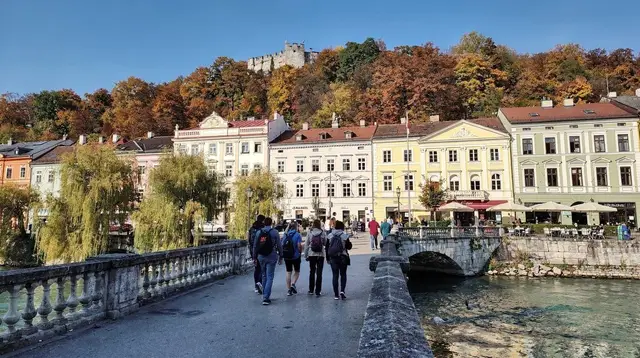
I had walked across the Triple Bridge a dozen times before I understood what I was looking at. It is easy to treat it as scenery: three stone spans fanning out over the Ljubljanica, cafe tables on either bank, a good spot for a photo before heading up to the castle. What changed for me was reading, almost by accident, that this bridge is not really a bridge in the ordinary sense. It is one clause in a much longer sentence that Joze Plecnik wrote across the entire centre of the city, and on 31 July 2021 UNESCO agreed that the sentence should be read whole.
A single work, not a collection of landmarks
Before the inscription, I think most visitors - and, honestly, most guidebooks - treated Ljubljana’s centre as a pleasant assortment: a nice bridge here, a covered market there, a library building somewhere behind it, each worth a look on its own terms. The UNESCO listing does something more specific.
It names Plecnik’s urban work as a single site: the squares and public spaces he shaped, the embankments and quays along the Ljubljanica riverfront, the bridges, the Central Market halls, the National and University Library, several churches, and the funerary complex at Zale. All of it is read as one continuous design, built by one architect over roughly three decades, with a coherent idea running underneath it about what a capital city’s public space should feel like. My longer Plecnik UNESCO heritage guide walks through what is and is not covered, piece by piece, if you want the full list before you set out.
That distinction matters more than it sounds. A city with scattered monuments manages each one separately - a bridge gets repaired, a market gets renovated, a library gets a new roof, and nobody has to think about how the decisions relate to each other. A city with one inscribed urban ensemble has to think about the relationships: sightlines between the market and the river, the material continuity between one embankment and the next, what happens to the whole composition if one piece is changed in isolation. I have watched Ljubljana lean into that logic since 2021, in small ways - the way the riverside is kept remarkably free of clutter, the way new lighting along the quays echoes Plecnik’s own fixtures rather than competing with them.
What the listing pointedly leaves out
The detail I most want to correct, because I got it wrong myself the first time a friend asked me about it, is that Ljubljana Castle is not part of this inscription. The castle sits on its hill above the old town, and it has its own long history that predates Plecnik by hundreds of years - I cover its funicular, its combined ticket, and its viewpoint separately at Ljubljana Castle and in more detail in my Ljubljana Castle guide. Plecnik worked in the city below the hill, not on it. If you go looking for a UNESCO plaque at the castle gate, you will not find one, and that is not an oversight in the paperwork - it is the correct boundary of what was actually inscribed.
I bring this up because the confusion is common enough to be its own small myth, on the level of the Triglav permit story I debunk on the blog. Two of Ljubljana’s most photographed things - the castle on the hill and Plecnik’s river below it - sit right next to each other and get folded into the same mental postcard. Separating them is not pedantry. It changes what you should expect to see and how you should look at it: the castle rewards a climb and a view, the Plecnik ensemble rewards a slow walk at river level, noticing how one stone surface hands off to the next.
Reading the river as one idea
Once I started walking the quays with the inscription in mind rather than a sightseeing list, the city read differently. The Triple Bridge stopped being a single clever crossing and became evidence of a habit: Plecnik rarely built from nothing when he could rework what already existed. The original single bridge on that site got two pedestrian arms added to it, turning a traffic problem into a plaza.
The Central Market, a stone’s throw downstream, does something similar with the riverbank itself, turning a working market into a colonnaded promenade that still functions as a market today. I walk this stretch on nearly every visit now, and I have a longer, slower version of that walk laid out in my old town walking guide and my dedicated Plecnik walk if you want to follow the same route.
The building that convinced me the inscription was right to treat this as one body of work, rather than a greatest-hits list, is the National and University Library. From the street it barely announces itself - a plain brick facade with an odd, heavy door. Inside, a dark stone staircase narrows and rises toward a bright reading room, a sequence Plecnik designed to move you from difficulty toward light, quite literally.
It is not a building you can appreciate from a photograph on your phone, which is probably why it gets less attention than the bridges outside, and it rarely makes the shortlist of Ljubljana’s other collections in my museums guide even though it deserves to. I go into the building’s design logic properly in my guide to the National and University Library, because it rewards more attention than a paragraph here can give it.
Why the date on the inscription matters
It would be easy to treat 31 July 2021 as a bureaucratic footnote, but I think it lands differently against Slovenia’s own timeline. This is a country that became independent only in 1991, after a war that - unlike almost everywhere else in the region - lasted ten days, a fact I go into in my guide to Slovenia’s independence history.
Three decades later, its capital’s public spaces were recognised not as relics of an empire or an occupying power, but as the deliberate work of one of its own architects, designing a national capital’s civic identity from the ground up in the newly independent country’s early twentieth-century predecessor state. That sequencing - a young country’s capital, shaped by a single national architect, later read by UNESCO as one unified achievement - is part of why locals I have talked to take real pride in the listing, beyond the tourism value.
If you are planning to see this properly rather than skim it, give the centre more than an afternoon; my two-day and three-day itineraries both build in slow river time rather than a checklist pace, and my guides on where to stay in Ljubljana and visiting Ljubljana for the first time are useful before you arrive.
It is also worth checking whether the Ljubljana Card covers anything you plan to see along the way, since some of the museums near the river fall under it. A guided walk that ties the pieces together in order, rather than letting you stumble on them separately the way I first did, is genuinely worth it here.
a guided walk through Plecnik’s UNESCO-listed bridges, market and squares puts the whole ensemble in the order it was designed to be read, which is the single biggest thing I would have wanted on my first visit. And if the idea of one city holding several separate UNESCO-recognised sites appeals to you, Slovenia’s smallness makes it easy to extend the theme in a single day: a day trip pairing the UNESCO-listed Skocjan Caves with the old town of Piran shows a completely different kind of heritage site, inscribed 35 years before Plecnik’s, on the other side of the country.
I go into that comparison more directly in my Skocjan Caves guide and on the Skocjan Caves destination page, since a limestone cave system and an architect’s riverside make an odd but genuine pair of neighbours on the same World Heritage List.
None of this requires expertise to enjoy. It just requires slowing down at the river long enough to notice that the stone under your feet, the market colonnade on your left, and the library two streets over are not three separate sights competing for a spot on your itinerary. They are one idea, and as of 2021, the world’s heritage authority agrees. If Plecnik’s ensemble is what pulls you toward Ljubljana in the first place, my old town walking guide is the natural next stop for turning this into an actual route.
tours.museums-art
Verified deep-linked GetYourGuide tours. Book through these links and we earn a small commission at no cost to you.
GetYourGuide does not provide a product photo for this activity — the image shows the meeting point, photographed by us.