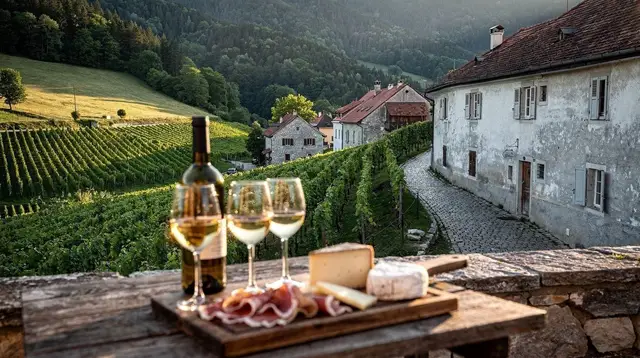
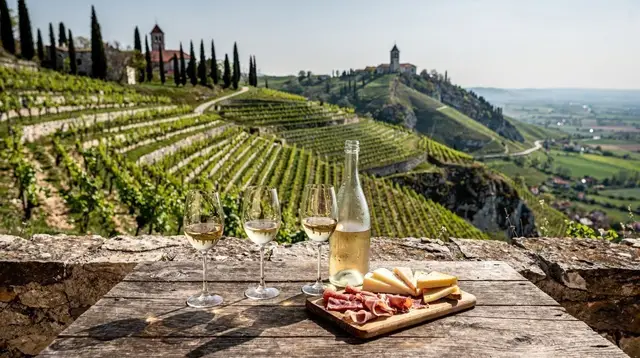
Vineyards Instead of Mountains
Most first-time visitors to Slovenia never make it out to Goriška Brda, and that is largely a matter of geography rather than merit. The country’s headline images — Bled’s island, the Julian Alps, the underground halls of Postojna — all pull west and north. Goriška Brda pulls the other way, into a corner of hills folded against the Italian border where the landscape stops being alpine and starts looking almost Tuscan: terraced vineyards, cherry orchards, stone farmhouses, and a light that softens everything by late afternoon. If you have already ticked off Bled and the Julian Alps and are wondering what a quieter, slower final day or two could look like, this is one honest answer.
This page treats Goriška Brda as what it is on this site: the second wine region worth naming alongside the Vipava valley, the two of them forming the wine-growing spine of eastern and western Slovenia. It does not try to cover Vipava in depth — that comparison, and the practical detail on Vipava’s own villages and cellars, lives on its own page, and the two are genuinely different enough in character that conflating them does neither justice. What follows here is what makes Goriška Brda distinct, when to actually go, and how it fits into a longer Slovenia itinerary.
Where Goriška Brda Sits on the Map
Goriška Brda occupies the far western edge of Slovenia, wedged between the Vipava valley to the south, the Soča river to the north, and the Italian region of Friuli-Venezia Giulia immediately to the west. The border here is not a dramatic mountain crossing; it runs straight through wine country that Italians simply call Collio on their side, using different labels for what is, agriculturally, one continuous hill formation split by a modern line on a map. That continuity matters for what you’ll taste: the same Rebula grape (Ribolla Gialla in Italian) grows on both sides, and a short drive can put you in a second country’s version of the same wine culture.
The name itself gives away the geography: “Brda” means hills, and the region is a dense cluster of small, steep rises, rarely more than a couple hundred meters high, each planted almost to the summit with vines. There is no single town that functions as an obvious base the way Bled or Piran does. Instead there’s a scatter of villages — Dobrovo, with its Renaissance castle and wine cellar; Šmartno, a walled hilltop village that is arguably the most photogenic single spot in the region; Medana; Vipolže, with its own restored manor. Visiting Goriška Brda well means accepting that the destination is the driving between these places as much as any one stop.
Getting There from Ljubljana
Goriška Brda is roughly 130 km from Ljubljana, and the drive takes something like an hour and three-quarters to two hours depending on which village you’re aiming for and whether you route via the Vipava valley or further north. There is no meaningful public transport network through the hills themselves — buses connect the larger towns on the region’s edges, but they will not get you cellar to cellar in a single afternoon.
This is a region built for a rental car, and if you’re coming straight from an itinerary that has so far been walkable (central Ljubljana, day trips by organized tour), it’s worth reading up on renting a car in Slovenia and the country’s electronic vignette system before you set off, since the vignette requirement catches a lot of first-time renters by surprise.
For travelers without their own wheels, an organized wine day trip is the realistic alternative, and it’s also arguably the better way to taste properly, since nobody in your group has to stay sober enough to drive the winding hill roads back down. A guided walk through the Goriška Brda vineyards ending in a seated tasting covers exactly this gap: transport, a knowledgeable guide, and a tasting that doesn’t require you to have booked ahead with an individual winery yourself.
If you’re arriving in Slovenia from the Italian side rather than from Ljubljana, Goriška Brda is genuinely closer to Italy than to most of the rest of Slovenia — see getting to Ljubljana from Trieste for the wider routing, and consider the region as a stop on the way in rather than a detour from the capital.
Why Autumn Is the Season That Actually Matters Here
It would be easy to slot Goriška Brda into a summer road trip alongside the coast or the Soča valley, and that would be a mistake. This is a working agricultural landscape, and its calendar is the vine’s calendar, not the beach’s. Summer here is green, warm, and pleasant enough, but it’s also the season when the hills look most like any other stretch of Central European farmland — full, uniform, and a little flat as scenery.
Autumn is different. From September into October, the harvest (trgatev, if you want the local word) brings the hills to life: pickers moving through the rows, presses running in village courtyards, the first young wine appearing in local restaurants. The vine leaves themselves turn through reds, oranges and golds before they drop, which is what actually produces the postcard version of Goriška Brda that shows up in photographs — not the deep green of July. Wineries that keep a low profile the rest of the year open their doors more readily during harvest season, and tastings tend to include whatever has just come off the press.
This is worth stating plainly because it cuts against the instinct to bolt Goriška Brda onto a July or August coastal itinerary simply because the weather is reliable. The weather in September and October is still good — mild, often clear, without the summer heat — and it’s the only season that shows you what the region is actually for. If your Slovenia trip has any flexibility in timing at all, it’s worth reading through what autumn in Slovenia looks like more broadly before you lock in dates.
The Villages Worth Slowing Down For
Šmartno is the village most people photograph, and deservedly so: a small walled settlement on a hilltop, its stone lanes barely wide enough for two people to pass, ringed by vineyards on every side and, on a clear day, a view that reaches toward the Adriatic. It takes perhaps twenty minutes to walk the whole thing, which is the point — this is a place to sit with a glass rather than tour.
Dobrovo functions as something closer to a regional center, with a 16th-century castle that now houses a wine cellar and gallery space, offering tastings without requiring you to have arranged anything with an individual family winery in advance. It’s a reasonable first stop if you’re unfamiliar with the area and want an overview before deciding which smaller producers to seek out.
Medana and the surrounding hamlets are where the smaller, family-run cellars cluster — the kind of places where the person pouring your wine is also the person who picked the grapes. These generally reward either advance booking or a guide who already has relationships with specific producers, which is the practical case for joining a structured tasting rather than knocking on doors cold.
Beyond the villages, the region’s other defining crop is cherries — Goriška Brda cherry orchards blossom in spring and fruit in early summer, giving the hills a second, shorter season of visual interest that has nothing to do with wine, and a local cherry festival is a fixture on the area’s calendar if your dates happen to align with it.
Goriška Brda and the Vipava Valley: Two Different Wine Regions
Slovenia’s wine country is not one region but several, and the site groups two of them together as the country’s “wine-east” cluster for a reason: they’re genuinely comparable in purpose, and travelers often have to choose between them rather than visit both. The Vipava valley sits just to the south and east, more open and wind-swept, with its own distinct grape varieties and a slightly different, less hilltop-village character.
This page deliberately doesn’t detail Vipava’s own villages, wineries or driving routes — that belongs on its own page, and the fuller side-by-side comparison of what each region does better lives in the dedicated Slovenia wine regions overview and the Vipava valley wine guide.
As a rough steer: Goriška Brda has the more dramatic hill-and-village scenery and the closer proximity to Italy, which makes it the natural choice if your route already bends toward Trieste or Venice at the end of a trip, or if you’re arriving in Slovenia from that direction in the first place — see the Trieste gateway page for that framing. Vipava is the easier add-on if your Slovenia loop is centered further south, closer to the Karst caves and the coast.
If a wine tasting in the Vipava valley’s own cellars is part of your itinerary as well, it’s worth deciding up front which region gets the fuller day and which gets the shorter stop — trying to do a serious tasting circuit through both in a single day tends to produce two rushed visits rather than one good one.
What to Do Beyond the Glass
Wine is the reason most people come, but Goriška Brda rewards slowing down beyond the tasting room too. The network of quiet back roads through the hills is popular with cyclists, and the gradients — steep but short — suit an e-bike far better than a conventional one if you’re not used to hill climbing. There’s no dedicated cable car or funicular viewpoint here the way there is at Bled or Bohinj; the views come simply from standing at the top of whichever hill you’ve driven or ridden up to, which is arguably more honest scenery for the effort involved.
Dobrovo Castle aside, this isn’t a region dense with museums or formal sights, and that’s largely the appeal — it functions as a deliberate contrast to a Slovenia itinerary that has otherwise been front-loaded with castles, caves and lakes. A traveler who has already done Ljubljana castle, Predjama and Škocjan and is starting to feel like every stop needs an entrance ticket will likely find Goriška Brda a relief precisely because there’s less to “do” and more to simply sit in.
Pairing Goriška Brda with the Rest of Eastern Slovenia
Goriška Brda is grouped on this site with Slovenia’s other eastern wine and heritage towns — Maribor, home to the world’s oldest producing vine, and Ptuj, the country’s oldest town — even though geographically Brda sits considerably further west, hard against Italy. The grouping reflects theme rather than distance: all of these places are about wine, harvest, and a slower, more rural Slovenia than the alpine and coastal postcards suggest.
In practice, Goriška Brda and Maribor are not an easy same-day pairing — they’re roughly on opposite sides of the country — so most itineraries treat them as alternative endings to a Slovenia trip rather than stops on the same loop. If your route continues east rather than toward Italy, a wine cellar tour through the Haloze hills near Ptuj is the closer equivalent experience to what Goriška Brda offers in the west: terraced vineyards, small producers, and a tasting that doesn’t require you to already know which winery to book.
For a fuller sense of what that side of the country covers, the Slovenia wine regions overview and the dedicated Maribor old-vine tasting guide lay out the comparison in more detail, and the Slovenian wine trail itinerary sketches a route that links several of these regions across multiple days rather than trying to force them into one.
Practical Notes: Budget, Timing and Logistics
A single afternoon is enough to get a real feel for Goriška Brda — one or two cellar stops, a walk through Šmartno, lunch somewhere with a view over the vines. A full day allows for three or four wineries plus unhurried time in the villages, and an overnight in one of the region’s small guesthouses is the version that lets you catch both a late-afternoon and an early-morning light over the hills, which is when the landscape looks best.
Budget here runs on the moderate side by Slovenian standards: tastings at individual cellars typically carry a modest fee that’s often waived or reduced if you buy a bottle afterward, and a proper sit-down lunch with local wine easily fits the daily range noted in the quick facts above. There’s no city-style entry ticket or pass system the way there is for Ljubljana or Bled — this is pay-as-you-taste, cellar by cellar.
One logistical point worth flagging for anyone driving themselves: Slovenia’s electronic vignette is required on the motorway sections you’ll likely use to reach the region, even for a short hop, and it’s checked electronically rather than with a physical sticker — see the vignette guide if this is your first time renting in the country. If self-driving through hill roads and remembering which cellars to book isn’t how you want to spend a vacation day, an organized visit built around a guided regional tasting experience removes that planning entirely, even if the specific stops differ from Brda’s own villages.
Frequently Asked Questions About Visiting Goriška Brda
Is Goriška Brda the same as the Vipava valley?
No. They’re Slovenia’s two best-known wine regions and are often mentioned together, but they’re geographically separate and have different characters — Goriška Brda is hillier, closer to Italy, and built around small hilltop villages, while Vipava is more open. This page focuses on Goriška Brda; see the Vipava valley wine guide for that region specifically.
What is the best time of year to visit Goriška Brda?
Autumn, specifically September and October, during the grape harvest. This is when the hillsides show their color, wineries are most active, and tastings often include the newest wine. Summer is pleasant but visually flatter, and it misses the harvest entirely.
Can I visit Goriška Brda without a car?
It’s difficult on your own — there’s no dense local bus network linking the villages and wineries. An organized wine day trip, such as a guided walk and tasting through the vineyards, is the practical alternative for travelers without a rental car.
How far is Goriška Brda from Ljubljana?
About 130 km, which typically takes an hour and three-quarters to two hours by car depending on the route and the specific village. There is no direct train service into the hills themselves.
Do I need to book wineries in advance in Goriška Brda?
For the larger cellars, such as the one at Dobrovo Castle, walk-ins are often possible. Smaller, family-run producers generally expect advance contact, which is one reason a guided tasting tour — where those relationships are already arranged — tends to work more smoothly for a single-day visit.
Is Goriška Brda worth visiting if I’ve already done the Julian Alps and the coast?
Yes, precisely because it offers a different kind of scenery — rolling vineyard hills rather than mountains or sea. It works well as a change of pace late in a Slovenia itinerary, particularly for travelers continuing on toward Trieste or Venice.
Can I combine Goriška Brda with a trip into Italy?
Easily. The region sits directly against the Italian border, and the same wine country continues on the Italian side under the name Collio. Since both countries are in the Schengen area, there’s no routine border crossing formality to plan around, though it’s still worth carrying identification.
Does Goriška Brda have anything to see besides wineries?
The villages themselves are the other draw, particularly Šmartno’s walled hilltop lanes, plus Dobrovo’s castle and the cherry orchards that blossom in spring and fruit in early summer. It’s a region for slow driving and short walks rather than ticketed attractions.