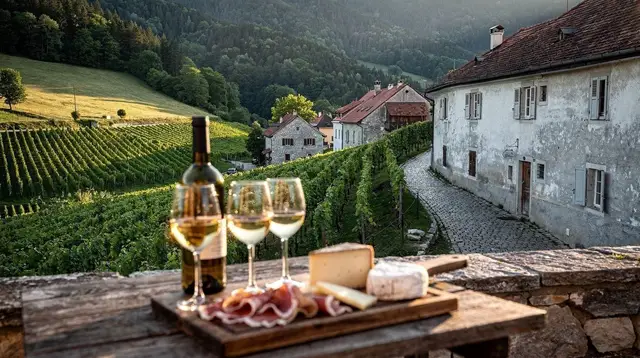
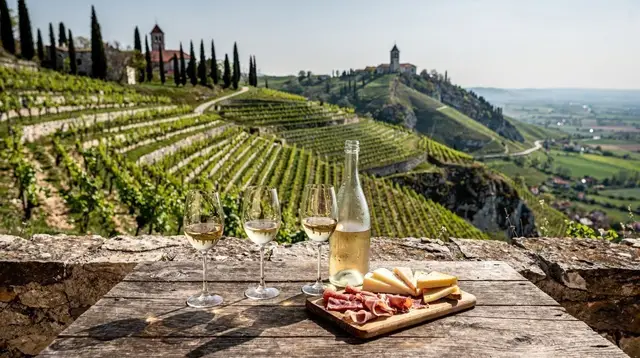
Most visitors who reach Slovenia’s wine country get there by accident, on the way to or from somewhere else — the Karst caves, the Adriatic coast, Ljubljana. The Vipava Valley is built for exactly that kind of visit: a low, sheltered stretch of vineyards and villages tucked between the limestone plateau of the Karst and the eastern hills, close enough to the capital for a day trip and unhurried enough to reward the people who slow down for it. It is not the place for a quick photo and a checked box. It is the place for a harvest afternoon.
Where the Vipava Valley Fits on Slovenia’s Wine Map
Slovenia’s wine country splits, broadly, into a western half and an eastern half, and the Vipava Valley sits on the western edge of the eastern group — closer, in practice, to Ljubljana and the Karst than to Maribor or Ptuj further east.
Its neighbor to the west, right up against the Italian border, is Goriška Brda, a hillier and more famous wine district that this page deliberately does not try to cover in depth — the two regions are close on the map but different in character, and treating them as one would flatten what makes each worth visiting on its own terms. If Goriška Brda is what brought you here, our dedicated Goriška Brda guide is the better starting point.
The valley itself is a wide, low corridor running roughly east-west, flanked by the karst plateau to the south and the foothills of the Julian Alps to the north. That geography gives it a genuinely unusual climate: warm Mediterranean air pushes up from the Adriatic while cooler Alpine air spills down from the north, and the two meet over the same vineyards. It is this mixing of air masses — more than any single village or cellar — that locals point to when they explain why the valley grows grapes found almost nowhere else.
Anchor towns worth knowing before you set out include Vipava itself, a small town built around a spring-fed stream at the foot of the hills, and Vipavski Križ, a fortified hilltop settlement with a monastery and sweeping views back over the valley floor. Neither is a headline attraction on the scale of Ljubljana Castle or Bled; both are the kind of quiet, working towns that make more sense once you have a glass of the local Zelen in hand.
Why Autumn Is the Valley’s Best Season
It bears repeating plainly, because it is easy to assume the opposite: the Vipava Valley is at its best in autumn, not in summer. September and October bring the grape harvest — the trgatev — when the vineyards fill with pickers, the cellars run at full tilt, and the hillsides turn from green to gold and rust. Tastings booked in this window often coincide with the actual pressing of that year’s grapes, which is not something you can arrange to see on demand outside harvest time.
Summer in the valley is pleasant enough as scenery, but it misses the entire point of visiting a wine region: the vines are still growing, the cellars are quieter, and the seasonal energy that makes an autumn visit memorable simply is not there yet. If your itinerary has any flexibility at all, shift a Vipava Valley stop toward September or October rather than treating it as an interchangeable summer day trip alongside Bled or the coast. For a broader sense of how Slovenia’s seasons differ region by region, see our guide to Slovenia in autumn.
| Season | What you’ll find in the Vipava Valley |
|---|---|
| Spring (Apr-May) | Budding vines, green hills, quiet cellars — pleasant but early |
| Summer (Jun-Aug) | Warm, scenic, but vines are still ripening — not the harvest experience |
| Autumn (Sep-Oct) | Grape harvest, busiest cellars, best light on the hillsides — the valley’s peak |
| Winter (Nov-Mar) | Dormant vines, fewer open tastings, a quieter and more local pace |
Vipava Town, Vipavski Križ and the Villages Worth a Stop
The valley doesn’t have a single must-see monument, and that is largely the appeal — it rewards wandering between small stops rather than ticking off one big sight. Vipava town sits where a karst spring surfaces as a small river, with a walkable old center and a handful of family-run wine bars where you can taste before committing to a full cellar visit. A short drive uphill, Vipavski Križ clusters around a Capuchin monastery and a set of narrow lanes that look out over the valley floor toward the mountains — a good stop for the view alone, better with a glass of something local.
What makes the wine itself distinctive is the presence of Zelen and Pinela, two indigenous white grape varieties that survive in meaningful quantity almost only here. Neither travels far outside Slovenia, which is exactly why tasting them in the valley — rather than reading about them elsewhere — is the point of coming. Alongside these local varieties, growers here also work with Malvasia, Sauvignon Blanc, and Merlot, a mix that reflects the valley’s split personality between Mediterranean warmth and Alpine cool.
For context on how this fits into the country’s wine landscape as a whole, including how the Vipava Valley compares with Slovenia’s other wine districts beyond Goriška Brda, see our overview of Slovenia’s wine regions.
Tasting the Valley: Wine Roads, Cellars and Tours
The most straightforward way to taste your way through the valley without spending days scouting cellar doors is a guided tasting built around one or two stops. The Lepa Vida wine tasting in the Vipava Valley is set up exactly for this — a focused visit to a working cellar, with a guided walkthrough of the valley’s grape varieties rather than a generic pour-and-go. It suits travelers who want to understand what makes Zelen and Pinela worth seeking out, not just drink them.
If you would rather not drive and want the whole day handled for you, the Vipava Valley wine express day tour from Ljubljana covers the return trip from the capital along with tastings, which removes the need to plan a route between villages yourself. It is a reasonable option for anyone basing themselves in Ljubljana who wants the valley experience without renting a car for the day.
Vipava Valley vs Goriška Brda
Both regions sit under the same “wine country” heading on this site, and both are genuinely worth a visit — but they are not the same trip, and this page is not the place to duplicate what belongs on the Goriška Brda page instead.
| Vipava Valley | Goriška Brda | |
|---|---|---|
| Terrain | Flatter valley floor, easy half-day loop | Rolling hills, closer to Italy’s Collio |
| Distance from Ljubljana | About 50 km, ~45-50 min | Further west, closer to Nova Gorica |
| Signature grapes | Zelen, Pinela (indigenous, rare) | Rebula, blends with Italian Collio wines |
| Best paired with | The Karst caves and Postojna | The Soča Valley or a Trieste/Italy border trip |
| Best season | Autumn harvest (Sep-Oct) | Autumn harvest (Sep-Oct) |
If Goriška Brda’s hillier terrain and Italian border setting sound like the better fit for your trip, the full Goriška Brda guide picks up where this page deliberately leaves off.
Getting There from Ljubljana and Combining It with the Karst
The Vipava Valley’s real advantage is its position: it sits almost exactly between Ljubljana and the Karst region, just off the A1 motorway that also serves Postojna. That makes it one of the easiest wine detours to build into an existing itinerary rather than a separate trip in its own right. A common pattern is to leave Ljubljana in the morning, stop at Postojna Cave or Predjama Castle, then finish the day with a tasting in the valley before heading back — or to reverse the order if you are continuing on toward the coast.
Driving is the practical way to link these stops, and if you’re renting a car, remember that Slovenia’s motorways run on an electronic vignette system rather than toll booths — our car rental guide and vignette guide cover what to buy before you set off.
If you would rather skip the logistics entirely, a guided tour such as the Vipava Valley wine express tour handles the driving and the route for you. For travelers weighing whether to self-drive at all, our comparison of a rental car versus an organized tour and our note on getting around without a car both apply directly here.
Where the Wine Trail Continues East
The Vipava Valley is one end of Slovenia’s eastern wine country; the trail continues further east toward Maribor, home to the world’s oldest producing grapevine, and Ptuj, the country’s oldest town, both of which sit in a different pocket of vineyards well beyond a single day trip from Ljubljana.
If your route eventually takes you that far east — perhaps combined with Celje or a detour to Idrija for its lace and mercury-mining history — a cellar visit such as the Ptuj and Haloze wine cellar tour with tastings extends the same harvest-season logic to that end of the country. Travelers building a longer loop through the east can also read our old-vine wine tasting guide for Maribor before deciding how far to extend the trip.
For a wider view of how a wine-focused route through Slovenia could be structured start to finish, our Slovenian wine trail itinerary lays out how the Vipava Valley, Goriška Brda, and the eastern cellars around Maribor and Ptuj can fit together, or stay separate, depending on how much time you have. If you are still deciding how many days to give Slovenia overall, our days-needed guide is the place to start that planning.
Planning Your Visit
A single cellar visit fits comfortably into a half-day, which is what makes the valley such a natural add-on to a Karst day trip rather than a destination that demands its own overnight stay. If you want to see more than one village — Vipava town and Vipavski Križ, say, with two tastings along the way — plan for a full day and build in time for lunch at one of the valley’s small, wine-forward restaurants rather than rushing between cellar doors.
Booking ahead matters most in autumn, when the harvest draws the highest number of visitors to the same handful of family-run cellars. A tasting slot that is easy to arrange on short notice in May can be fully booked in late September, so if your trip lands in the valley’s best season, reserve your cellar visit or tour before you arrive rather than hoping to walk in.
Whichever season you visit, browse our /things-to-do/wine-tasting/ category page for more tastings across both of Slovenia’s wine regions, and pair the trip with the broader east-of-Ljubljana picture in our Slovenia wine regions overview if Vipava turns out to be just the first stop on a longer wine-focused route.
Vipava Valley travel FAQ
When is the best time to visit the Vipava Valley?
Autumn, specifically September and October, when the grape harvest is underway. Vineyards are at their most photogenic, cellars are at their busiest and most willing to pour, and the summer heat has broken. Visiting in July or August will show you the same hills without the reason most people come.
How far is the Vipava Valley from Ljubljana?
Around 50 km, about 45 to 50 minutes by car on the A1 motorway toward the coast, exiting before Postojna. It sits almost exactly between Ljubljana and the Karst caves, which is why most visitors combine it with Postojna or Škocjan rather than treating it as a standalone trip.
Should I visit the Vipava Valley or Goriška Brda?
They cover different ground and both sit in Slovenia’s eastern wine country, so neither replaces the other. The Vipava Valley is flatter, easier to explore in a single afternoon, and closer to Ljubljana and the Karst. Goriška Brda is hillier, borders Italy’s Collio wine region, and rewards a slower, more dedicated visit — see our dedicated guide to Goriška Brda for that side of the comparison.
Do I need a car to visit the Vipava Valley?
A car makes it far easier, since the valley’s wineries and villages are spread out with limited public transport between them. Guided day tours from Ljubljana are the practical alternative if you would rather not drive, and several of them combine a tasting with the Karst on the same day.
What grapes is the Vipava Valley known for?
The valley is one of the few places that still grows Zelen and Pinela, two indigenous white grape varieties found almost nowhere else in the world. Alongside them you will find more familiar names such as Malvasia, Sauvignon Blanc, and Merlot, since the valley’s mix of Mediterranean and Alpine air suits a wide range of styles.
Can I combine the Vipava Valley with Postojna Cave or Predjama Castle?
Yes, and it is the most common way to see it. The valley sits just off the same motorway corridor as Postojna and Predjama, so a wine stop pairs naturally with a cave visit on either the outbound or return leg of a day trip from Ljubljana.
Is the Vipava Valley touristy?
Far less than Bled or the coast. It is a working wine region rather than a sight built for visitors, which is part of its appeal but also means fewer signposted attractions — most of what you come for is a cellar door, a village square, and a view over the vines.