Pokljuka Plateau Hiking: Peat Bogs and Forest Trails
Is Pokljuka worth visiting for hiking?
Yes, if you want forest and peat bog trails that are calmer than the crowded paths around Lake Bled or the approaches to Triglav. Pokljuka is a separate wooded plateau above Lake Bohinj, not an extension of the lake itself, with its own trailheads, protected peat bogs, and a biathlon stadium that only matters in winter.
A plateau, not a lakeside extension
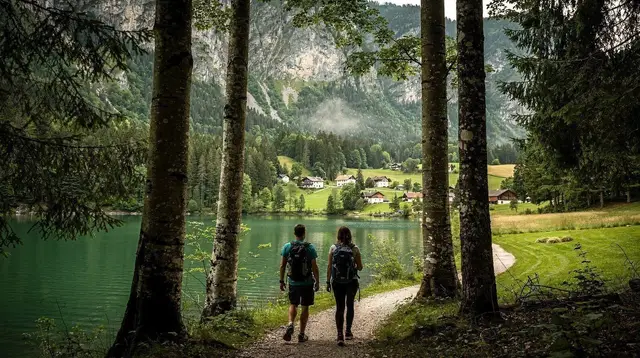
It is easy to glance at a map, see Pokljuka sitting right next to Lake Bohinj, and assume it is simply the wooded hill behind the lake, worth a glance on the way to somewhere else. That reading misses what actually makes the plateau worth a half-day of its own. Pokljuka rises above the Bohinj valley as a distinct table of land, roughly thirteen hundred meters up, carpeted in dense spruce forest and dotted with slow-growing peat bogs that do not exist anywhere near the lakeshore itself. It has its own access road, its own trailheads, and its own reason for being on a hiking itinerary: quiet.
That quiet is the point. The paths around Bled and the busier corners of Triglav National Park fill up fast in July and August, and even Bohinj’s lakeside trail gets crowded by mid-morning in high season. Pokljuka’s forest tracks and boardwalk trails see a fraction of that traffic, because most visitors never separate it from Bohinj in their planning at all. If you want a walk where the loudest sound is wind moving through spruce branches, this is the plateau to book time for, not the lake you can already see from the road below.
What Pokljuka actually is
Geographically, Pokljuka is the largest of the karst plateaus that ring the Julian Alps on their southern side, part of the same limestone system that produces the show caves further south around Postojna and Škocjan, though nothing here is developed as a cave attraction. What the karst bedrock produces instead, combined with heavy rainfall and poor drainage, is peat: a slow accumulation of partly decomposed plant matter that has built up over thousands of years in shallow, water-logged basins across the plateau. These peat bogs are protected as a natural monument within the park, and they support plant life, sundews, cotton grass, dwarf pines, that does not grow in the drier forest just a few dozen meters away.
The plateau’s main access point and informal hub is Rudno Polje, a highland clearing reached by a paved but winding road up from the Bohinj valley. In winter, Rudno Polje is the site of the Pokljuka Biathlon Centre, a genuine World Cup venue that draws its own dedicated crowd for cross-country skiing and biathlon events, a season this guide deliberately does not cover; if that is what brought you here, the ski-focused stations at Kranjska Gora and the broader winter categories are a better fit. For the rest of the year, the same clearing and its parking area serve as the starting point for forest walks and the plateau’s best-known short trail.
Many visitors reach this side of the park by first passing through Radovljica, whose compact old town sits on a river terrace below the plateau road and makes a natural stop before or after a Pokljuka walk. The town’s small museums, including the one covered in our guide to the Radovljica beekeeping museum, give the day a change of pace from forest walking, and its old town is small enough to see on foot in an hour or two without cutting into plateau time.
The Goreljek peat bog trail
The single most accessible introduction to Pokljuka’s landscape is the educational trail through the Goreljek peat bog, a short loop laid out almost entirely on raised wooden boardwalks so that visitors can cross the boggy ground without disturbing it. Information panels along the way explain how peat forms, what plants have adapted to grow in it, and why this particular pocket of the plateau is protected. It is flat, well marked, and manageable for most fitness levels and for families, which makes it a natural complement to more demanding days elsewhere in the park.
Traveling with children makes this trail an easy inclusion; broader planning for a family trip is covered in our guide to Slovenia with kids. Hikers looking for something more strenuous than the flat peat bog loop, without leaving the immediate area, are generally better served by the trails around Lake Bohinj itself, covered in our dedicated guide to hiking around Lake Bohinj.
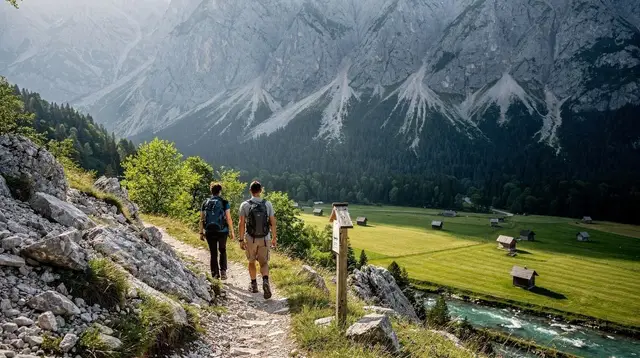
Beyond the peat bog loop, Pokljuka’s forest paths branch out toward viewpoints and smaller clearings, with the plateau functioning as a quieter access route toward some of the peaks and huts used on longer approaches into the Julian Alps. Trail conditions and exact routes shift from year to year with forestry work and park maintenance, so treat any specific trail name as a starting point to confirm locally or with a guide rather than a fixed itinerary. What stays constant is the character of the walking: shaded, mostly gentle underfoot, and a genuine change of pace from the open, rockier terrain around the higher Julian Alps trailheads at Vršič Pass and the Soča Valley.
a half-day guided hike on the Pokljuka gorge trail from Bled is the most direct way to see this side of the plateau without piecing together a route yourself, especially useful if you are staying in Bled or Bohinj and do not want to manage a rental car up the plateau road.
Pokljuka as a step toward Triglav
Pokljuka is one of the recognized approach routes toward Slovenia’s highest peak, with trails from the plateau connecting to mountain huts used by climbers heading toward the summit over one or two days. It is worth being precise about what that means in practice: the plateau walking described above is not the same undertaking as a Triglav ascent.
The final approach to the summit crosses genuine high-mountain and via ferrata terrain, exposed sections with fixed cables that call for proper equipment, conditioning, and, in almost every case, a certified mountain guide. No permit is required to attempt Triglav, despite a persistent myth to the contrary, but that absence of paperwork should not be mistaken for the climb being casual. If a summit attempt interests you, read the dedicated guide to hiking Mount Triglav before committing, and treat anything on this page as plateau-level walking only.
For travelers who want a taste of Julian Alps scenery without the summit ambitions, a guided multi-day option such as a guided hiking trip through the Julian Alps (also run in shoulder-season conditions) folds Pokljuka-style terrain into a broader mountain itinerary with a guide managing the route decisions.
How Pokljuka compares to its neighbors
| Feature | Pokljuka plateau | Lake Bohinj | Bled |
|---|---|---|---|
| Landscape | Spruce forest, peat bogs, no lake | Slovenia’s largest natural lake | Small lake with island and cliffside castle |
| Typical visitor | Hikers seeking quiet forest trails | Hikers, swimmers, Vogel cable car riders | Photographers, castle and pletna-boat visitors |
| Crowds in July–August | Light to moderate | Moderate | Heavy |
| Winter draw | Biathlon World Cup venue, cross-country skiing | Limited | Christmas market period, quieter lakeside |
| Access | Plateau road from the Bohinj valley | Direct road, some bus service | Direct road, more frequent bus service |
If you are choosing where to spend a limited afternoon, our comparison guide on Bled versus Bohinj covers the lake-to-lake decision in more depth; this page exists precisely because Pokljuka usually gets left out of that comparison, when it should be weighed on its own terms as a forest-and-bog alternative to either lake.
Getting there and combining it with a lake day
Most visitors reach Pokljuka as a detour from a Bohinj day, since the plateau road climbs directly out of the Bohinj valley. Coming from Bled adds driving time but is entirely workable as a single long day if you start early. Public transport onto the plateau itself is thin, which is the main reason organized tours do well here: a guided option removes the need to navigate unfamiliar mountain roads and parking at Rudno Polje during a short visit.
Whether a rental car or an organized tour makes more sense for the drive up depends largely on how the rest of your trip is structured; our guide comparing a car against an organized tour in Slovenia walks through that trade-off in more general terms, and the companion guide to renting a car in Slovenia covers what to expect at the practical level, from mountain-road driving to where to park once you reach Rudno Polje.
a combined day tour covering Bled, Bohinj, Radovljica, and Pokljuka is built for exactly this situation, stringing the plateau together with the lakes and the old town at Radovljica so you are not choosing between them. If you would rather stay closer to Ljubljana and still get a comparable forest-and-highland feel, a day trip to Velika Planina and Logar Valley covers a different but similarly quiet highland landscape, herders’ huts and an alpine valley rather than peat bogs, without the drive out to Bohinj at all.
Travelers based in the capital who want an easier taste of forested hiking before committing to a full Pokljuka day can also consider a guided half-day hike up Šmarna Gora with a local guide, a hill on Ljubljana’s own doorstep that shares the same unhurried, forested character on a much smaller scale.
Pairing Pokljuka with Vintgar Gorge
Hikers based in Bled who want two contrasting walks in a single day sometimes pair a Pokljuka forest walk with a morning at the Vintgar Gorge, a narrow river canyon with its own boardwalk trail on the opposite side of the valley. The two are different enough in character, a carved gorge versus a flat plateau, that combining them does not feel repetitive, though it does make for a longer day than either destination alone. Our dedicated guide to Vintgar Gorge covers the logistics of that walk in detail, including how it compares to the gentler Goreljek peat bog loop described above.
What to pack and when to go
Pokljuka’s elevation, roughly 1,300 meters at Rudno Polje and higher on the surrounding ridgelines, keeps mornings noticeably cooler than in Ljubljana or on the coast, even in the height of summer. Pack a light layer regardless of the season on the calendar, along with proper walking shoes for the boardwalk sections, which can be slick after rain, and the forest paths, which are rooted and uneven in places.
The trails described here are realistically walkable from around May through October; outside that window, snow cover shifts the plateau’s purpose entirely toward the cross-country skiing and biathlon season, which this guide does not attempt to cover. For a broader sense of how Slovenia’s seasons differ by region, see our guide to Slovenia in summer, and for a longer weather picture across the whole country, the month-by-month weather guide is worth checking before you fix dates.
Shoulder-season travelers weighing exactly when to come can get more detail from our dedicated guides to Slovenia in spring and Slovenia in autumn, both of which cover the wider seasonal patterns that also apply to a highland plateau like this one, where temperatures swing more than they do at lake level.
Late spring and early autumn tend to offer the most comfortable walking temperatures and the fewest other hikers on the boardwalks, mirroring the pattern found across most of Triglav National Park: the shoulder seasons reward anyone willing to trade a little summer warmth for a much quieter trail. Photographers in particular do well in early morning light, when mist often sits low over the peat bog basins before burning off.
Wildlife on the plateau
The forests around Pokljuka form part of a wider range shared with brown bears, red deer, roe deer, and a broad range of forest and wetland birds drawn to the peat bogs specifically. Direct sightings of large mammals are uncommon and should never be expected or sought out, but the marked trails, boardwalks, and signage across the plateau are designed with that shared habitat in mind, including guidance on staying on the path through the boggy sections. Anyone particularly interested in Slovenia’s wildlife beyond a chance encounter should read our separate guide to wildlife and nature watching, which covers where sightings are more structured and guided.
Where Pokljuka fits in a longer trip
On its own, Pokljuka rarely fills more than half a day, which is exactly why it works well stitched into a Bohinj day trip or a broader Julian Alps loop rather than booked as a standalone destination. If you are building a multi-day plan around Kranjska Gora, the Vršič Pass, and the Soča Valley, our Julian Alps adventure itinerary and the broader Slovenia hiking itinerary both show where a plateau stop like this can realistically slot in without overloading a single day.
And if a car and a fixed schedule are not what you are after, our roundup of multi-day tours from Ljubljana lists guided options that already build a plateau or highland stop into the route.
Anyone still mapping out an overall trip length rather than a single day’s itinerary may also find it useful to check our guide on how many days in Slovenia are enough, since a plateau stop like this one is exactly the kind of half-day addition that decision needs to account for.
The habit to break, more than any single trail choice, is treating Pokljuka as scenery glimpsed on the drive to Bohinj. Give it its own half-day, boardwalk and forest path included, and it earns the distinction the map already gives it: a plateau, not a lakeside footnote.
tours.hiking-mountains
Verified deep-linked GetYourGuide tours. Book through these links and we earn a small commission at no cost to you.
GetYourGuide does not provide a product photo for this activity — the image shows the meeting point, photographed by us.