Visiting Slovenia with Children: Ages, Prices and Logistics
Is Slovenia easy to visit with young children?
Yes. The country is small enough that most sights are under 90 minutes from Ljubljana, several major attractions (Bled Castle, Vintgar Gorge) waive the entry fee before age 6, and tap water is safe to drink everywhere, which removes a lot of daily logistics for parents.
What actually changes when you travel with kids
Slovenia doesn’t require any special adjustment for families — no permits, no separate family visa track, nothing bureaucratic. What changes is the math: which tickets are discounted or free by age, how long a drive with a fussy toddler can realistically be, and which sights are physically awkward with a stroller or a car seat in tow. This page covers that logistics layer specifically. For the actual list of kid-friendly things to do, see best family activities in Slovenia and, for the capital specifically, the zoo and the Kavalir shuttle.
The one assumption to drop before you start planning: it is not true that every attraction charges young children. Bled Castle is explicit about it — entry is free before age 6 — and several other sights follow a similar pattern. But the age brackets are not standardised across the country, so each ticket needs its own five-second check.
Age brackets: what’s free, what’s discounted
A handful of major sights publish clear, current age brackets. These are the ones worth planning around:
| Attraction | Adult | Child rate | Free under |
|---|---|---|---|
| Bled Castle | 19 EUR | 7 EUR (ages 6-14) | 6 |
| Vintgar Gorge | 15 EUR | 5 EUR (up to 15) | — (3 EUR per dog) |
| Ljubljana Card, 24h | 41 EUR | 26 EUR (ages 6-14) | see visitljubljana.com |
| Ljubljana Card, 48h | 49 EUR | 31 EUR (ages 6-14) | see visitljubljana.com |
| Ljubljana Card, 72h | 54 EUR | 35 EUR (ages 6-14) | see visitljubljana.com |
For sights without a clearly published child bracket — Postojna Cave and the Skocjan Caves among them — the safest approach is to check the operator’s own site (postojnska-jama.eu, park-skocjanske-jame.si) shortly before you go, since family and child pricing does exist but the exact cut-offs vary by season. Don’t assume a toddler travels free everywhere just because it’s free at Bled: verify per site rather than extrapolating one good rule across the whole country.
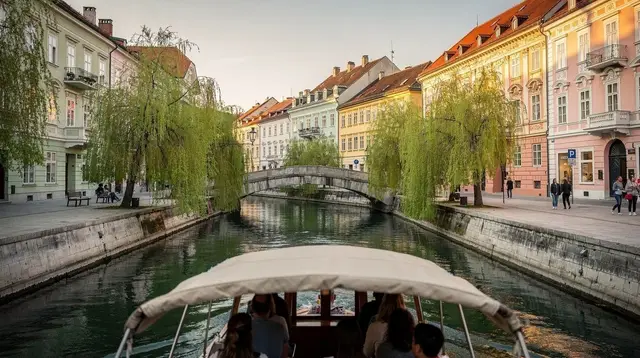
The Ljubljana Card is worth a specific mention for families because it bundles the funiculaire, castle entry, a Ljubljanica river cruise, a bike rental and more than twenty museums into one child-priced ticket. If your days in the capital involve two or more paid stops plus the castle, run the numbers — our card versus individual tickets guide breaks down when it pays off and when it doesn’t.
If you’d rather have someone else handle the capital’s transport logistics for a day, the Ljubljana City Card covering 30 attractions and public transport folds most of this decision into a single purchase.
How far is too far? Distances with young kids in the car
Slovenia’s small size — 20,271 km2, roughly the area of Wales — is the single biggest reason it works well with children. Almost nothing requires a long haul:
| From Ljubljana to | Distance | Realistic drive time |
|---|---|---|
| Bled | ~55 km | 45-60 min |
| Postojna | ~53 km | 45-60 min |
| Piran | ~120 km | ~1h45-2h |
| Maribor | ~130 km | ~1h30-2h |
For a family with a toddler who naps or a child prone to car sickness, treat the Bled and Postojna day trips as easy, low-risk outings and treat the coast or Maribor as a “pick one, don’t chain them” day — or better, an overnight rather than a round trip. The Bled day trip and Postojna and Predjama combined day trip are both built around this shorter, easier distance.
If a full itinerary with young kids feels like a lot to sequence yourself, a guided day tour removes the driving and the ticket queues in one move — the Slovenia in One Day tour covers several highlights from Ljubljana without anyone in the car needing to read a map.
Getting around with a stroller, a car seat, or a baby carrier
In Ljubljana’s old town: the historic centre is closed to car traffic, which helps enormously, but the streets and squares are cobbled, and a soft carrier is often more practical than a stroller on the Triple Bridge and Preseren Square walk. When small legs get tired, the free electric Kavalir runs from 6am to 22:00 with no fixed stops — you flag it down or call it, and it takes up to five passengers at a time.
On public buses: Ljubljana’s LPP buses have not accepted cash since 2010. You’ll need an Urbana card (2 EUR for the card itself) or a bank card; check lpp.si for the current per-ride fare and any child conditions before you rely on the bus network for a full day. Our getting around Ljubljana guide and Slovenia without a car guide go into more detail if you’re not renting a vehicle at all.
By car: child car seats are compulsory in Slovenia, as elsewhere in the EU. Book one directly with your rental company rather than assuming the pickup desk has your child’s size in stock. If you’re driving in from Italy, Austria or Croatia, buy the electronic e-vinjeta before your first motorway on-ramp — there’s no toll booth to catch the mistake, only a fine after the fact.
And if you’re arriving specifically from Zagreb or Trieste, note that Slovenia has reintroduced temporary checks at its borders with Croatia and Hungary, extended through 21 December 2026 — build a little slack into a schedule built around nap times, and keep documents within reach for every passenger.
At the Karst sites specifically: Vintgar Gorge is a one-way wooden walkway system — manageable with a carrier, awkward with a stroller. Postojna Cave involves a partial underground train ride plus walking on paved but uneven ground; Predjama Castle, built into a cliff face, has stairs throughout. None of these rule out a family visit, but none of them are stroller trips either — plan for a carrier or for older children who can walk the distance themselves.
Traveling with a baby: nappies, formula, and strollers on the go
Bringing an infant rather than a toddler changes some of the day-to-day logistics but doesn’t rule much out. Supermarket chains such as Mercator and Spar operate in every town covered on this site, and they stock a normal range of infant formula, baby food and nappies, so there’s no need to pack a full trip’s worth from home — a few days’ buffer for the first stop is plenty. Pharmacies, marked Lekarna, fill in anything a supermarket doesn’t carry, including basics like infant fever medicine.
Baby-change facilities are least reliable at smaller rural sights and roadside stops, and most consistent at shopping centres, larger museums, and the bigger visitor centres at Postojna Cave and Bled. If you’re renting a car, the same rule as elsewhere applies: reserve a child seat with the rental company at the time of booking, since correct sizing and availability at the counter on pickup day isn’t guaranteed.
The one packing mistake almost every parent makes
The karst caves — Postojna and Skocjan alike — sit at a constant 8-12°C year-round, regardless of what the thermometer outside says. Parents who show up in August in shorts and sandals, having checked the surface forecast and nothing else, are the single most common casualty of this. Bring a jacket for every child (and yourself) even mid-heatwave; our karst cave temperature and what to wear guide covers this in more detail. It’s a five-minute fix that saves an otherwise good day.
A second, gentler seasonal trap: Lake Cerknica is an intermittent karst lake that is often completely dry by midsummer. If a child has been promised a lake visit in July or August, redirect to Lake Bled or Lake Bohinj instead — both hold water all year.
Best season to bring young children
There’s no single “best” month, but the trade-offs are consistent. Summer (June-August) gives the longest daylight for packing in a lake, a cave and a walk in the same day, but it’s also when Lake Bled and the coast around Piran are busiest — expect queues for the funiculaire up to Bled Castle and for parking near the lake. Spring and early autumn bring milder crowds and comfortable walking weather, though mountain passes and some high-altitude trails in the Julian Alps can still carry snow into late spring. Winter is the quietest and often the cheapest, but several outdoor activities pause for the season, and days are short for driving between sights.
Whatever the season, the karst caves are a reliable fallback: Postojna and Skocjan hold their 8-12°C year-round regardless of what’s happening outside, which makes them a useful “plan B” on a rained-out day at any time of year.
Safety, water, and what to do if something goes wrong
Slovenia is widely regarded as a safe, low-crime country to travel in with children, and the emergency number is the same one used across the EU: 112 for any emergency, 113 specifically for police. Tap water is safe to drink everywhere in the country, including straight from the tap in restaurants — one less thing to source, carry, or worry about running out of during a hot afternoon at Bled or on the Slovenian coast.
For families with mobility considerations beyond a stroller — a wheelchair, a child who tires easily, or a member of the party who needs step-free routes — our accessibility in Slovenia guide is a useful companion to this page, since several of the sights mentioned above (Predjama Castle in particular) involve stairs with no alternative route.
Eating out with young kids
Restaurants across Slovenia are generally accustomed to family diners, and it’s common to find a children’s menu, half portions, or a willingness to split an adult dish for a younger appetite, particularly at the more tourist-oriented restaurants around Ljubljana’s old town and Lake Bled. High chairs are widely available but not universal, so it’s worth asking when you book a table rather than assuming one will be free. For a broader sense of what’s on a Slovenian menu before you sit down with a hungry, tired child, see what to eat in Ljubljana.
Building a family-paced itinerary
The instinct on a first Slovenia trip is to chain together as many sights as an adult itinerary would — Ljubljana in the morning, Bled by lunch, Vintgar Gorge by mid-afternoon. With young children, that pace usually backfires by day two. A gentler rhythm that still covers the highlights: one “big” outing per day (a castle, a cave, a lake walk), built around nap or rest time, with the shorter Ljubljana-to-Bled or Ljubljana-to-Postojna distances doing most of the heavy lifting.
Arriving at Lake Bled early in the day, before tour buses from Ljubljana and the coast arrive, also makes a real difference with young children who don’t queue well — see our guide to avoiding the crowds at Bled for the specific timing. Our Slovenia with kids itinerary lays out a full week on this slower cadence, and how many days in Slovenia is worth reading before you commit to a fixed number of nights.
On the coast, a boat trip tends to hold a young child’s attention far better than another walking tour of old-town streets — the Izola cruise aboard one of Slovenia’s oldest boats, drinks included or the panoramic tour of the Slovenian coast from Piran both turn transit time into part of the entertainment rather than a stretch to endure between stops. If you’re budgeting the whole trip in advance, our Slovenia daily budget guide is a useful cross-check against the ticket prices in the table above.
Frequently asked questions about visiting Slovenia with children
At what age do children start paying full entry in Slovenia?
There is no single national rule. Bled Castle is explicit: free before age 6, then a discounted rate from 6 to 14. Vintgar Gorge charges a reduced fee up to age 15. Other sites publish their own brackets, so check the official price list for each attraction rather than assuming a blanket age.
Is the Ljubljana Card worth buying for a family?
The card offers a discounted child rate (age 6-14) alongside unlimited buses, the funiculaire and castle entry, a river cruise, and access to more than twenty museums. It pays off once you plan two or more paid attractions plus the castle in a day; for a lighter itinerary, individual tickets can work out cheaper.
How far can we realistically drive in a day with young kids?
Slovenia’s compact size makes this easy. Ljubljana to Bled is about 55 km, to Postojna about 53 km — both under an hour by car. Piran and Maribor are farther, around 120-130 km, which is closer to a two-hour drive and better suited to an overnight stay than a there-and-back day with toddlers.
Do we need to book a child car seat with our rental car?
As across the EU, child car seats are compulsory by age and height in Slovenia. Reserve one directly with the rental company when you book rather than assuming the pickup desk will have the right size available on arrival.
Are the karst caves too cold for children?
Postojna Cave and the Skocjan Caves sit at 8-12°C year-round regardless of the season outside. Pack a jacket for every child even in the middle of an August heatwave — this is the single most common packing mistake parents make in Slovenia.
Is Slovenia a safe country to travel with children?
Slovenia is generally considered a low-crime, family-friendly country, and the single emergency number 112 covers the whole territory. Tap water is safe to drink everywhere, including in restaurants, which removes one common travel worry with young kids.
Is Ljubljana’s old town stroller-friendly?
The historic centre is closed to car traffic, which helps, but much of it is cobbled. Many parents find a soft carrier easier than a stroller for toddlers, and the free electric Kavalir shuttle (no fixed stops, running 6am-10pm) is a useful option when small legs get tired.
Do border crossings from Croatia or Italy cause delays with children in the car?
Possibly. Slovenia has reintroduced temporary checks at its borders with Croatia and Hungary, extended through 21 December 2026, so build in extra time and keep identity documents accessible for every passenger, including children, when crossing by road.
Can we find baby formula and nappies easily in Slovenia?
Yes. Supermarket chains such as Mercator and Spar, present in every town this site covers, stock a normal range of infant formula, nappies and baby food, and pharmacies (marked Lekarna) fill in anything a supermarket doesn’t carry. There’s no need to pack a full trip’s supply from home.
Is there anywhere for young children to run around and play in Ljubljana?
Tivoli Park, a short walk from the old town, has open lawns and play areas, and works well as a stop to let energy out between sightseeing — a useful counterweight to a morning spent on cobbled streets or in a museum queue.
Family-friendly things to do on GetYourGuide
Verified deep-linked GetYourGuide tours. Book through these links and we earn a small commission at no cost to you.
GetYourGuide does not provide a product photo for this activity — the image shows the meeting point, photographed by us.