Piran and Its Venetian Memory
I got off the bus at Piran expecting, on some half-conscious level, to have crossed a border. The square in front of me had a marble statue of a violinist in a frock coat, a bell tower with a familiar silhouette, and facades the color of old parchment leaning over lanes barely wide enough for two people to pass. Everything about it said Venice. Nothing about it, on the ground, said Italy. That gap between what a place looks like and what a place is turns out to be the whole story of this town, and it is worth taking seriously rather than treating as a curiosity for a photo caption.
A square built by a republic that no longer exists
Tartini Square, the oval plaza at the heart of Piran named for the violinist and composer Giuseppe Tartini who was born here in 1692, is not Venetian by accident or by import. It is Venetian because Venice built it, or at least built the town around it, over roughly five centuries of direct rule. The Republic of Venice controlled this part of the Adriatic coast from the late Middle Ages until 1797, when Napoleon’s armies dissolved the Republic itself — not just its colonies.
Piran’s bell tower, visible from most of the old town, is a deliberate, unmistakable echo of the campanile of St Mark’s in Venice. The Gothic windows on the merchants’ houses along the harbor front are the same style you find on the Grand Canal, built by the same trading culture, using the same masons’ vocabulary, because this coast was never a distant outpost — it was part of the same maritime world.
That is the piece easy to miss walking through Piran’s old town today: the architecture is not a tribute or an inspiration. It is the genuine article, aged in place for over two hundred years since the republic that commissioned it ceased to exist.
What happened after Venice fell
Here is where I have to correct a version of the story I half-believed before I checked it properly, and it is the trap worth naming outright: Piran is not, and has never been since 1797, administratively Italian in any sense that matters to a modern traveler. After Venice fell, the town passed to Habsburg Austria, briefly to Napoleonic France, then back to Austria for most of the nineteenth century.
It became part of the Kingdom of Italy after the First World War, in 1918, and stayed Italian until the end of the Second World War, when the region was absorbed into socialist Yugoslavia. When Slovenia declared independence in 1991, Piran became Slovenian — and it has remained so ever since, on the same 46 km of Adriatic coastline that also holds Portoroz, Izola, and Koper.
So the town carries four distinct layers of political history stacked on top of one architectural identity that predates all but the first of them. What you see when you look at the bell tower is Venetian. What is printed on the street signs, in two languages, is the compromise the region reached with itself.
A bilingual town, not a border town
Piran and the surrounding strip of Slovenian Istria are officially bilingual in Slovene and Italian, a status written into the local statute rather than left to habit. Signs give street names in both languages, town announcements are bilingual, and the local Italian-speaking community — the descendants of families who stayed after 1945 rather than resettling across the new border into Italy — still runs its own schools and cultural institutions here. I found that detail more interesting than the architecture, honestly, because it is proof that the Venetian memory of this coast is not just stone. It is a living, if small, community, still speaking the language that built the square.
It also means the trap I mentioned cuts both ways. Piran is not Italy pretending to be Slovenia, and it is not Slovenia erasing an Italian past — it is a Slovenian town that never stopped being visibly, audibly bilingual about where it came from. Compare that to how carefully this site treats the country’s own name: see Lubiana, Laibach, and the Names Slovenia Had to Shed for how Ljubljana shed its own Italian and German names after 1918 and 1945. Piran, oddly, kept its window open on the past that Ljubljana closed.
Why the comparison to Venice actually holds up
I have visited Venice itself more than once, and I will say plainly that Piran rewards the comparison rather than suffering from it. The scale is completely different — you can walk the entire old town of Piran in under an hour, memory palace and all, where Venice takes days to even begin to map. But the architectural grammar is identical enough that walking Piran after Venice feels less like a knockoff and more like reading the same sentence in a shorter draft. The same Gothic tracery, the same salt-stained stone, the same relationship between narrow lane and sudden open square — just without the crowds, the cruise-ship crush, or the vaporetto queues.
If you want to feel that connection on the water rather than just from the quay, a sunset boat tour of Piran from Ljubljana times the approach for the hour when the stone actually turns the color everyone photographs it as. And because this stretch of coast sits close to the Karst hinterland, a combined day trip pairing the Lipica stud farm with Piran’s old town is worth considering if you are coming from inland Slovenia and want the coast and the Karst in a single outing rather than two separate ones.
The same logic extends the other direction, inland toward the wine country rather than the Karst. A countryside wine and food tasting tour or a guided walk through the wine village of Smartno pairs naturally with a Piran day for anyone routing back toward Ljubljana through Goriska Brda rather than straight up the highway — see the Goriska Brda wine guide for how that detour fits into a longer trip.
Piran on the map, not on a passport
None of this makes Piran less Slovenian. It sits inside Slovenia’s borders, inside Slovenia’s tax system, inside Slovenia’s tourist board — and, on a clear day from the town walls, you can see both Italy and Croatia across the water without any of the three countries overlapping on the ground. What Piran offers instead is a rare, concentrated look at what this whole coast used to be before national borders redrew it: one maritime culture, expressed in stone, that a modern line on a map cut through without managing to erase. That is a more interesting fact than “Piran looks Italian,” and it is the one I actually believed by the time I left the square.
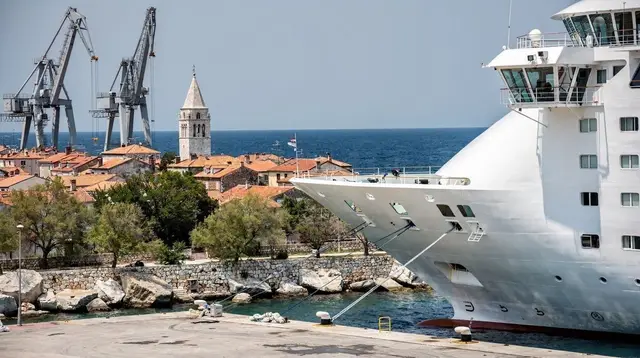
If Piran is your only stop on this coast, Koper and Portoroz sit close enough to combine into the same day, though each deserves its own visit rather than a rushed pass-through — see Izola for the fishing-port version of the same coastline. For the practical side of stitching a Piran day into a Ljubljana-based trip, this day-trip guide lays out the timing, and this cruise port guide is useful if you are arriving by ship rather than by road.
And if the Venetian thread interests you beyond Piran itself, this guide to Plecnik’s UNESCO heritage traces a completely different, entirely Slovenian architectural legacy back in the capital — proof that this small country’s building history did not stop at the coast, and did not need Venice to make its case twice. For the wider political story behind why Piran ended up on the Slovenian side of a line that could easily have run differently, Slovenia’s independence history and Slovenia Is Not Slovakia are worth the extra ten minutes.
Reaching Piran from across the border
Piran’s position near Slovenia’s western edge means a meaningful share of its visitors never start from Ljubljana at all. Trieste sits close enough that day-trippers arrive directly from Italy, and Venice itself is within range for anyone treating this stretch of coast as an extension of a longer Adriatic trip — see arriving from Trieste and arriving from Venice for what that crossing looks like in practice, or getting to Ljubljana from Trieste and getting to Ljubljana from Venice if Ljubljana itself is the base instead.
For travelers coming from the other direction, across the Croatian border, arriving from Zagreb and getting to Ljubljana from Zagreb cover the same logistics eastward.
Frequently Asked Questions About Piran’s Venetian Identity
Is Piran part of Italy?
No. Piran sits on Slovenia’s short Adriatic coastline, between Portoroz and the Croatian border, and has been Slovenian territory since the country’s independence in 1991. What makes it feel Italian is its architecture, not its passport.
Why does Piran look like Venice?
The Republic of Venice controlled this stretch of the Adriatic for roughly five centuries, until Napoleon dissolved the Republic in 1797. Piran’s Gothic facades, its bell tower modeled on St Mark’s campanile, and its central square all date from that period.
Is Piran bilingual?
Yes. Piran and the surrounding Slovenian Istria are officially bilingual in Slovene and Italian, a legacy of the local Italian-speaking community. Street signs, town notices, and the town charter appear in both languages.
What happened to Piran after Venice fell?
After 1797 the town passed to Habsburg Austria, then briefly to Napoleonic France, then back to Austria until 1918. It became part of Italy after the First World War, then part of Yugoslavia after the Second, before joining independent Slovenia in 1991.
Should I visit Piran or Portoroz?
They serve different purposes and sit a short walk apart. Piran is the historic old town for wandering and photographs; Portoroz is the modern resort for beaches and hotels. Most visitors do both in the same afternoon — see Piran vs Portoroz for the practical comparison.
How do I get to Piran from Ljubljana?
Piran is roughly 120 km from Ljubljana, about ninety minutes by car including the coastal approach through Koper. Organized day tours from Ljubljana cover the same route without the parking headaches of the old town.
Is Piran worth visiting if I have already seen Venice?
Yes, precisely because it is smaller and quieter. Piran shows the same architectural language on a scale you can absorb in an afternoon, without the crowds, and it adds a layer Venice cannot — the same visual heritage on the Slovenian side of the Adriatic.
tours.Analysis
Verified deep-linked GetYourGuide tours. Book through these links and we earn a small commission at no cost to you.
GetYourGuide does not provide a product photo for this activity — the image shows the meeting point, photographed by us.