A Stop Between Two Rivers, Not Inside a National Park
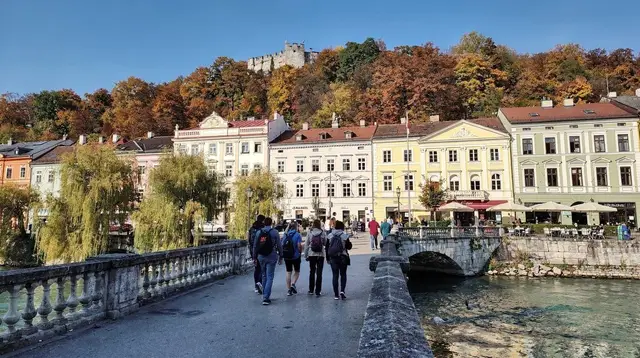
Kranj sits where the Kokra river meets the Sava, its old town raised on a narrow rock plateau above the confluence — the kind of setting that photographs better than its reputation suggests. It is easy to lump Kranj in with the mountains, since every route from /destinations/ljubljana/ toward /destinations/kranjska-gora/ and the Julian Alps passes through or near it.
But Kranj itself belongs to a different part of the map: the Green Ring, the loop of mid-sized towns and hills that ring the capital, well short of the Triglav National Park boundary. Nothing here requires a park permit, an altitude jacket, or a full day of hiking. It requires about the time it takes to walk a compact old town, duck into a tunnel network, and have a coffee by the river before moving on.
That “moving on” is really the point of this page. Kranj is not a headline destination on this site, and it is not trying to be. It is the practical answer to a specific question: what do you do with the middle third of a day when you have already seen Ljubljana and you are driving north toward the mountains, or looping through the hills east and west of the capital.
The Green Ring, and Where Kranj Sits in It
The Green Ring is a loose grouping, not an official region: it covers the towns and landscapes close enough to Ljubljana to visit without committing to an overnight, but distinct enough from the capital to feel like a change of pace. Kranj shares that billing with /destinations/skofja-loka/, a better-preserved medieval town about 20 minutes further west, and /destinations/kamnik/, the gateway to /destinations/velika-planina/ and its herders’ huts, roughly 25 minutes northeast of Ljubljana in the other direction.
This page does not retrace either of those two in depth — they get their own coverage, and the short version is that Skofja Loka has the better-kept historic core and Kamnik has the mountain pasture day trip attached to it. What Kranj offers instead is convenience: it is the Green Ring stop that lines up on the road and rail corridor heading toward Kranjska Gora, the Vršič Pass and the Soča Valley, so it works as a planned pause rather than a detour.
If you are building a loop rather than a straight line north, the three towns fit together in an afternoon each, and none of them demands a car — Kranj and Skofja Loka are both reachable by regional bus from Ljubljana, which matters if you are following the advice in /guides/slovenia-without-a-car/.
The Old Town on Its Rock
Kranj’s historic core runs along the cliff edge above the Kokra gorge, a compact grid of Baroque and older facades that a visitor can walk end to end in under half an hour. The main square is anchored by the Rotovž, the old town hall, and by a plague column typical of small Central European towns that survived the eighteenth century intact.
Kranj is also where France Prešeren, the poet whose verses supply Slovenia’s national anthem, spent his final years and is buried — his grave sits in the town cemetery, and a modest house-museum on the main street covers his life. It is a quieter, more municipal kind of history than the grand set pieces of the capital, and that is more or less the appeal: Kranj feels like an ordinary Slovenian town that happens to have a dramatic site under it.
That “under it” is not a figure of speech. The rock the old town stands on is honeycombed with tunnels dug as air-raid shelters, and a section of them is now open to visitors as a self-guided or guided walk — cool, echoing corridors carved into the same cliff the houses above sit on, with information panels tracing the town’s more recent history. It is an easy, air-conditioned counterpoint to a summer afternoon on the square, and it is the one attraction in Kranj that regularly shows up as a bookable tour rather than a free wander.
a self-guided walk through the tunnels beneath Kranj’s old town covers the underground route at your own pace, while a guided version of the same tunnels adds a narrator who fills in the wartime and Cold War context between chambers.
Below the old town, a path drops down to the Kokra gorge itself, a green, quieter contrast to the cliff-top streets above — a short walk rather than a hike, and an easy way to fill the last half hour before heading back to the station or the car. Families traveling with children tend to find Kranj manageable for exactly that reason: a flat old town, a short underground walk that most kids find more exciting than tiring, and a riverside stretch to run around in afterward. For wider planning around traveling with kids in Slovenia, see /guides/visiting-slovenia-with-children/ and /guides/best-slovenia-activities-for-families/.
Getting to Kranj from Ljubljana
Kranj is close enough to the capital that it rarely needs advance planning. Regional trains connect Ljubljana’s main station to Kranj in well under half an hour, several times a day, and the walk from Kranj’s station up to the old town takes about ten minutes on foot. Driving covers the same distance on the A2 motorway in roughly the same time, traffic allowing — for background on /guides/getting-around-ljubljana/ and the wider question of whether to rent a car at all, see /guides/slovenia-without-a-car/ and /guides/renting-a-car-in-slovenia/.
If Kranj is your first stop on a drive that continues north, this is also the moment to sort out Slovenia’s electronic motorway vignette, which the country’s roads require regardless of how short the onward drive feels — see /guides/slovenia-vignette-guide/ and /blog/the-vignette-nobody-explains-before-you-cross-the-border/ before you leave Ljubljana, since it is far easier to buy before setting off than to hunt down mid-route.
Few visitors stay overnight in Kranj itself. The town works better as a stop than a base, and most travelers on this route sleep in Ljubljana before and after, or push on to a base further north in the Julian Alps. See /guides/where-to-stay-in-ljubljana/ for where to base yourself instead.
Driving Yourself or Booking a Tour
Kranj’s location on the main road and rail line north means most visitors decide for themselves whether to drive, take the train, or fold the stop into an organized tour heading further into the mountains. A rental car gives the most flexibility for combining Kranj with Skofja Loka or Kamnik on the same day, since public transport between the three towns is less direct than the routes each has to Ljubljana.
The tradeoff is the vignette, parking in small old towns with narrow streets, and the general hassle of self-driving in an unfamiliar country. An organized day tour trades that flexibility for a fixed schedule but removes the driving and parking questions entirely — see /guides/car-vs-organized-tour-slovenia/ for a fuller comparison of the two approaches.
Pairing Kranj with the Rest of the Green Ring
Because none of the three Green Ring towns needs a full day, most visitors combine two of them, or use Kranj as a hinge between the capital and the mountains rather than a loop stop at all. A practical way to think about the combinations:
| Pairing | Approx. time needed | Best for |
|---|---|---|
| Kranj + Skofja Loka | Half a day | Two old towns, minimal driving between them |
| Kranj + Kamnik | Half a day to a full day | Old town plus a mountain-pasture cable car detour |
| Kranj alone, en route north | 2–3 hours | Breaking a drive to Kranjska Gora or the Soča Valley |
| Kranj + Julian Alps day trip | Full day | Using Kranj as a coffee-and-walk stop before or after the mountains |
If Kamnik is on the itinerary, a guided walk through Kamnik’s old town that ends with a drink is a low-effort way to see it without planning your own route. Skofja Loka pairs naturally with a food-focused stop: a Skofja Loka tour built around a traditional honey bread workshop covers both the town and a local craft in one booking.
Neither of those neighboring towns gets full treatment on this page — for the historic core of Skofja Loka and the cable car up to the herders’ huts above Kamnik, follow the links to /destinations/skofja-loka/ and /destinations/kamnik/ directly.
From Kranj Toward the Julian Alps
The reason Kranj earns a page on a Ljubljana-based site at all is its position on the road north. Past Kranj, the same route continues to /destinations/kranjska-gora/, the ski and hiking base below the /destinations/vrsic-pass/, and on into the mountains proper.
A traveler with a full day can treat Kranj as a morning stop before pushing on to the Julian Alps in the afternoon, or as an easy re-entry point on the way back to Ljubljana after a long day in the mountains. For a structured version of that route, /itineraries/julian-alps-adventure/ lays out a fuller multi-stop plan, and /things-to-do/kranjska-gora/ covers what to do once you arrive.
Two of the bookable tours that touch this corridor start from further north but pass through the same general route: a full loop covering Bled, Kranjska Gora and the Planica valley is worth considering if Kranj is a stop rather than the goal of your day. Travelers heading the other direction, deeper into the hills east of the capital, sometimes fold in the Logar Valley on the same trip; a day trip from Ljubljana to the Logar Valley covers that alpine valley without requiring a rental car.
Practical Kranj: Budget and Timing
A half-day in Kranj is inexpensive by design — there is no castle entrance fee or lake crossing to budget for, unlike Bled or the chateau in the capital. A coffee and pastry on the main square, the tunnel walk, and a light lunch comfortably fit inside €35–65 per person, and a picnic by the Kokra gorge brings that down further. Kranj’s shops and cafes keep fairly standard daytime hours, and the old town has little to offer after dark beyond a handful of restaurants, so an early afternoon arrival works better than a late one.
For a wider view of what a day anywhere in Slovenia tends to cost, and how Kranj compares to pricier stops, see /guides/how-many-days-in-slovenia/ — the short version is that a Green Ring day like this one sits well below the average for a day built around Bled or the coast.
When to Visit Kranj
Kranj’s outdoor appeal — the old town’s cafe terraces, the walk down to the Kokra gorge — depends on the season more than the tunnel tour does, since the underground walk holds a steady temperature year-round while the streets above do not. April through October covers the period when the riverside paths and outdoor seating are at their best, and shoulder months tend to be quieter here than the same weeks at Bled or on the coast. For a month-by-month picture of what to expect across the country, see /guides/slovenia-weather-by-month/.
Kranj and the Green Ring: Frequently Asked Questions
Is Kranj part of the Julian Alps or Triglav National Park?
No. Kranj is a Green Ring town, part of the belt of mid-sized settlements close to Ljubljana, and it sits well outside the Triglav National Park boundary. It functions as a stopover on the road toward the Julian Alps rather than as a park destination itself — the mountains proper begin further north around Kranjska Gora and the Vršič Pass.
How is Kranj different from Skofja Loka and Kamnik?
Kranj offers a cliff-top old town, the Prešeren connection, and the underground tunnel walk. Skofja Loka has a more intact medieval core with less traffic, and Kamnik is the jumping-off point for Velika Planina’s mountain pasture and cable car. None of the three needs more than a half day, which is why they are usually combined two at a time rather than visited on separate trips.
Can I visit Kranj without a car?
Yes. Regional trains run frequently from Ljubljana’s main station and take well under half an hour, with the old town a short uphill walk from the platform. See /guides/slovenia-without-a-car/ for the wider picture of getting around the Green Ring and beyond without renting.
What is the tunnel tour in Kranj actually like?
It runs through a section of air-raid shelters carved into the rock beneath the old town, connected by narrow corridors and lit chambers with historical panels. Both a self-guided and a guided version exist; the guided walk adds spoken context, while the self-guided option lets you move through at your own pace.
Do I need Slovenia’s motorway vignette to drive to Kranj?
If you are arriving by car from Ljubljana on the motorway, yes — Slovenia’s electronic vignette applies to the country’s motorway network generally, not just to longer routes further north. It is worth buying before you leave the capital; see /guides/slovenia-vignette-guide/ for how.
How much time should I set aside for Kranj?
Two to three hours covers the old town and the tunnel walk comfortably. A half day allows for a slower pace with a proper meal; a full day makes sense only if you are combining Kranj with Skofja Loka, Kamnik, or the start of a longer push toward the Julian Alps.
Is Kranj worth it if I only have a few days in Slovenia?
Only as a stopover rather than a dedicated day. With limited time, most visitors are better served spending it in Ljubljana, at Bled, or in the mountains — Kranj earns its place when it sits naturally on your route north, not as a separate detour. For how to weigh a short Slovenia trip overall, see /guides/how-many-days-in-slovenia/.
Is Kranj good for a family day trip?
Yes, reasonably. The old town is flat and compact, the tunnel walk appeals to most children more than a traditional museum would, and the riverside path below the cliffs gives a place to run around afterward. See /guides/visiting-slovenia-with-children/ for wider family planning across Slovenia.
Should I stay overnight in Kranj?
Most visitors don’t. Kranj works as a half-day or full-day stop rather than a base, and travelers on this route typically sleep in Ljubljana or continue on to a base in the Julian Alps. See /guides/where-to-stay-in-ljubljana/ for where to stay instead.